
In the blizzard of memes, conspiracy theories, political finger pointing, and tons of folks celebrating a wicked act of murder as though it was righteousness personified I spotted a screenshot from Mario Mangione’s twitter feed. In it, he shared a link to a Telegraph article prophetically titled: “Christianity’s Decline Has Unleashed Terrible New Gods.”
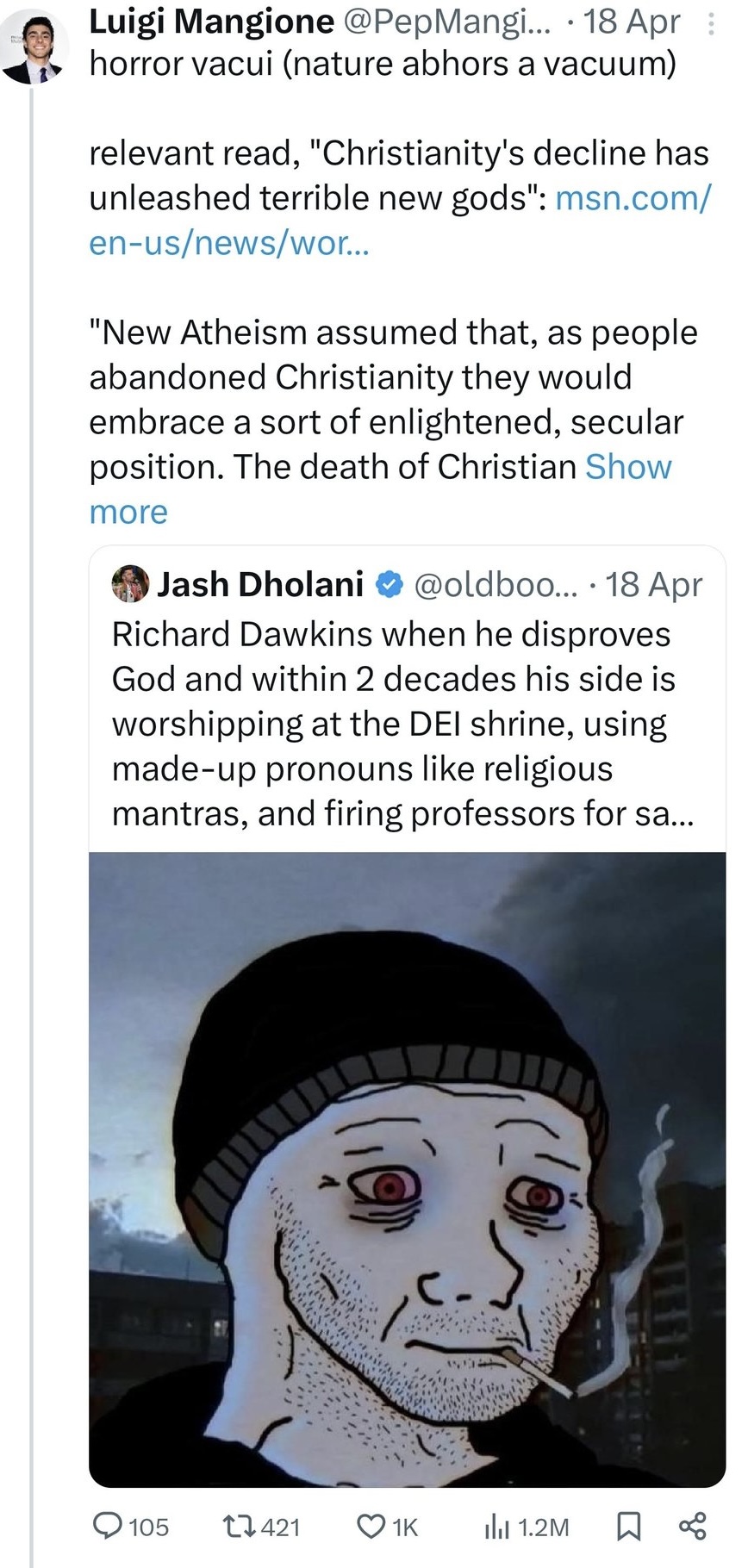
The post caught my attention because I recognized the article and was taken aback at the dark bit of foreshadowing, not just in the title, but also in the content/thought behind the article itself.
The Telegraph piece dealt with evolutionary biologist Richard Dawkins’ laments over the state of post-Christian UK. Dawkins published several anti-theistic books, acting as a champion of new atheism throughout his career. In an interverview, he explained that he had assumed that the decline of Christianity would result in a value neutral, enlightened, secular culture would emerge to replace it. He was wrong.
Instead, the vacuum left by Christianity’s absence was filled by something worse: the unleashing of the terrible new gods, as the Telegraph article describes them. Had Dawkins spent time studying philosophy instead of writing terrible philosophy books, he would have known that Nietzsche’s predicted something akin to this very outcome.
Specifically, Nietzsche predicted that the post-Christian western world would hold on to elements of the Christian ethical system for a while, but that it would gradually shed them as the people realized that the rules and constrains have nothing behind or beneath them. Nietzsche went on to predict that pagan ethical systems would flow into the void left behind.
The “terrible new gods” Dawkins lamented are, in fact, neither new nor gods. They are the old pagan moral systems. For those unfamiliar with ancient pagan moral systems, it is important to recognize that they were not religious in nature. In fact, Judaism and Christianity were wholly unique in their connection of moral imperatives and life purpose to deity in the western world. The Bible describes this ethical approach as simply: “Doing what is right in your own eyes.”
Philosophy, household codes, legal systems, Aristotle’s virtues, and other external restraints were the source of most ethical norms. Self and family interests were often the only thing that mattered. Human rights or humane treatment were nonexistent. The ancient pagan world was a brutal place, where life had little value, and the tears of another man’s family were nothing more than water.
The reality is that the terrible old gods are going to return as our culture abandons its Christian moral & ethical roots. In the Telegraph piece, Dawkins exclaimed that he was happy about the death of Christianity but wanted to remain a cultural Christian, not realizing that such a thing is unsustainable over the long term. Christian ethics only work when paired with the Christianity.
Mario Mangione’s cold blooded murder, his justification for doing so, and the public reaction are early, very public tremors created by the new (old) gods as they crawl from the sewers they have resided in for millennia. Mario decided that he was the arbiter of right and wrong, declared that a husband and father deserved execution without due process or anything resembling a fair hearing, then he shot the man in the back, murdering him in cold blood. He “did what was right in his own eyes.”
The response of far too many internet spectators and media personalities was to see a murder committed in cold blood and applaud it. Reporters and late night talk show hosts gushed over Mario like schoolgirls with crushes. Mangione has been elevated to the level of hero in some circles, where what he was right in their eyes. They applauded what they saw as an act of righteousness on behalf of their terrible new gods.
Note: I am not commenting on the health insurance industry. I agree that the system is broken. I also have been paying attention long enough to know that it has a lot to do with the fact that the whole industry is a Frankenstein’s monster of regulations, laws, self-seeking industry insiders, and politicians all pretending they can make a limited resource unlimited. I also know that Mario shooting that man solved nothing in the healthcare industry. It was an angry, bitter, self-righteous act of a man who followed his own moral compass.
The particularly alarming aspect of this event is that it isn’t all that isolated. It is a growing pattern of morally reprehensibly actions that are applauded broadly by one group or another. The attitude all too often seems to be “It’s ok as long as our side is doing it.” It’s just another sign that the terrible new gods are coming out in force.
Do not read me as an alarmist or predicting that the sky is falling. It is not. What is happening is a gradual change that has been happening since the 19th century is beginning to become far more visible in the western world. There are other signs, but the devaluing of human life is a major river to cross. God is still in control and the gates of hell will not prevail against his church. But, the terrible new gods are going to reign out in the open in increasingly overt ways in our culture. It is best to be aware that it is coming.
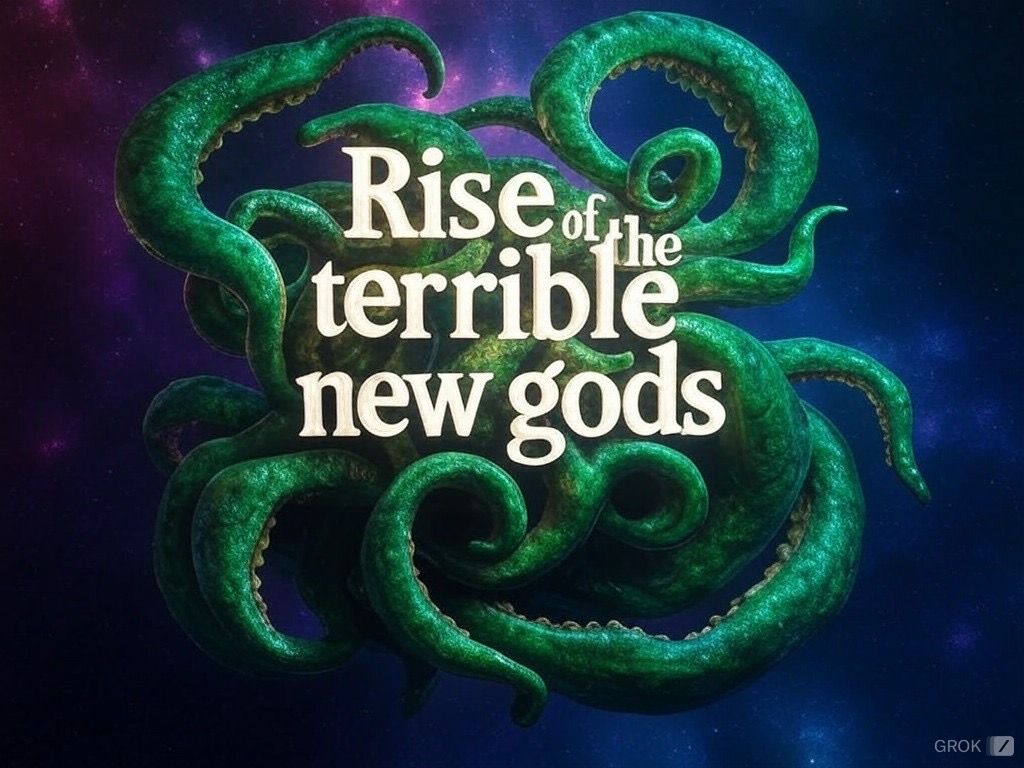
HP Lovecraft stories often depict insane cultists conjuring the old gods to our world, revealing them to be tentacle covered horrors that consume their worshipers along with everything else in their path. I often imagine the looks on the cultists’ faces as they realize that the god they’ve summoned is a monster that cares nothing about its worshippers and proceeds to consume or destroy them and everything else in its path.
The nature of the new gods, which in truth are just the old pagan gods, is exactly that. They care nothing for humanity and the new morality is the old sinful nature we project onto them. Dawkins woke up to the terrible new gods and realized they were not the pretty pets he expected. Mario shared the story and 6 months later summoned the new gods before the whole world.
Now we all get to watch and hope they won’t be released in full force just yet. For on that day, to paraphrase (and rewrite) Kipling:
“…after this is accomplished, and the brave new world begins
When all men are paid for existing and no man must pay for his sins,
As surely as Water will wet us, as surely as Fire will burn,
The new gods of old pagan origin with terror and slaughter return.”




 One of my favorite stories to read my daughter at bedtime is from The Adventures of Frog and Toad. In the story, Toad bakes a batch of cookies. He and Frog discover that they cannot stop eating the cookies because they are too delicious. They begin to devise ways to prevent themselves from eating the cookies by making it more difficult to give in to temptation. Frog called it: “Building up willpower.” They quickly discovered that if they wanted to eat the cookies badly enough they would find a way around obstacles. Eventually, Frog throws away all the cookies and proclaims: “we have lots and lots of willpower.” To which Toad responds: “You may keep it all, Frog, I am going home now to bake a cake.” It’s a funny story with an interesting point. The problem wasn’t the cookies, the problem was that they wanted the cookies more than they wanted to not eat them. The book of James touches on this idea when it addresses the things that are in our lives that cause temptation. It’s easy to blame God for giving us such temptations. However, temptation starts in us and are a product of our fallenness. In Romans Paul describes how the sin living in us seizes upon the law of God as a standard to rebel against. Sin drives us to do things we hate. He describes sin and the ensuing temptation as powerful and ruling over our bodies. As a result of this powerful force within us, even if the things we want are not in front of us, if we want them badly enough, we will go looking for them. Mind you, it is not the case that desire itself is bad. Desire is natural. Desire for food, pleasure, leisure, security, relationships, being right, or anything else are simply a part of how people are designed. Desire becomes destructive when it loses all checks and begins to cause damage. It can be seen in decisions made simply based on a desire with no concern for inevitable consequences and what is right or wrong. A common example is carelessly spoken words that are regretted the moment they are spoken. Other examples include extramarital affairs, the seemingly iron grip that pornography seems to have over the lives of many men, addictions, eating disorders, spending problems, etc. These typically involve normally healthy desires that become distorted and get out of control. James describes this as being dragged away by our own lusts. Ultimately, it’s important to recognize that the source of the problem is within us.

 The topic of manhood is complicated and will take more than one post to properly explore. In the short term, it’s important to establish a basic concept of manhood from which to work. I’d suggest that the place to start is with the source of manhood identity that is built into our world: Boys learn to be men by watching their fathers. This is because parents stand in God’s place in the lives of their children for the first several years of their lives. They provide life, food, shelter, moral guidance, correction, etc. Children’s conception of God is often shaped by their perception of their dads. Genesis tells us that when God created man, He created them in His own image. Fathers (and all men for that matter) are supposed to be copies of God in many respects. We are to share His heart, passions, loves, understanding of family, and work. When dads fail to model this lifestyle and teach their boys to do the same, they create problems. Fortunately, God provides us a more clarified example of manhood in the person of Jesus, who is God made flesh. A boy without a good fatherly model to follow can see ideal manhood in Jesus. When we choose to follow Jesus, our job is to learn to be like him through a lifetime of training, which is discipleship. This is why Christ’s self-sacrificing love and attitude of humble service is the example for husbands. He demonstrates the ideal manner of intimate relationship through his relationship with the church.
 It’s easy to picture Jesus as a pollyanna-type figure or as the feathered haired guy in a bathrobe that we all encountered on flannel graphs in Sunday School as kids. Fortunately, the tame version of the Son of God is far from accurate. C.S. Lewis captured Jesus’ identity best when he wrote: “He’s not safe! But, he’s good.” Jesus’ integrity, passion, penchant for action, grace, wisdom, willingness to speak openly (even offensively if necessary), self-sacrificing service, and lifetime focus on making the world better are just a few of the qualities that make Jesus is the ideal standard of manhood. He is the ideal mold from which men were meant to be cast. It is from Him that we learn how God desires us to be. Once we know, our job is to enter training to become like him.
 Patching Cracks