
For the church this season I am writing devotions. This morning I decided to post them on my blog as well… God bless.
Sunday — A season of preparation
Reflection —
My younger brother runs marathons. He intensely trains for them in the months, weeks, and days leading up to race day. Sometimes, those races involve particularly difficult obstacles, like running up a mountain, or in Death Valley where the heat coming off the asphalt can melt your shoes while you run. He trains accordingly: running up and down hills, lifting weights, or even working out in the sauna to increase his heat resistance. In training season, he eats a certain way to fuel and prepare his body. Paul draws a comparison between running in races and the spiritual training for our lives of following Christ. He explains that all athletes are disciplined in their training to win a prize that will fade, but that followers of Christ train for the purpose of receiving a reward that will last forever.
In the New Testament, Timothy is a young pastor who was discipled by Paul for ministry work. In Paul’s first letter to the young pastor, he includes a powerful bit of instruction: “…train yourself for godliness; for while bodily training is of some value, godliness is of value in every way, as it holds promise for the present life and also for the life to come.” (1 Timothy 4:7–8) We live in a culture that is obsessed with the physical, but Paul is telling us that physical fitness is far less vital than spiritual fitness. He states that it is “valuable in every way, as it holds promise for the present life and also for the life to come.” In the ancient church, the seasons of Lent and Advent were seen as times of intensified training leading up to the big day.
The ancient church believed wholeheartedly in preparing spiritually for major spiritual events.They used the seasons like Lent (the 40 days preceding Easter) and Advent as times of preparation. God stepped from heaven to earth to save us from our sins. He did it because He loved us when we did not love Him. Preparing for Christmas during the weeks that precede it involves more than simply decorating trees and listening to Christmas music to get yourself into the spirit of the season. It is spiritual training for celebrating God’s arrival in our world.
You might wonder how we train spiritually. Everywhere you look there are advertisements for fitness gadgets and meal plans to reshape your flesh, but how do you reshape your soul? There are plenty of ways to do it and still more ways that don’t help or make things worse. Daily prayer, reading the scriptures, reflecting on God’s love for us and His work to provide our salvation, worship, fellowship with the church, serving, and many other practices are prescribed in the scripture as exercises for spiritual fitness.
One passage in particular that will inform our Advent devotions going forward is found in 1 John 4:19-21. John tells us that the reason we love like Christ is because He first loved us. He goes on to say that loving God leads to love others. This is one vital component of spiritual training. When we focus on the love of God, it results in loving others and everything that entails. We will be spending the next few weeks gazing at the love of God as a means of training for race day, for our walk with Jesus, and for eternity. Ultimately, we know what love is because of Christ. 1 John 3:16-20 tells us that Christ freely laying down His life for us. The added benefit of understanding this perspective is that it frees you to engage in training out of love for Him and a desire to be closer to your Savior, rather than out of obligation, guilt, or shame.
Scripture — 1 John 3:16-20, 1 John 4:19-21 (read 7-21 if you have time), 1 Timothy 4:8, 1 Corinthians 9:24-7, Matthew 6:31-34, Lamentations 3:22-23
Readings —
I remember visiting Indonesia and speaking with a Hindu leader and a Muslim leader. They would say, “We have different paths that lead us to spiritual fulfillment, that lead us to God.” And they said, “We respect your path. You respect our path and we will all go different ways. Together we are one and we’ll end up in the same place.”
I looked at them and I said, “Well, let me make sure I understand. You’re saying that basically you picture God at the top of a mountain and we’re all at the bottom of a mountain. And I may take one path to get to God and you may take another path up the mountain to get to God, but in the end, we’ll all eventually end up at the same place?” They both had big smiles on their face and agreed with my assessment.
I looked at them and said, “Well, if that’s the way it is, let me ask you one question: What if the God at the top of the mountain decided he was going to make his way down the mountain to us, and he came to bring us up the mountain himself?” And they said, “Well, that would be wonderful.” And I said, “That’s what the God of the Bible did. Let me tell you about who Jesus really is. It’s not about trying to find our way to God. Jesus has come to us and he says, “I am the way.”
From Radical by David Platt
A quick note on this reading — It is easy to fall into the belief that training toward Godliness is climbing the mountain. Christians often fall into this trap of believing that they can do good works and earn their way to God. It’s just not possible. God came down the mountain to us. Training spiritually doesn’t earn our way to Him. It makes us capable of knowing Him completely. — Erik
God’s ultimate goal for us, however, is that we be truly conformed to the likeness of His Son in our person as well as in our standing… Jesus did not die just to save us from the penalty of sin, nor even just to make us holy in our standing before God. He died to purify for Himself a people eager to obey Him, a people eager to be transformed into His likeness… This process of gradually conforming us to the likeness of Christ begins at the very moment of our salvation when the Holy Spirit comes to dwell within us and to actually give us a new life in Christ. We call this gradual process progressive sanctification, or growing in holiness, because it truly is a growth process.
From Transforming Grace by Jerry Bridges
Prayer Guide —
A — Take time to express adoration to God for His amazing love for you. Talk to Him about Christ coming down to us because we cannot climb up to Him.
C — Spend time reflecting on the ways you have fallen short in your walk with Jesus. In particular, reflect on the times and ways you have neglected your training for Godliness.
T — Thank God for the amazing truth that before you even confessed your sins, He had already forgiven you through the death and resurrection of Jesus. Thank Him for the incarnation
S — Pray for the coming weeks and the time of preparation you are embarking on. Ask God to help you tune out the noise and stress of the season that will draw you out of your training for Christmas. Pray for Him to reveal His love for you more completely and fully.

 I am a magnet for bad habits and addictions. I know I am not alone in this. I have spoken to scores of men who have developed unwanted patterns in their work, relationships, stress management, and leisure. Part of what puzzled me about my habits over the years is that many of them are things I don’t really want to do, but it seemed like my mind would shift into automatic pilot time and again, allowing me to live out some impulse that I’d just as soon avoid. The following is a newspaper column I wrote looking at brain functions and why they make habitual behaviors so difficult to break.
 One of my favorite stories to read my daughter at bedtime is from The Adventures of Frog and Toad. In the story, Toad bakes a batch of cookies. He and Frog discover that they cannot stop eating the cookies because they are too delicious. They begin to devise ways to prevent themselves from eating the cookies by making it more difficult to give in to temptation. Frog called it: “Building up willpower.” They quickly discovered that if they wanted to eat the cookies badly enough they would find a way around obstacles. Eventually, Frog throws away all the cookies and proclaims: “we have lots and lots of willpower.” To which Toad responds: “You may keep it all, Frog, I am going home now to bake a cake.” It’s a funny story with an interesting point. The problem wasn’t the cookies, the problem was that they wanted the cookies more than they wanted to not eat them. The book of James touches on this idea when it addresses the things that are in our lives that cause temptation. It’s easy to blame God for giving us such temptations. However, temptation starts in us and are a product of our fallenness. In Romans Paul describes how the sin living in us seizes upon the law of God as a standard to rebel against. Sin drives us to do things we hate. He describes sin and the ensuing temptation as powerful and ruling over our bodies. As a result of this powerful force within us, even if the things we want are not in front of us, if we want them badly enough, we will go looking for them. Mind you, it is not the case that desire itself is bad. Desire is natural. Desire for food, pleasure, leisure, security, relationships, being right, or anything else are simply a part of how people are designed. Desire becomes destructive when it loses all checks and begins to cause damage. It can be seen in decisions made simply based on a desire with no concern for inevitable consequences and what is right or wrong. A common example is carelessly spoken words that are regretted the moment they are spoken. Other examples include extramarital affairs, the seemingly iron grip that pornography seems to have over the lives of many men, addictions, eating disorders, spending problems, etc. These typically involve normally healthy desires that become distorted and get out of control. James describes this as being dragged away by our own lusts. Ultimately, it’s important to recognize that the source of the problem is within us.
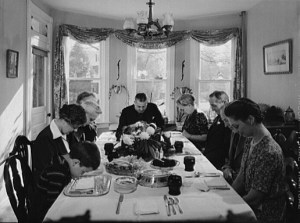 In 1863, President Lincoln declared the final Thursday in November the official Thanksgiving holiday. While Thanksgiving had been celebrated irregularly for several hundred years, it was not an official holiday in the United States and was not annually celebrated until this point. It is significant that Lincoln chose to establish the holiday in 1863 because the American Civil war had been raging for several years. Hundreds of thousands of Americans were dead, the United States was united no more, the nation lay in shambles, and it appeared as though the North wouldn’t win the Civil War. To top it off, Lincoln’s son had died less than a year previous. It was in the midst ofone of the darkest points in American history, and certainly Lincoln’s own life, that he declared that Americans would dedicate a day to thank God for the blessings that they had received. This is a powerful testimony to the degree of faith and dedication Lincoln had toward God. It is also an attitude that is difficult to muster during times of tragedy.
 It is tough to stop and say thanks for what God has given you when everything seems to be falling apart. Often, disaster prompts people to turn and ask: “Where is God in all of this difficulty?” or “Why Doesn’t God do something to fix this for me?” Lincoln offers us a terrific model for our attitudes toward God in times of trial. This attitude can seem almost superhuman, and certainly unattainable for normal people. I’d suggest that this is probably the case. But, while it may be impossible for men to be thankful in all circumstances, it is certainly isn’t impossible for God to create an attitude of thanks in man’s heart. I’d argue that this is a product of intentional effort and practice, that God aids us in accomplishing.
 Attempting to sustain our happiness through temporary means produces the same result in our soul. We scratch the itch over and over again, only to find that the practice changes us. It leaves us emptier than we were when we started. The reason that this pathway to happiness can never work is because it is an attempt to fill an emptiness in the soul. Philosopher Blaise Pascal describes it as a void that God had intended to occupy. Everyone has it. The problem is that only God can properly fill it. We can mask the emptiness with possessions, experiences, or alcohol, but in the end, it always comes back. Paul wrote in his letter to the Philippians that he had learned the secret to living in any circumstance, whether he was poor or rich, hungry or well fed. It’s worth noting that he wrote this while sitting in a maximum security prison facing the possibility and being executed for preaching about Jesus. He still was able to point to a contentment that was not based on his experience. That contentment was found in his relationship with Jesus and the hope he had for eternity with Christ. Paul relied on God for all of his needs. He recognized physical discomfort as a temporary condition that would pale in comparison to heaven. When he was hungry or in pain, he looked to God for context and relief. Ultimately, this resulted in Paul becoming the sort of person that could be content and joyful no matter what befell him. This lasting joy stands in stark contrast to the temporary satisfaction we feel when we get a new toy, eat a delicious meal, or go on a stellar vacation. Even more impressive is that this lasting joy is free and available to anyone who would simply choose to engage in relationship with Christ.
 Patching Cracks