
This is my second blog post on the Proverbs 31 woman and I haven’t started to really dig into the passage. I usually try to write shorter essays because most folks won’t read thousands of words just to get an answer. Easy answers are nice, but they are often incomplete. There’s always a temptation for pastors to shortcut and assign meaning to scripture rather than digging for the author’s intent. Understanding what the author meant to tell the reader means looking at it from their cultural perspective/historic perspective.
Interpretive Decisions: Allegory, Literal, or Something Else
There is a final matter that needs to be considered when deciding how to interpret the text properly, that is selecting the right interpretive approach. This basically means that we need to decide if the author intended the reader to see the passage as referring to something other than is being presented, if the reader is supposed to understand it in a word-for-word sense, or if it’s a combination of the two.
Proponents of taking an allegorical approach argue that the wife in the passage is symbolic of wisdom. Thus, the advice being offered is that young men keep wisdom as though it is their wife. This position has the benefit of being consistent with some of the rest of the book. Wisdom is repeatedly referred to as a woman. The advantage of this approach is that it can easily end the argument with folks who misuse this passage by making it about something else entirely. There are several problems with selecting the allegorical approach. For starters, the book of Proverbs does speak of women without doing so allegorically. Chapter 5 is a great example of this. The adulterous woman discussed in the passage isn’t indicated as a symbol for sexual behavior. Rather, the advice seems to be to avoid loose women, which is in harmony with the direction in 2:16-19, which advises the young man to avoid getting trapped in sexual sin, with no indication that is is an allegory. Later in chapter 5, advice is given about “drinking water from your own cistern” and the value of not spreading your streams of water into the street. These warnings about not being sexually loose are paired with an instruction to “Let your fountain be blessed, and rejoice in the wife of your youth.” The wife in the passage is clearly a reference to an actual wife, who young men ought to confine their sexual behaviors to. There is no indication that she is anything but a wife. Further, it would be extremely weird to approach this passage allegorically, trying to make the talk of sex fit somehow with wisdom personified as a woman. It makes far more sense that the instruction is to enjoy sex with your wife, and only your wife. Beyond just being awkward, the text offers no hints that the passage ought to be read that way. Contrast this with passages like 7:4: “Say to wisdom, ‘You are my sister,’ and call insight your intimate friend…” The author tips his hand that he is speaking allegorically. The same practice is repeated in 8:1: “Does not wisdom call? Does not understanding raise her voice?” The author tells you that he has shifted into allegory. The same can be said of 1:20 and 9:1. The text tends to telegraph these ideas. The author tells the young man when he is instructing through allegory. The problem with ignoring this tendency is that it results in a book of advice for young men that in no way addresses their interaction with women in any capacity. It cripples the text by applying a template automatically without regard for contextual prompts.
Regarding the allegorical approach and Proverbs 31, there is no indicator that the wife mentioned is wisdom personified. Nowhere does the author telegraph his intent to shift into allegory. Further, if we are going to read it as an allegory then we have to ignore a rather awkward idea presented in 26, that she (Wisdom) opens her mouth with wisdom. It’s a bit of a circular concept.
There is one other matter to consider when looking at whether or not the passage is allegorical: the context for the passage in terms of the surrounding verses and who is speaking. In this case, the mother of the king is speaking. She offers advice on how to rule wisely, specifically instructing her son: “Do not give your strength to women, your ways to those who destroy kings.” She then goes on to direct him to avoid strong drink. It seems clear that the women described are actual women, because there is no indication of allegorical intent. Further, the advice about women is paired with a direction about liquor. If one is figurative, then the next line would be as well. It makes very little sense for allegory to be inserted randomly in this manner. For this woman to advise her son to avoid women that are destructive and to follow it up a few lines later with advice on how to properly select a wife makes sense. It fits the context. She is giving whole life advice.

Part of the temptation to read the wife in Proverbs 31 as wisdom personified is rooted in the fact that she is living out many of the tenets of wisdom presented in the book. She is demonstrating wise behaviors. They are the same types of behaviors that the young men are instructed to try to live out. It seems reasonable that a man ought to seek out a wife who is strong, intelligent, hard-working, independent, and compassionate. Really, as far as ideal wives go, this seems to be a very positive message regarding what is important to seek out in a wife.
The other extreme position sometimes taken when interpreting the passage is to read it with a strict literal understanding. This would be unusual in wisdom literature and poetry, which tend to describe concepts. Lines in poems ofter reflect qualities or ideas. Further, reading the text in a strictly literal manner makes finding the ideal wife nearly impossible because meeting all of the behavioral requirements is nearly impossible, particularly since many of them require that the couple already be married. If the son is seeking a wife who takes care of their kids, they have to be married. Further, the list is lofty and towering to the point of being impossible to meet. For example, if we summarize only some of the qualities we find that the ideal wife makes clothing from scratch, buys property, plants vineyards, she is strong enough to work the fields, and sells some of the clothing she produces. As a checklist for wives, it’d be silly to expect that every woman ought to be making her own thread or even sewing. In addition, not every family has need of a vineyard. Not every family has the financial wherewithal to purchase land, nor is land available for every family to purchase. I don’t even need to comment on bartering. If we are to read these lines from literal perspective, we have to force every 21st century woman into a wealthy family from 900 BC and the middle east. I am taking this to an extreme, but the point is that the list of behaviors is not reasonable for anyone to take on in our context. Even in the day the text was written, only a small percentage of families would have the servants necessary to fulfill verse 15. It’s easy to talk of taking the text literally without engaging the reality of the position properly. The premise falls apart quickly when we look more closely.
One might suggest that we should back off of the literal reading a little. I’ve read several essays that argue that we ought to interpret the text as pointing to a super housewife, that is subjected to her husband’s beck and call. She sews, cooks, plants a garden, stays up all night doing housework, and then gets up before dawn to make breakfast. The problem with this perspective is that the wife in the chapter takes on a number of tasks that are overtly masculine according to ancient standards. Beyond masculine, they are downright liberated, particularly when considering the standard social expectations for women in the ancient world. She makes financial decisions, is physically strong and demonstrates it through her participation in what would otherwise be seen as “man’s work.” She also produces income through her own work. Many of these activities were off-limits to women in the ancient world, particularly women of social stature. The “super housewife” perspective fails when the passage is considered according to the historical context. Though she takes on domestic responsibilities, this woman works outside the home and clothes herself with strength.

How then are we to properly interpret the text? The answer is a mixture of the literal and the figurative. It is typical of Hebrew poetry to offer examples that represent virtues. This is most easily seen in verses like 20: “
She opens her hand to the poor and reaches out her hands to the needy.” Verse 20 can easily be read literally, but it represents more than a behavior. The wife described in verse 20 is compassionate to the needs of others. This is an attainable quality and is in harmony with the depiction of wise behavior discussed in the rest of the text. Apply the same approach to verse 16: “
She considers a field and buys it; with the fruit of her hands she plants a vineyard.” I’ve already dealt with the problem with handling this literally. If instead we see it as representing a particular type of behavior, we quickly recognize that the passage describes a common sense business decision that she willingly follows up with hard work. Boil it down further and we have: She makes wise decisions and works hard. Neither of these is as unattainable as purchasing real estate and hand-planting a vineyard.
Much of the difficulty I have heard expressed in terms of this passage is connected directly with reading the passage overly literally, and ignoring the literary genre. This is often done in the name of forcing an interpretation on the text that is outside of the author’s intent. It is also done without viewing the additional meaning given to the text by the coming of Jesus and the new Covenant. If the poem is a to do list, it easily becomes law for a wife to obey. Paul tells us repeatedly that the law is impossible for us to attain. It is a crushing weight on us because of our imperfection through sin. In the next installment we will look at how understanding this passage is altered by the gospel.


 Over the past few years, I’ve read several articles arguing varying perspectives on the ideal wife portrayed in Proverbs 31. Most of these articles have argued the matter in terms of whether or not this woman is a standard model for wives and women everywhere to aspire to be the best housewife possible in serving her 1950s family or an allegory for wisdom so as to remove the unattainable ideal that just serves to discourage women into standardized gender roles. I’ll admit that these characterizations are hyperbole, but I am exaggerating the extreme sides of this debate for a reason: because this text has become a bit of a tug-o-war passage for folks in the battle over the role of women in the church. Each side pulling for a gender political stance and taking pride in their position, sometimes without bothering to ask whether or not they are glorifying Christ in their stance. My intent in this post is not to engage either of these positions, but rather to offer an analysis of the text with an eye on shedding a little light as to what believers are actually supposed to do with these passages.
 Understanding the historic context is also important for getting a solid grip on the meaning of the passage. The advice being offered isn’t being given in a culture where people typically married for love. Marriage was generally a very utilitarian institution. Wives were selected based on all sorts of considerations, most of them pragmatic. The poem is literally about choosing a wife according to high character standards. This choosing was more akin to shopping than our culture tends to immediately recognize.
 If you haven’t noticed the excess of advertising yet, Valentines Day will soon be on us. It’s the one day a year everyone expects you to act romantic. Flowers, cards, candy, stuffed bears, and all manner of other romantic stuff are practically a requirement if you don’t want to get into trouble. The crazy thing is that I know guys who go out of their way to show their wives they care on that one day of the year, but otherwise live like roommates with their spouse. The reality is that February 14th is just another day. If husbands are to take seriously their vows to love their wives and follow the direction Paul gives in Ephesians 5, they have to take loving their wives seriously the other 364 days as well. Here are 5 suggestions to kick off a year of showing your wife how special she is.
 For many folks, the great stumbling block of the Ephesians household code is the first 3 verses. For this reason, I have saved it for last in the discussion. Not because I am avoiding controversy. Rather, because it is so often understood in terms of our own desires and demands rather than in the context of scripture. This results in all sorts of bad behavior in relation to the text, including willful ignoring of the passage, wielding it like a bat, interpretive gymnastics to make it more palatable, attempts to turn the passage into a prooftext for all sorts of marital arm-twisting, etc. This legacy of Bible believers behaving badly prompted my careful handling and intentional approach to the text. If you haven’t read the preceding posts, I suggest checking them out in advance of reading this one.

 In the garden, at the time of the temptation and the fall, the text depicts Eve talking with the snake, who makes all sorts of promises. They talk back and forth regarding God’s rule and whether or not it was wise to follow it. When Eve succumbs to temptation, the text reveals something interesting:
 Ephesians 5 to 6 is what is called a “household code.” In ancient Greece household codes were pretty common, generally memorized by members of the household, and were used for outlining everybody’s job in the home. This genre of writing would have been very recognizable to the readers. When Paul digs into roles in marriage, he starts with the wife, but spends more time on the husband, which is why we will consider the husband first. Beyond spending more time on the husband, Paul outlines a great deal more responsibility and an active role for the husband. He begins by directing husbands to love their wives. The word he uses for love is agape, which is the word used to describe selfless, unconditional, divine love. Paul’s direction for husbands to love their wives is unique to Greek household codes in the ancient world. There was no expectation amongst ancient cultures that husbands love their wives. Christian men are given a MUCH higher standard than the world: selfless, unconditional, sacrificial love for their wives. This is reinforced by Paul telling husbands that they are to use Christ’s example as their guide. They are to act toward their wives as Christ acted toward the church, sacrificing himself for her sake.
 I have heard men denounce women for not submitting, women denouncing men for the suggestion of submission, I’ve encountered authors and speakers who have twisted this passage every which way imaginable to assert that the verse is advocating anything from total equality, to a slave master relationship, to a 49/51 voting split, to discussions of whether or not getting your man sandwiches during football games is a spiritual discipline. This excess of commentary on the topic can tempt me to throw up my hands and pass altogether. The problem with this is that Paul included this bit of instruction on purpose and marriage is important. If the scriptures have something to teach us on the matter, we need to learn it.
 “You know that the rulers of the Gentiles lord it over them, and their high officials exercise authority over them. It is not this way among you, but whoever wishes to become great among you shall be your servant, and whoever wishes to be first among you shall be your slave; just as the Son of Man did not come to be served, but to serve, and to give His life a ransom for many.” Simply put, the disciples jockeying for authority was a result of them looking at the world from the same perspective as the pagans around them. They are seeing the world as pagans see it. Greatness means being served. Followers of Jesus assume the status of servant. Jesus demonstrates this very graphically when he washed his disciples feet at the last supper, taking on the job of the lowest servant in the household. The message seems pretty clear: followers of Jesus are called to serve. We aren’t called to be served or to lord position over others. Believers are nowhere instructed to fight with each other over rights to subjugate each other. Our primary concern in life ought to be our focus on Jesus and commitment to grow in our faith and obedience.
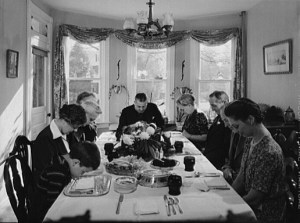 In 1863, President Lincoln declared the final Thursday in November the official Thanksgiving holiday. While Thanksgiving had been celebrated irregularly for several hundred years, it was not an official holiday in the United States and was not annually celebrated until this point. It is significant that Lincoln chose to establish the holiday in 1863 because the American Civil war had been raging for several years. Hundreds of thousands of Americans were dead, the United States was united no more, the nation lay in shambles, and it appeared as though the North wouldn’t win the Civil War. To top it off, Lincoln’s son had died less than a year previous. It was in the midst ofone of the darkest points in American history, and certainly Lincoln’s own life, that he declared that Americans would dedicate a day to thank God for the blessings that they had received. This is a powerful testimony to the degree of faith and dedication Lincoln had toward God. It is also an attitude that is difficult to muster during times of tragedy.
 It is tough to stop and say thanks for what God has given you when everything seems to be falling apart. Often, disaster prompts people to turn and ask: “Where is God in all of this difficulty?” or “Why Doesn’t God do something to fix this for me?” Lincoln offers us a terrific model for our attitudes toward God in times of trial. This attitude can seem almost superhuman, and certainly unattainable for normal people. I’d suggest that this is probably the case. But, while it may be impossible for men to be thankful in all circumstances, it is certainly isn’t impossible for God to create an attitude of thanks in man’s heart. I’d argue that this is a product of intentional effort and practice, that God aids us in accomplishing.
 The city of Butte Montana is built over a mine which had been on fire for over twenty years. This was not a roaring blaze, but rather a smoldering fire that simply kept burning year after year. The fire was accidentally set by a fellow named Henshaw, who left a candle burning unattended on a pine beam. The beam caught fire. The fire spread to other beams and kept burning for decades. This is at least partially due to the miners managing to deprive the fire of oxygen, which kept it from burning out of control but also prolonged the burn.
 My kids spent last weekend on a ranch in the foothills of the mountain range near our town. The ranch is the home of one of the elders from my church and his family. The kids love spending time there chasing cows, riding horses, feeding chickens, and doing all the other things they do on the ranch. With the children away for a couple days, my wife and I were free to take a weekend away mini-vacation. We spent the night at a bed and breakfast situated in a ghost town; we then spent the day christmas shopping; and finally spent a night at home alone together. We do these mini-vacations twice a year, and have found that they are a perfect opportunity to spend time together, focusing on each other. We love our kids, but they demand a great deal of attention. I don’t begrudge them that attention, and in fact, feel that it’s our duty as parents to love our children and meet their emotional and relational needs. The challenge that comes with meeting the hefty attention and emotional needs of children is in maintaining a healthy relationship with each other. It’s easy for the marriage to go on the back burner when you’ve got kids to attend to. I’ve written several articles on the importance of date nights. The mini-vacation is a step beyond date night. It’s taking a day or two away to be together, alone. I know couples who haven’t spent days alone together in years, since they were first married, because of the demands of parenting. My wife and I agreed that keeping our relationship vital was good for us and for the kids, so we are intentional about planning these overnight dates a couple times a year. The trick is that it’s not an instant success. Weekends away need to be approached with appropriate expectations and with a degree of careful planning to ensure their success. Here are a few things we have recognized and learned from our experiences:
 Make Careful arrangements for Your Children: As important as the time together is, your first responsibility is for the safety and care of your children. The plans you come up with for their care need to be carefully considered. They need to be comfortable with the arrangement. The person watching them needs to be responsible and knowledgable in caring for kids. There needs to be plans in place in the case of an emergency, and you need to plan for their care and comfort. Family is ideal for this sort of arrangement, particularly grandparents. Another possibility is utilizing a sitter. I know couples who take turns watching each others children to support date nights. Taking turns with another couple watching watching kids is another way to make the weekend away possible.
 It probably won’t fix the problem for good. It may help, but you’ll likely still need to work at it. Another way that realism is important is in the area of romance. Wives, frustrated with their husband’s lack of romantic efforts, may not find that their husband is instantly transformed into Don Juan. Husbands who are looking for their wives to suddenly have a supercharged libido, may wind up frustrated. In both cases, unrealistic expectations can sour the weekend. Both of these problems are best dealt with through communicating with each other about the frustrations. The best plan is to be realistic and have realistic expectations about your time away.
 Patching Cracks
