 In recent years, I have found the habits of elite athletes and soldiers interesting. Guys who not only do physical things well, but at a level above everyone else in the world. I am not an athlete, but am starting to appreciate the habits and mindset of folks who are top-tier in their fields. One of the interesting things I have noticed about such people is that they maintain physical discipline even when they are not doing their jobs. A former Navy Seal I follow online talks about getting up early every day to train. This is a man who is no longer fighting wars on the battlefield, but sees his own training and discipline as non-negotiable. Football legend Herschel Walker continued to train hard whether he was playing ball, between seasons, or retired. Training isn’t seen as a component of his career. Rather, it is a way of life. Pushing yourself daily to exceed yesterday’s best is never questioned. These are folks who are elite athletes and warriors by nature, not just by vocation. I am never going to be an athlete or a warrior. I am a pastor. I live a different calling. I exercise hard every day because I want to be better. This new practice and reading about the habits of these men has helped me to realize something powerful. I study and meditate on scripture verses 8 to 9 hours a week so I can teach them on Sundays. I truly love this aspect of my work. However, I struggle with spending time daily reading and studying the same book for my own edification. I also struggle with the daily discipline of prayer. This morning, I realized something convicting. While the elite athletes and soldiers I’ve been reading about do their required trainings as a part of their work, they also do it as a part of their lives. These men get up, train, then go to work and train more. They do it because it is who they are, not because it is their job. I study because it is my job, but if I want to be a man of God, I must study and pray because it is in my nature to do so. I will never be at the elite level of pastorate. I don’t really know that such a thing exists and if it did, I definitely wouldn’t want anyone to refer to me as something like that. However, I love the folks under my pastoral care. I love my family. I love to teach and preach. I love the folks in my community. I love the folks who read my writings and listen to my preaching online. Most of all, I love the God I serve. If all of this is true, and not just something I say, it really ought to be in my nature to hunger for better. I should treat my spiritual state as though my personal spiritual growth will glorify God and minister to those around me. The higher the quality of my spiritual life, the better I will minister to the people I come into contact with. Prayer and personal study are not optional to a person who loves the folks they minister to. It is training. It is conditioning. It creates in us a state of readiness for the moment when we need to love someone we are angry at or forgive the sins of our neighbor. Pastors and brothers in Christ: we must train daily in study and prayer so we can be ready for the moment God calls us to serve. Prayer must be like running. We should do it so much it is natural to us to pray without ceasing. Study should be like lifting weights. It should create strength in us to handle anything we encounter. Paul put it best when he wrote to Timothy: “Physical exercise has some value, but spiritual exercise is valuable in every way, because it promises life both for the present and for the future.” Brothers, we must train to be better because it is in our nature.
Patching Cracks
Trying to Be Wise In God's Eyes

Tag Archives: Maturity
Faking Spirituality
 I wrote this piece for my weekly column. It was originally published in the Big Sandy Mountaineer in June of 2015.
One of the worst sins I’ve ever committed was actually committed over several years. During my early years working in ministry, I pretended to be perfect. When I left for work every day, I put on my “perfect Christian” mask. I hid any struggle with sin, temptation, and anger. I made excuses and ignored my own shortcomings. Eventually, I stopped talking openly with anyone about anything that might look un-Christian in my life. When I taught, the only sins I ever acknowledged were innocuous, like driving too fast, which is an imperfection of mine that’s well known to any reader of this paper’s traffic ticket listings. I believed that perfection was expected of minsters, and because I wasn’t perfect, I faked it. It may seem excessive to identify this as a terrible sin, but it is because it is a denial of the central message of Christianity: that all people sin and need forgiveness. Pretending to be perfect is self-deceiving and denies our need for God. Beyond distancing us from God, it also drives others away from Him, either because they see our hypocrisy or they see being “good enough” as unattainable.
The saddest misconception about Christianity that drives folks away from knowing God exists primarily amongst Christians: the myth of perfection. Whereas the previous columns in this series have largely addressed those who walk away from God in frustration/hurt, this week will primarily address folks in the church who believe this falsehood.
Believing we are, or ought to be, perfect is spiritual poison. When we look at the life of Jesus, there is no-one that he strikes out against more vehemently than religious folks, specifically the Pharisees, who couldn’t see or confess their own failings. Most were so convinced of their own perfection that they couldn’t ask for forgiveness because they didn’t believe they needed it. They lived for the praise of others, thrived on comparing themselves to “sinners”, and constantly bragged of their righteousness. This puffing up results in blindness to the seriousness of our own sins.
False perfection is also poisonous to relationships. Maintaining the illusion of perfection keeps us from confessing or seeking help. While living this way, I often wished I could talk about my struggles, but wouldn’t do so because I did’t want anyone to know how imperfect I am. Hiding secrets isolates us. Conversely, openness and accountability knits us together in community, because calling on each other in times of need teaches trust and interdependence.
The most profound lesson I learned from being open happened when I talked openly about struggling with sin while teaching one day. A young man approached me afterward, tearfully opening up about his own struggles. He thanked me for being honest, because he too had been hiding everything for fear of being condemned by others. Being vulnerable provides a safe environment for others to be vulnerable. The most common response I hear to openness about my own imperfection is appreciation for being real and human.
Living life- honestly acknowledging our imperfection- is risky. It’s possible that others will judge or ostracize you for being a sinner. I discussed with a friend how tempting it is to want other Christians to be human, but not too human. It’s easy to succumb to the temptation to believe that God should forgive our brand of sin, but not the sin of others. This is the power of acknowledging our imperfection/dependance on God’s forgiveness. It emphasizes God’s mercy, rather than our self-righteousness. This makes judging others harder to justify. Awareness of our dependance helps us empathize with others in the same predicament.
Your Bad Habits and Your Brain

This article was originally published in the Big Sandy Mountaineer 9/9/15.
There was a large wooded park with a lake behind the house my family lived in while I was attending high school. During the four years we lived in that home, my siblings and I frequently spent hours wandering through the woods around that lake. When we did, we usually walked along the trails and paths, because it was easier. Occasionally, I remember straying from the well-worn paths and crashing through the brush. This usually took longer and resulted in scratches, scrapes, and swearing to yourself that you’d stick to the path next time. The reason is obvious: well-worn pathways are easier to travel. There is a similar phenomena that takes place within the human brain. We all have a portion of our brain that controls motor functions and handles our actions/reactions during times of stress, often referred to as fight-or-flight moments. In moments when thinking isn’t possible and the body needs to act quickly, our actions will tend to follow the “well-worn paths” that exist within our brains. This is why athletes and soldiers practice the same movements over and over in training, to prepare them to act without thinking. It sometimes leads to strange behaviors under pressure. I recently read about soldiers collecting spent cartridges in combat, mimicking their repeated behavior on the shooting range. It’s a terrible decision to collect brass while being shot at, but the point is that it isn’t a decision. It’s rehearsed behavior. This is an extraordinary example, but there are far more common ones, like when a person reaches for a cigarette or drink without thinking – especially during times of stress. There’s a part of the brain that knows that a drink or a smoke helps manage stress, which makes this an easy pathway to develop in our brains.
A far more common example of this is seen in bad habits, particularly communication and coping habits that folks develop in their relationships. We learn to fight certain ways, and breaking those habits is difficult because it’s what we’ve memorized through repeated practice. We know our arguing strategies or our escape plans and go to them almost instinctively. Married couples often find themselves having arguments that follow the same course as every previous argument they’ve had over the last several years. Husbands sometimes respond to arguing by shutting down and running for the safety of the tv, late work days, or just hanging out in the garage. Wives learn to argue as effectively as possible or to hide out by focusing on the kids or some other part of life other than their spouse. The pattern repeats and repeats, even when it doesn’t make sense anymore or when both parties realize and acknowledge that it’s making them miserable. This is largely because they have found a pathway in their brains that works, even if it doesn’t. This easy path becomes the “go to” rut that they get stuck in, largely because it is practiced and repeated so often. Changing these trained behaviors can be terribly difficult, as anyone who has ever tried to break a bad habit knows. Success can frequently be short-circuited by new stress or frustration, which sends the individual running back to the old behavior. The last few installments of this column have looked at poor communication habits that develop in marriage. Part of what makes these habits so very difficult to break is that developed pathway. We learn them and they stay learned until we unlearn them. Unlearning involves an intentional effort to change our attitude and that couples work as a team in changing the relationship patterns. Only by intentional working together, sometimes with the assistance of a counselor, (or by an act of God) are most of well-worn pathways replaced with new healthier ones. The first step is always to acknowledge the problem and choose to work toward overcoming the habit.
Men With Stone Hearts: Becoming an Emotionally Mature Man
We may give our human loves the unconditional allegiance which we owe only to God. Then they become gods: then they become demons. Then they will destroy us, and also destroy themselves. For natural loves that are allowed to become gods do not remain loves. They are still called so, but can become in fact complicated forms of hatred.
C.S. Lewis — the Four Loves
 In general, emotions are a difficult topic for men. This difficulty spans a broad spectrum, from emotionless stoicism on one end, to the uncontrolled passions of aggression, anger, lust, and ambition that have earned the male gender a reputation for acting as the bull in the china shop of their relationships. One of the hallmarks of a mature man is his ability to manage his emotions. This is not full repression of feeling and passionless existence. The stoic philosophers succeeded in producing incomplete men by attempting to avoid one of the fundamental strengths of man. God designed passion into men, that we might reflect his character. You cannot read the scriptures and miss God’s love, joy, sorrow, rage, and jealousy. In short, we were made in the image of a passionate God. Jesus was often angry. He loved folks passionately. He wept at the death of Lazarus, and he mourned over Jerusalem’s ongoing rebellion. It is important to understand that God’s passions are restrained by His will and holiness. Further, it is important to understand that these are qualities of God, they are not God himself.
C.S. Lewis explains this idea well by pointing out that “God is love”, but “love is not God.” Men can find it tempting to turn their passions into gods. It’s easy to do because in its finest state, love can resemble God. This is appropriate, being that God’s perfect love is one of His major attributes. However, when love, or any of our passions, is elevated to the level of a god to be worshipped, it quickly also becomes a demon. Lewis’ book exploring this topic focuses exclusively on love, and he is correct in asserting that love, apart from any of our passions, most tempts us to worship it as a god. However, I would argue that all of emotions and passions can quickly take control of our lives. A man who pretends that he experiences no lust is no more honest and right than a man who worships romantic love and connection, being led by the nose from romantic infatuation to infatuation. A man who follows his heart and his secretary’s short skirt away from his wife and children is not magically virtuous if he justifies it saying: “The heart wants what it wants” with the reverence of a man righteously worshipping romantic infatuation.
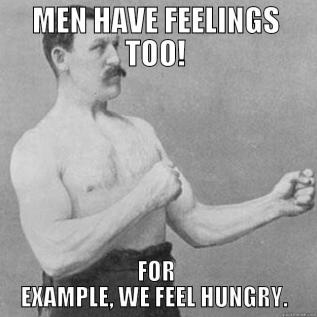
We joke about men being emotionless, but it’s not really true. Watch a man jump up and down cheering on his sports team for proof of this idea.
Lewis classifies love into four categories: affection, charity, friendship, and Eros (romance). A man does well to exhibit each with zeal where appropriate; along with other emotional states, like anger, pride, sorrow, etc. The mark of a mature man is that he is not controlled by these emotions. A mature man doesn’t drop into fits of rage like a petulant child, flinging hurtful words at those around him in retribution for not getting his way. Rather, godly men control anger, using it judiciously to improve the world around them, imitating Christ in passionate pursuit of what is right and good in the creation. A righteous man strives to love his wife faithfully, devoting his romantic energies to her and investing in the relationship so as to strengthen the marriage, enjoy his wife, and model Christlike marriage to his children. This precludes his chasing after romantic trysts, allowing a momentary infatuation to ruin his family, or submitting to his lust by indulging in pornography. Maturity sees romantic love as a component of long term committed relationships. Love for life’s mission and goals is another area where passion can quickly overrule good sense and wreck a man’s good judgement and direction. This is often seen with ministers who sacrifice their marriage and family on the altar of ministry success. This is a passion that neglects the weightier things of mature, Godly manhood. A man’s pride will drive him to work tirelessly to provide for his family, but the same pride can lead him to abandon his family in favor of his work. Desire to win drives athletes to training and living lives dedicated to success, though the same desire to win can lead a man to cheat or compete dishonorably. These are only a few examples of powerful passions that can drive a man to accomplish great things or break him.
This is no easy task. It requires maturity, accountability, prayer, and learning to imitate Christ. Jesus repeatedly proclaimed that his actions were a reflection of the Father’s will and in pursuit of his earthly mission. Mature men learn to bring their passions into submission, not ruled by them. But rather harnessing them in the pursuit of life mission.
Growing Up To Be Like Jesus 10/3/15

I’m not an athlete. In high school, I lettered in competitive public speaking. As a kid, my idea of a workout was changing extra channels on the remote. I was marathon watching television shows before Netflix marathons were invented. All of my years of non-athleticism culminated in a glorious moment when I stood in the path of Dave during a pickup football game behind the library one afternoon in college. Dave had been named the hardest hitting football player in the state of Michigan before coming to the small private college where we were playing ball. Dave took the ball and ran right up the middle. I planted my feet and stared Dave down as he charged at me. Several moments later I was on my back and Dave was somewhere downfield. I had pretty much no chance of stopping him because he was fit, strong, and an experienced football player. I wasn’t any of those things. There’s an important lesson here. I wasn’t prepared to stop Dave. Had I done the work to grow in stature and prepared for the momen,t I would certainly have done a better job of standing firm in the moment. As Alexander Graham Bell once said: “Before anything else, preparation is the key to success.”
Of course, this sports moment doesn’t matter much. However, the lesson behind the experience is worth learning. In his letter to the church in Ephesus, Paul describes the various gifts that believers receive from the Spirit in order to mature and prepare the church to stand firm in the faith. He explains that the various leadership roles, like pastors, teachers, and evangelists, are there to train the church. At its core, training the church involves training individuals to help them grow to spiritual maturity. The church and God’s people are to constantly train and grow to become solid and mature. When difficulty, temptation, persecution, hardship, or anything else come at us, we are to be prepared to plant our feet and stand our ground. This is the product of spiritual maturity. Which begs the question: What does this spiritual maturity look like? Paul answers the question in 4:13:
…till we all attain unto the unity of the faith, and of the knowledge of the Son of God, unto a full-grown man, unto the measure of the stature of the fulness of Christ…
Simply put, the church grows in its resemblance to and imitation of Christ. This is the goal. Jesus is the ultimate man, who all men should aim to resemble in their lives and lifestyles. His life and teachings are the model we’re to imitate. The job of teachers, preachers, and leaders is to help the people of God grow to be like Jesus by discipling them.
Paul goes on to explain that once this discipleship is completed:
…we may be no longer children, tossed to and fro and carried about with every wind of doctrine, by the sleight of men, in craftiness, after the wiles of error; but speaking truth in love, may grow up in all things into him, who is the head, even Christ… (4:14-15)
Paul’s letter focuses on causes of division and the need for believers to live righteously before God. For men, this means that living out our masculinity means becoming the kind of man who shows Jesus to others through his words and actions. Men should aim to act and speak like Jesus. They should be firm in doing so, not stumbling or inconsistent. This is no small task and cannot be accomplished alone. It requires that men who desire to grow to be like Christ to enter into the task of discipleship, or rather, training for Christ-like living. It is a daily, conscious effort to grow.
 Patching Cracks