
I originally wrote this for the Big Sandy Mountaineer in the Patching Cracks column. I have updated it for this setting.
 I recently read the Wizard of Oz and was surprised at some of the differences between the film and the novel. The most interesting difference related to the story of the Tin Man, who started out as just an ordinary woodsman. The woodsman was cutting wood to earn money to buy a home for his fiancé, who he loved dearly. While he was working one day, he accidentally cut off his own leg, which he has replaced with a mechanical one. The same kind of accident claims his other leg and his arms, all of which he replaces with mechanical limbs. He discovers that he is able to work much better as a result of replacing his body parts with machine parts. Eventually, he loses his head and splits himself in half and becomes a fully mechanical man. Now he can work all day and all night without ever resting. The problem is that his heart is gone and he no longer cares about the woman he loves. All he cares about is working. Everything else is forgotten entirely.
This story is interesting because, despite being a children’s tale, it illustrates a sad phenomena that takes place all the time in our world. I have met many men who meet a woman, fall in love, get married, then work very hard to provide her with the best life he can give her. Those are great things. The tricky part is when the man becomes so engrossed in his work that he stops pursuing his wife. It’s easy to do because men are geared to work hard. It’s part of what gives life purpose. In fact, one of the first things God did when he created Adam was give him a job to do: naming animals and working in the garden. Work holds an important place in the male identity. The problem comes when he stops loving everything else. Work becomes his mistress and he leeches time from his wife and family in order to work more. Eventually he winds up struggling with restoring peace to his relationship when conflict inevitably arises as a result of the attention paid to work and not paid to his home life. This is a natural result of misaligned priorities.
In the story, the Tin Man believes he has no feelings, but in reality he does. He becomes emotional at different times, but avoids it because crying makes him rust. This is typically the case for men who fall in love with work. Feelings are hard to deal with and it’s easier to avoid them than to deal with them. When home life becomes difficult, he works harder and hides out at the office because the world there is easier and safer. I’ve known plenty of guys who are afraid of the emotional complexity of repairing their home situation and simply sit at their desks to solve the problem. They get the reward of achievement, financial benefits, and can point to their long hours “to provide for the family” when criticized for neglecting their wives. I’m not saying that working hard is wrong. However, I am arguing that marriage comes with its own set of responsibilities that do not evaporate at 9 AM on Monday.
In reality, most men still love their wives and become easily frustrated when things don’t go smoothly at home. They want things to work right but can’t quite figure it out. Or, they work hard to provide for their families and don’t realize that they are forgetting the other things they are responsible for. Either way, work is a necessity and it’s easy to justify making it the number one priority in life. However, that is not the way God designed us to be.
The solution to this issue in our lives is to acknowledge the importance of our family relationships and focus on them. Work is important, but it is not all-important. The cool thing about the book is that the wizard doesn’t actually do anything for the Tin Man. He just convinces him that he still loves his fiancé so that he will act like it again. The same is true of most men. They can fix their problems by simply acting like they love their wives: showing them attention, doing nice things for them, having conversations again, going on dates, and all the other stuff they did when they were dating. This is really just a matter of making our outward actions reflect our inward reality. It’s really not that hard to do. Most men did it well when they were younger. They just have to decide to do it again. I would suggest that this is encapsulated well in Paul’s direction to “love your wife like Christ loves the church.” Love her. Meet her needs. Put your own self second. Have a heart for loving and serving.
 Last year, I read Theodore Rex, a biography of Teddy Roosevelt. Amongst the many things that stood out to me in the life of that great man was that he took his children camping almost every night while staying at his vacation home. This was a man who was the leader of the free world, a world class intellectual, and a war hero. He was not too busy or too important to sleep under the stars with his children. I am willing to wager that for all the great things that Teddy was, his kids valued that time spent with him more than anything else. As dads, we often get distracted by our work, our hobbies, and our comforts; all to the detriment of the time we spend with our kids. Putting forth the effort to create special times with them is important. It is when the real impact of our parenting will blossom. Camping is a unique way to do this, because it takes us out of our comfort zone and away from our distraction, forcing us to pay attention to each other. For a child, camping with dad is a great adventure and a privilege. Here are a few of the things I have learned from camping with my kids.
 Plan time together. The first big camping trip I took my daughter on in the mountains included fishing. She had seen fishing in cartoons and assumed it would be a very different experience. I am confident that she did not love it. She is too impatient. However, she loved sitting in my lap, eating snacks, talking, and reeling in the only fish we managed to catch, which she was terrified of when we finally got it to shore. The time we spent together was the big part. Eventually, I will teach my kids how to pick a campsite, build a fire, cook outdoors, etc. Those activities will be great because it will involve time together. For children, the time you spend focused on them is more valuable than anything else.


 Early in my career, I worked at a facility for children with emotional disorders. We provided services for children ranging in age from 8 to 18. Many of our clients came from juvenile detention and it wasn’t unusual for them to have received little parental discipline or direction. One of the major challenges of the job was getting our adolescent clients through their everyday routine without major blowups, violence, or even having them just sit down and refuse to do anything at all. This was particularly challenging when it came to doing chores, going to school, and going to bed on time. During the first few months at the agency the training regimen is excessive, between behavior intervention techniques, therapeutic crisis intervention, and basic relational techniques. During that time I learned a grab bag of techniques for convincing kids to follow directions or to stop acting badly without resorting to physical intervention. As a parent, I’m increasingly discovering how useful these techniques are in raising and disciplining my own children. Having options when it comes to kids is great because they can be incredibly frustrating. Being able to choose an approach gives you a sense of control that can feel like it’s in short supply when you have only one or two approaches. The following are the interventions that I have found most useful in parenting:
 Planned Ignoring/Positive Attention– This technique is based on the assumption that kids sometimes act out in an effort to get your attention or to get you to act in a particular way. Simply put, you do not reward undesirable behavior at all. You don’t cater to it or even acknowledge it. When they do what you want, you lavish praise and attention on them. One of the most obvious examples of this is the temper tantrum. Every morning I dress my 3 year old daughter and take her to work with me. Since she reached the age of 2 she has begun to disagree with me regarding the right wardrobe choices. This sometimes results in a fit of screaming and carrying on. Since it’s in my own home, I’m under no pressure to engage it. So, I usually walk away and let her yell. When she realizes that it’s not working she stops. On the other hand, when she asks for different clothes appropriately, I praise her and listen to her opinion. This approach works best with annoying behaviors when there are no time pressures. It essentially allows the child to figure out that what they are doing isn’t working. If they have a fit in the middle of the grocery store, ignoring it isn’t the right choice. If they are playing with knives, ignoring it is a bad idea.
 I take my daughter with me to the office every day. She goes on nursing home visitation with me. Sometimes she goes with me when I visit parishioners in their homes. She spends about 8 hours of every day with me. Unfortunately, there is a difference between time when she is playing with dolls in my office while I work and quality time. I’ve spent some time in previous posts discussing daddy-daughter date nights and tea parties. Those sorts of activities are great, but tend to be spread out. It’s important to spend time with your kids daily. I encourage dads to try to spend at least an hour with their kids daily, just focusing on them. This sort of invested time is important to children and will impact them well into the future. This time investment may seem difficult, but I’ve discovered that it’s all about how you spend the time. It’s easy to look at an energetic kid at the end of a long work day and cringe at the thought of trying to keep up with them for 5 minutes, let alone an hour. Or to look at your daughter’s Frozen dolls with horror at the thought of reenacting a few of the dance numbers. However, there are a few tricks that work well for making the time more enjoyable for both you and your child.
 Focus on the Big Picture– Everything is about the mindset you bring to it. It’s important to remember that the time you are spending is an investment in the life of a person you love and who loves you unconditionally. That investment will help shape their sense of self worth, confidence, and your influence on their values and beliefs. Further, your child is also a child of God, one who you are preparing for a life of knowing Him. Part of how they perceive God will be shaped by their relationship with you. This isn’t time wasted when you’d rather be unwinding. It’s time spent on a job that is far more important than the one you get your paycheck for doing.
 Be Creative- I recently found myself playing with my daughter’s frozen castle and toys on the living room floor. I cannot stress enough how little interest I have in princesses. Rather than phoning the time I was spending with her in, I took out some batman toys I had picked up during one of our trips to the comic books store. Before long, Batman was saving Elsa from the Joker. There was fighting and adventure and princess stuff. She loved the silliness of it, though I suspect that my enthusiasm and energy was what she really appreciated. Kids like being the center of their parents’ attention. Bringing a little creativity to the table is important for making sure that you are able to enjoy the time as well. Don’t hear me saying that spending time with your kids is dull or that it’s all about you. What I am saying is that adult men don’t necessarily enjoy the same activities as small children. Bringing your own interests into the mix can raise the entertainment factor and make it easier to consistently put the time in every day.
 Pay attention to them– Kids catch on pretty quickly when you aren’t interested in what they are doing. If you sit and surf the internet on your phone while you play with them, they’ll notice. If you ignore the stories they tell you, they’ll catch on. It won’t make them hate you. It’ll adjust where they think they land on your priority list. While you are giving the time they are getting from you, give them your undivided attention. Ask questions. Tell them things. Take the time to teach them new things.
 After 15 years as a professional minister, working with kids for 13 of those years, I have watched all sorts of young people grow up and make decisions to continue in the faith of their youth or opt to walk away. I have also read arguments as to who or what is usually at fault for the exodus of young people from the church. Colleges with secular agendas, public high schools, federal education standards, pop culture, and television are among the favorite targets. While all of these things may play a part in the trend, one of the major factors that gets far less attention is parental involvement. While there is no guarantee that anything will guarantee that kids will continue in the faith after growing up, there are several common factors I have observed that influence outcomes enormously.
 Pray with and for them. Prayer is like breathing to spiritual life and development. It’s also powerful and effective. Going before God and raising up your kids daily is important. It’s also important to teach them how to pray and its importance. Thanking God together, praising Him in prayer, learning to confess our sins against Him, and seeking His assistance in our lives are all practices we teach our children when we pray for them.
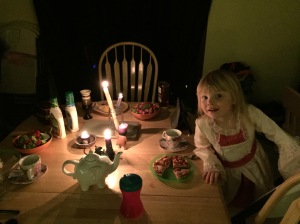 The last few days, which were supposed to be days off, wound up being impromptu work days for me. When I came home this evening, my 3 year old attacked me with pleas for attention and play time. It’s important to understand that as a dad and a follower of Jesus, I consider it my duty to love my daughter in a way that shows her who Jesus is. It’s a job I take very seriously. So, I spent some time playing, but I had to start making dinner. It was late and I was tired, so dinner was not going to be anything spectacular. I put a frozen pizza in the oven and made sandwiches and salads for my wife and I, all the while my daughter was danced around me in an effort to get my attention. Then, I had an idea. I put on the kettle to boil and made tea in her teapot, one I picked up specifically for tea parties with her. As soon as she saw it out and me filling it with water, she started squealing about having a tea party. I set the table with candles, put out teacups and saucers, put her in her fancy dress, and put on my suit. My wife quickly joined the act, putting on a dress. The result was a
  tea party with our little girl over a regular dinner of frozen pizza and salads. It’s not an elaborate daddy-daughter date night, but throughout dinner she repeatedly exclaimed how excited she was to have a tea party for dinner. It wasn’t my preferred daddy-daughter day together. However, given the brief time I had available to plan dinner, our impromptu candlelit tea party was a huge hit with one of the people who matters most to me.


 While watching my kids play at the park yesterday, my daughter came running to me from under play structure, crying and rubbing her forehead. She had bumped her head on the underside of of the fire engine jungle gym. A hug, a kiss on the forehead, and and a few comforting words later, she was running around again. The most natural response to my little girl’s feeling pain, is offering comfort and doing the best I can to make it better. This is a natural response for parents. Protecting our children is programmed into our DNA. The most natural thing in the world is to hurt when our kids hurt and to try to fix it. Unfortunately, as time goes on, this instinct can get in the way of healthy development into adulthood. There are times when parents need to reign in their instinct and allow their children to struggle or hurt sometimes because its whats best for them.
 then the natural consequence is a poor grade. All too often, parents see their child panicked the day before, and bail them out. At times this involves doing the work for them or calling them in sick for school the next day. These situations are teachable opportunities. Parents must decide if they will teach their child that someone else will always be there to bail them out, or if they will learn the hard lesson: “If you don’t do the work, you will fail.” This is one example, but of a huge area of teaching. If you watch people long enough, you will witness parents who attack teachers because their kids aren’t getting A’s, or demanding their kid gets to play a starting position on the soccer team, or any other situation where a parent shields their child from the consequences of their actions or failures. I’m not saying that helping your kid deal with consequences isn’t okay sometimes. Rather, I am saying that protecting them from everything teaches them to be sheltered.
 Patching Cracks