

I love my wife. I want her to love me and think I am a great husband. Heck, I want to be the kind of husband that makes my wife feel loved, appreciated, and treasured. Further, I want her to look to me as a source of comfort, assurance, and joy. Achieving this means courting her throughout our marriage. Sitting around and wanting our marriage to grow stronger without putting forth effort is unrealistic. I also want to be faithful to God’s command that I love my wife like Jesus loved the church. This means serving her. Over and over Jesus taught that love is demonstrated through service. Over the course of 18 years of marriage, I have learned through trial and error (lots and lots of error) that simply doing things for her is a start, but it is not everything. There are all sorts of things I, and lots of husbands, do to mess up the good things we do for them. We men can be thick-headed in regards to relationships and often act stupidly in ways that mess up what we are trying to achieve. Figuring out the big pitfalls and avoiding them is a huge part of courting our wives. Here are a few I have done or have observed in others.
- We remind her that we did them. This is pretty simple. Your wife probably noticed what you’ve done. If you cleaned the house, she noticed. If you did laundry, she noticed. If you do dishes, wash the dog, wash the car, play with the kids, do yard work, write love notes, buy flowers, or anything else… she probably noticed. If she didn’t, she isn’t that concerned about it or is too tired or busy to notice right now. Eventually, she will. The more you talk about the good things you do, the less impressed she is by your effort. No one is that impressed by folks who have to blow their own horn. Serve your wife and let her notice on her own. She will. You not playing it up for points will make your acts more meaningful.
 We think it’s a bigger favor than it actually is. There are some things we do that seem like a big deal to us. These are things that she sees as something we should have been doing all along or something that isn’t that important to her. It makes more sense to understand what she is impressed by, wants you to do, or would be meaningful to her, and then do those things. It’s easy to figure out what to do. Just watching what she reacts to or just asking her will tell you most of what you need to know. Also, a single nice act is one thing and will likely be something she appreciates. However, a real impact can be made by putting effort into doing things for her regularly. There is a cumulative effect. A thousand small acts of service, performed over the course of months, will mean more than one huge one standing on its own.
- We do things she doesn’t want us to do. My wife doesn’t like surprises and isn’t moved by gifts. I spent years planning huge, elaborate surprises and giving her gifts. Neither impressed her much. I thought I was doing all sorts of things to court her, but I hadn’t bothered to learn that she loves acts of service and words of affirmation. Those sorts of things mean a lot more to her. I did what I liked, not what she liked. The point is to meet her needs.
- We expect sex in exchange. Guys, admit it. We sometimes do things for our wives because we want sex. We clean, serve, get flowers, etc. because we want sex. The problem is that if your loving gesture has an ulterior motive, she will see it as a manipulation. All your good will dissolve the moment she knows you are doing things for you, not for her. Your loving acts need to be about her. They need to be done because you love her. She is smart. She knows. In addition, if you’ve been doing your loving gestures with the expectation of sex as payment, there is a cumulative effect. You build mistrust. You may have to do better for a while before she believes that you are doing them because you love her.
- We play martyr. If you do things for her and play up the hardship on you or your sacrifice in an effort to build additional good will, it backfires. Do things because you love her, show strength in the effort, don’t make a big deal about it, and be clear that you are doing what you are doing because you love her. In the end, this the reason we court our wives: we love them. That’s what makes acts of service so powerful.
 We do it half-heartedly. Do the things you do for her as best you can do them. If you can, do them without her asking. Definitely do them without her having to nag you. Your effort and you thinking about her is what makes your actions meaningful. Don’t do a bad job and don’t procrastinate.
- You fight with her. Don’t fight with her! If she comments on something you missed when you were cleaning or something you did wrong, don’t lash out. If she doesn’t acknowledge what you did immediately or show as much appreciation as you expect, don’t lash out. I know it’s easy to get frustrated or feel hurt or feel unappreciated. Don’t fight with her about it. Doing something for her and following it up with anger or hurtful words will do far more harm than good. Take a deep breath, take a walk, think it through, don’t approach her with unrealistic expectations, whatever it takes, don’t pick a fight.
 Less than a week before my wedding day, I lost my job. It was a terrible fit for me and in retrospect, it was a good thing. However, at the time it was a crushing blow. Going to work and providing for my family was pretty much the most important thing in the world. I had no idea how or when this happened, but I am quite certain that my pride and identity were magically tied to my ability to bring home a pay check, put a roof over my wife’s head, and food on the table. The experience shaped my attitude toward employment to this day. I don’t think my experience is particularly unique to me. Men derive much of their identity and sense of worth from their work. It lies at the core of the masculine identity, which is part of God’s design for men. We see this truth in the book of Genesis. The first thing Adam did after he was created was go to work. God put him in the garden and set him to work. It wasn’t miserable work and it wasn’t all that Adam did. He didn’t live to work. Adam tended to the garden, but he also named the animals. In addition, God recognized that Adam shouldn’t be alone, so he created a wife for him. In short, from the beginning man’s work was pretty important to him. In fact, I’d argue that Adam was designed to set his hand to tasks. If Adam was made in God’s image and God engaged in both creation and work, then it follows that work and creation would be important to Adam. One of the things I love about the creation account is that it gives us hints about the nature of men and women. The intended design is seen clearly without the haze of sin obscuring and distorting the foundational truths. In this case, the foundational truth is obvious: Men were made to work, but that’s not all they were made to do.
 In general, emotions are a difficult topic for men. This difficulty spans a broad spectrum, from emotionless stoicism on one end, to the uncontrolled passions of aggression, anger, lust, and ambition that have earned the male gender a reputation for acting as the bull in the china shop of their relationships. One of the hallmarks of a mature man is his ability to manage his emotions. This is not full repression of feeling and passionless existence. The stoic philosophers succeeded in producing incomplete men by attempting to avoid one of the fundamental strengths of man. God designed passion into men, that we might reflect his character. You cannot read the scriptures and miss God’s love, joy, sorrow, rage, and jealousy. In short, we were made in the image of a passionate God. Jesus was often angry. He loved folks passionately. He wept at the death of Lazarus, and he mourned over Jerusalem’s ongoing rebellion. It is important to understand that God’s passions are restrained by His will and holiness. Further, it is important to understand that these are qualities of God, they are not God himself.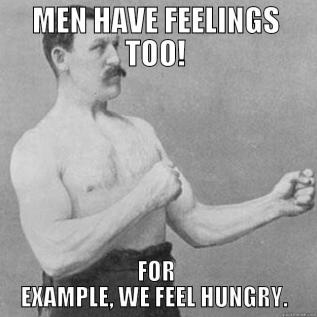
 Over the past few years, I’ve read several articles arguing varying perspectives on the ideal wife portrayed in Proverbs 31. Most of these articles have argued the matter in terms of whether or not this woman is a standard model for wives and women everywhere to aspire to be the best housewife possible in serving her 1950s family or an allegory for wisdom so as to remove the unattainable ideal that just serves to discourage women into standardized gender roles. I’ll admit that these characterizations are hyperbole, but I am exaggerating the extreme sides of this debate for a reason: because this text has become a bit of a tug-o-war passage for folks in the battle over the role of women in the church. Each side pulling for a gender political stance and taking pride in their position, sometimes without bothering to ask whether or not they are glorifying Christ in their stance. My intent in this post is not to engage either of these positions, but rather to offer an analysis of the text with an eye on shedding a little light as to what believers are actually supposed to do with these passages.
 Understanding the historic context is also important for getting a solid grip on the meaning of the passage. The advice being offered isn’t being given in a culture where people typically married for love. Marriage was generally a very utilitarian institution. Wives were selected based on all sorts of considerations, most of them pragmatic. The poem is literally about choosing a wife according to high character standards. This choosing was more akin to shopping than our culture tends to immediately recognize.
 In the garden, at the time of the temptation and the fall, the text depicts Eve talking with the snake, who makes all sorts of promises. They talk back and forth regarding God’s rule and whether or not it was wise to follow it. When Eve succumbs to temptation, the text reveals something interesting:
 Ephesians 5 to 6 is what is called a “household code.” In ancient Greece household codes were pretty common, generally memorized by members of the household, and were used for outlining everybody’s job in the home. This genre of writing would have been very recognizable to the readers. When Paul digs into roles in marriage, he starts with the wife, but spends more time on the husband, which is why we will consider the husband first. Beyond spending more time on the husband, Paul outlines a great deal more responsibility and an active role for the husband. He begins by directing husbands to love their wives. The word he uses for love is agape, which is the word used to describe selfless, unconditional, divine love. Paul’s direction for husbands to love their wives is unique to Greek household codes in the ancient world. There was no expectation amongst ancient cultures that husbands love their wives. Christian men are given a MUCH higher standard than the world: selfless, unconditional, sacrificial love for their wives. This is reinforced by Paul telling husbands that they are to use Christ’s example as their guide. They are to act toward their wives as Christ acted toward the church, sacrificing himself for her sake.
 There is an important principal in this. Comfort, a sense of meaning, and purpose for difficulty in relation to hard circumstances in our past can be discovered by recognizing God’s refining us through the pain we experienced, reflecting on the good it produced in us, and reflecting on how our experiences have shaped us into the person that we are. Doing so requires that we learn to take a different point of view in relation to our past. This can be terribly difficult, because hardship often creates bitterness, which tends to blind us to anything positive that may come of unfortunate incidents. It can also be hard because it’s easy to confuse finding positive outcomes with being glad a bad thing happened. We don’t have to be happy that tragedy has been present in our lives in order to recognize how hardship has shaped us. We can be thankful for what we have become without having joy at what made us the way we are. Learning to shift our perspective in relation to past pain can bring great comfort and release. As difficult as it is, it becomes easier to shift our perspective the further displaced we are from the events. This is often the first step toward healing.
 It’s easy to understand how alcohol or cocaine are addictive substances, but when it comes to pornography addiction understanding the issues involved can be more difficult for a variety of reasons. For starters, discovering a hidden pornography habit can result in significant feelings of betrayal for a wife and can make understanding the addiction component very difficult. In addition, pornography use carries some stigma, which clouds perspective and makes understanding the addiction more difficult. However, pornography addiction is a real illness, it’s diagnosable, and it’s treatable. Looking at pornography produces similar brain functions that take place with using cocaine. It is highly addictive for the same reasons as any other drug. This is not to excuse the betrayal of a spouse or anything of the sort. Rather, it is to say that an individual can develop an illness, which prevents them from quitting the behavior. Let there be no mistake, addicts cannot stop a behavior on their own. Denial, thinking errors, shame, and an out-of-control reward response system in their brains literally result in the addictive patterns becoming compulsive.
 comes with it. I had never replaced a clutch and had no idea how important the tool was, so I said “no problem” and was on my way. I discovered that it actually was a problem when I attempted to put the engine back into the car with the misaligned clutch. The engine simply would not fit the transmission. I tried several improvised fixes, but had no success. Finally, I pulled off the clutch and went back to the shop, where a different guy was now at the counter. He looked at the clutch and stated firmly that they didn’t sell the alignment tools separately and that the part was not returnable because I had attempted installation. After some arguing and effort, I realized I wasn’t going to make any progress. I then turned to the internet and discover that no one was selling my alignment tool. Finally, after days of working on the problem, I took the engine to the dealer and paid an hour’s worth of labor to a technician, who spent 3 minutes aligning my part. The little plastic alignment tool, that seemed so unimportant at the time, was vital to properly installing my clutch. Without the tool, the engine, which produces power, simply couldn’t connect to the transmission, which transfers power to the tires.
 but struggle with making the ideal version in their head transfer into relationship reality. They want to communicate without arguing, agree on financial decisions, experience perfect harmony in their physical relationship, and find that spark of excitement that was present when they first started dating. The problem arises when the idea as to how marriage ought to be fails to translate into forward and harmonious movement in the relationship. This misalignment is a product of the fallen nature, which inclines us toward self-centeredness. If you take a look at Paul’s description of love in 1 Corinthians 13, you will find the antithesis of the sinful inclination of man. It’s natural for people to struggle with making their behavior match their convictions. Paul describes this struggle in Romans 7,
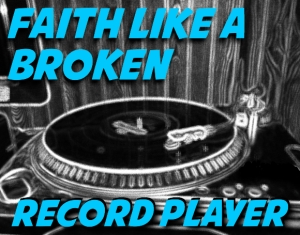 but do not have a decent player for my stereo in the living room. Last week I was volunteering at a community rummage sale and I came across an older, but fairly high end turntable. I was giddy as a school kid when I plugged it in and hit the play button. My heart sank when the turntable remained still. I quickly dismantled it and discovered the belt was broken. Further investigation revealed that the motor worked. The record player worked, but the turntable didn’t spin. No matter how well the motor ran, it didn’t matter, because the power didn’t transfer to meaningful motion. This record player sat on my desk all week while I was studying the book of James for last Sunday’s message. I believe that this is why that broken record player came to mind when I read James 2:14-17.
 Patching Cracks