
Wives, submit to your own husbands, as to the Lord. For the husband is the head of the wife even as Christ is the head of the church, his body, and is himself its Savior. Now as the church submits to Christ, so also wives should submit in everything to their husbands.
Husbands, love your wives, as Christ loved the church and gave himself up for her, that he might sanctify her, having cleansed her by the washing of water with the word, so that he might present the church to himself in splendor, without spot or wrinkle or any such thing, that she might be holy and without blemish. In the same way husbands should love their wives as their own bodies. He who loves his wife loves himself. For no one ever hated his own flesh, but nourishes and cherishes it, just as Christ does the church, because we are members of his body. “Therefore a man shall leave his father and mother and hold fast to his wife, and the two shall become one flesh.” This mystery is profound, and I am saying that it refers to Christ and the church. However, let each one of you love his wife as himself, and let the wife see that she respects her husband.
Ephesians 5:22-33
During my preaching and teaching career I’ve covered the Apostle Paul’s household codes several times. There are few topics that produce quite as much arguing, anger, and accusation. I have heard men denounce women for not submitting, women denouncing men for the suggestion of submission, I’ve encountered authors and speakers who have twisted this passage every which way imaginable to assert that the verse is advocating anything from total equality, to a slave master relationship, to a 49/51 voting split, to discussions of whether or not getting your man sandwiches during football games is a spiritual discipline. This excess of commentary on the topic can tempt me to throw up my hands and pass altogether. The problem with this is that Paul included this bit of instruction on purpose and marriage is important. If the scriptures have something to teach us on the matter, we need to learn it.
There is more than a little material to cover in Paul’s 11 verses on husbands and wives. I don’t intend to cover every interpretation, but rather in the three articles I will post on this topic, I will cover:
- Offer a perspective as to why this can be such a controversial passage.
- Look at how the text is instructing husbands to operate.
- Consider the instruction for women.
Approaching the Text While Wearing the Wrong Glasses
Matthew records an incident in which the mother of his disciples, James and John, approached Jesus and asked that her sons be his right and left hand men in eternity. Later, the other disciples are angered when they hear about the request, which prompts Jesus to call the 12 together and tell them that they are looking at the world all wrong.  “You know that the rulers of the Gentiles lord it over them, and their high officials exercise authority over them. It is not this way among you, but whoever wishes to become great among you shall be your servant, and whoever wishes to be first among you shall be your slave; just as the Son of Man did not come to be served, but to serve, and to give His life a ransom for many.” Simply put, the disciples jockeying for authority was a result of them looking at the world from the same perspective as the pagans around them. They are seeing the world as pagans see it. Greatness means being served. Followers of Jesus assume the status of servant. Jesus demonstrates this very graphically when he washed his disciples feet at the last supper, taking on the job of the lowest servant in the household. The message seems pretty clear: followers of Jesus are called to serve. We aren’t called to be served or to lord position over others. Believers are nowhere instructed to fight with each other over rights to subjugate each other. Our primary concern in life ought to be our focus on Jesus and commitment to grow in our faith and obedience.
Perhaps the biggest problem with how many folks approach the roles in marriage as they are discussed in Ephesians 5, is that they are approaching the text in terms of who owes who what degree of service and submission. They are wearing their pagan perspective glasses. When believers find themselves enmeshed in discussions about why “you have to” or “I don’t have to” instead of discussing what makes us more like Jesus, it’s a sign that there is something wrong. Believers ought to find themselves in a place of working to out-serve each other long before they even consider arguing about subjecting each other to our own wills.
Perhaps one of the cultural components that gets in the way of a proper perspective on the matter is the sense of entitlement that our culture has developed. We are consumers who should get proper service, not servants of the world following our master’s example. We no longer see ourselves as servants to all. The attitude has even pervaded the church, where all sorts of preachers who talk as though God himself ought to be at our beck and call, making our lives as comfortable as possible and fulfilling our wildest dreams. Churches are too often seen as existing to cater to our desires, rather than equipping us to serve Jesus.
Interestingly, discussion of whose desires get served in the marital relationship so often dominates the discussion of this passage that the vast majority of what Paul says winds up totally ignored. The passage itself spends more time discussing the relationship between Christ and the church than it does husbands and wives. Really, the key to the whole passage is verse 32, when Paul tells us that the institution of marriage, in which a husband leaves his parents to be joined to his wife as one, points to the union between Jesus and the church. As such, the passage is primarily about Jesus. The bit that we can garner regarding marital relationships is primarily in relation to the larger eternal truth of Jesus as His bride, the church. Really, if there is a unifying direction to take in relation to this passage it’s that we are to imitate Christ in EVERY aspect of our lives, including marriage.
The next post on this passage will deal with what Paul says regarding husbands.
 I love my wife dearly. I believe that she is a gift from God, who has made me a better man during the 17 years we have been married. I will confess that those 17 years have not always been a fairy tale where the young lovers live happily ever after. There have been more than a few frustrating days and fights. It’s strange how easy it is to be angry with someone who you care for so deeply. I often hear people say that they are far meaner and find it easier to be angry toward their loved ones than they would be toward strangers or acquaintances. Anger is powerful and can be dangerous to relationships. It is important to deal with it appropriately and effectively, lest it take root and grow into bitterness that poisons the whole relationship. The following are simple, Biblical steps to take in dealing with anger.
 I haven’t posted to this blog in 3 months. The reason for this leave of absence is simple: I am a small church pastor in a rural community of 700. I love my job and the people I serve. Between early October and December 26th, the busy season for church work, I didn’t have a single day when I didn’t field a work-related phone call, head over to the office to take care of a few tasks, visit with someone from the church, run into town for a hospital visit, spend time working on a sermon, sat down for counseling, attended a meeting, or spend time working. I often joke that I work every day, which is true. As the excess or work ramps up, the productivity of writing goes down. That having been said, I’m not bragging or complaining about this. I don’t consider burnout to be a sign of spiritual health. I actually really like my job and most days I don’t think I work to excess. In the past, I’ve worked at similar levels of busyness and not felt as good about it. Most ministers have experienced days when they didn’t want to get out of bed in the morning and when they felt like there was no escaping the crush of expectations.
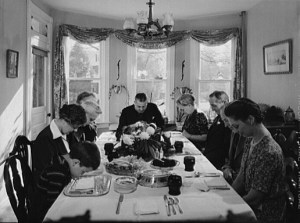 In 1863, President Lincoln declared the final Thursday in November the official Thanksgiving holiday. While Thanksgiving had been celebrated irregularly for several hundred years, it was not an official holiday in the United States and was not annually celebrated until this point. It is significant that Lincoln chose to establish the holiday in 1863 because the American Civil war had been raging for several years. Hundreds of thousands of Americans were dead, the United States was united no more, the nation lay in shambles, and it appeared as though the North wouldn’t win the Civil War. To top it off, Lincoln’s son had died less than a year previous. It was in the midst ofone of the darkest points in American history, and certainly Lincoln’s own life, that he declared that Americans would dedicate a day to thank God for the blessings that they had received. This is a powerful testimony to the degree of faith and dedication Lincoln had toward God. It is also an attitude that is difficult to muster during times of tragedy.
 It is tough to stop and say thanks for what God has given you when everything seems to be falling apart. Often, disaster prompts people to turn and ask: “Where is God in all of this difficulty?” or “Why Doesn’t God do something to fix this for me?” Lincoln offers us a terrific model for our attitudes toward God in times of trial. This attitude can seem almost superhuman, and certainly unattainable for normal people. I’d suggest that this is probably the case. But, while it may be impossible for men to be thankful in all circumstances, it is certainly isn’t impossible for God to create an attitude of thanks in man’s heart. I’d argue that this is a product of intentional effort and practice, that God aids us in accomplishing.
 The city of Butte Montana is built over a mine which had been on fire for over twenty years. This was not a roaring blaze, but rather a smoldering fire that simply kept burning year after year. The fire was accidentally set by a fellow named Henshaw, who left a candle burning unattended on a pine beam. The beam caught fire. The fire spread to other beams and kept burning for decades. This is at least partially due to the miners managing to deprive the fire of oxygen, which kept it from burning out of control but also prolonged the burn.
 Several times in the last few months, while scrolling my Facebook feed, I have come across friends who have posted those annoying fake news stories, that are technically “parodies”, but are not identifiable as parodies in any way, apart from reading the home page of the website it was originally posted on. These posts are usually political, outrageous, completely fabricated, and designed to induce rage in the reader. The thing that has blown me away is that on several occasions I’ve read where a comment will point out that the article is fictional, and the follow up comments will continue to pile on with rage about how “it might as well be true” or “that’s the sort of thing <insert some group here> would actually do.” In short, it doesn’t matter whether or not they’re true, these articles become an excuse to pour fuel on the fire of rage at an ideological group. They are, what I refer to as “rage porn.” They exist for the sole purpose of feeding an emotional state. They become an excuse to express rage and fury on the internet. Rage porn isn’t limited to the fake stories. There are whole websites that do the same thing with single line quotes and mischaracterizations. In these cases, the news articles will feature a single sentence and an editorial about how evil the speaker and everyone associated with them is. There is not attempt at context or intelligent engagement. The only objective is eliciting an emotional response, because anger is political strength in our culture.
 Believers have no place in their lives for stoking the flames of rage over politics or anything else. We may mourn over sin in the world. We can feel free to disagree with the actions of others. We can speak out for Christ and the protection of the innocent and helpless. At the end of the day, we must love those who Christ bled and died for. We need to pray for the folks we would be tempted to judge and love the folks we are more tempted to despise. It’s important to note that love involves more than lip service. If I rage at and trash talk a person, then explain that I love them; I am not doing much in the way of demonstrating my love toward them. Our call is to serve and to love concretely. This isn’t easy. Turning to reading materials that inflame our rage at “the enemy” does little to produce the sort of holiness that Christ is directing us to.
 The world of publishing has witnessed an interesting phenomena over the last few years. Sales of print books have slumped in almost every category as ebooks sales have surged. The only arm of book printing that has experienced growth over the last several years has been in the area of self-help. Self improvement book sales have defied the trend in the industry by experiencing a boom. Between books on weight loss, ways to improve your marriage, methods for overcoming depression, improve your career standing, and all manner of other do-it-yourself-to-yourself books; Americans are still buying. In our self-obsessed culture, feeling bad or inadequate is simply unacceptable. This has prompted a veritable gold rush of publishing in this area. The world of Christian books has not missed out on this trend. “Christian self-help” books are extraordinarily popular. I include quotation marks because far too often these books are simply christian flavored versions of their secular counterparts. Rather than being a distinct worldview, self-help Christianity has a tendency toward nearly identical in approach with bible verses attached to the ideas at strategic locations. At issue isn’t the notion of working to improve our health, emotional wellbeing, income prospects, or anything else we feel discontentedness toward. The issue is related to a basic philosophical incompatibility that exists between Biblical Christianity and most self-help approaches to the world.
 My kids spent last weekend on a ranch in the foothills of the mountain range near our town. The ranch is the home of one of the elders from my church and his family. The kids love spending time there chasing cows, riding horses, feeding chickens, and doing all the other things they do on the ranch. With the children away for a couple days, my wife and I were free to take a weekend away mini-vacation. We spent the night at a bed and breakfast situated in a ghost town; we then spent the day christmas shopping; and finally spent a night at home alone together. We do these mini-vacations twice a year, and have found that they are a perfect opportunity to spend time together, focusing on each other. We love our kids, but they demand a great deal of attention. I don’t begrudge them that attention, and in fact, feel that it’s our duty as parents to love our children and meet their emotional and relational needs. The challenge that comes with meeting the hefty attention and emotional needs of children is in maintaining a healthy relationship with each other. It’s easy for the marriage to go on the back burner when you’ve got kids to attend to. I’ve written several articles on the importance of date nights. The mini-vacation is a step beyond date night. It’s taking a day or two away to be together, alone. I know couples who haven’t spent days alone together in years, since they were first married, because of the demands of parenting. My wife and I agreed that keeping our relationship vital was good for us and for the kids, so we are intentional about planning these overnight dates a couple times a year. The trick is that it’s not an instant success. Weekends away need to be approached with appropriate expectations and with a degree of careful planning to ensure their success. Here are a few things we have recognized and learned from our experiences:
 Make Careful arrangements for Your Children: As important as the time together is, your first responsibility is for the safety and care of your children. The plans you come up with for their care need to be carefully considered. They need to be comfortable with the arrangement. The person watching them needs to be responsible and knowledgable in caring for kids. There needs to be plans in place in the case of an emergency, and you need to plan for their care and comfort. Family is ideal for this sort of arrangement, particularly grandparents. Another possibility is utilizing a sitter. I know couples who take turns watching each others children to support date nights. Taking turns with another couple watching watching kids is another way to make the weekend away possible.
 It probably won’t fix the problem for good. It may help, but you’ll likely still need to work at it. Another way that realism is important is in the area of romance. Wives, frustrated with their husband’s lack of romantic efforts, may not find that their husband is instantly transformed into Don Juan. Husbands who are looking for their wives to suddenly have a supercharged libido, may wind up frustrated. In both cases, unrealistic expectations can sour the weekend. Both of these problems are best dealt with through communicating with each other about the frustrations. The best plan is to be realistic and have realistic expectations about your time away.
 One of the biggest blessings I have experienced during my 2 years as a small town pastor has happened during my visits to the local nursing home. While there, I have met several married couples who have been together for decades longer than I have been alive. I have enjoyed watching couples eat together and spend time visiting. I am inspired by these folks and aspire to be together with my wife decades after we both said “I do.” To this end, I have been reading about the difference between couples who divorce and those who remain married for years. One of the interesting tidbits I came across in my reading was related to a decades-long study observing married couples. This study produced an interesting revelation regarding communication between spouses. Couples who exchanged insults or harsh words 5 out of every 100 verbal exchange tended to not divorce. If you increase the number of disparaging remarks to 10 out of every 100 exchanges, the likelihood of divorce increased dramatically. It hardly seems like a big deal, but careless words can take a toll on any relationship. Perhaps this is more so the case with marriage because husbands and wives make themselves vulnerable to each other as a part of their intimate relationship. In that setting, it doesn’t take much to wound each other significantly. The book of Proverbs makes a great comment on this matter: “The words of the reckless pierce like swords, but the tongue of the wise brings healing.”
 Early in my career, I worked at a facility for children with emotional disorders. We provided services for children ranging in age from 8 to 18. Many of our clients came from juvenile detention and it wasn’t unusual for them to have received little parental discipline or direction. One of the major challenges of the job was getting our adolescent clients through their everyday routine without major blowups, violence, or even having them just sit down and refuse to do anything at all. This was particularly challenging when it came to doing chores, going to school, and going to bed on time. During the first few months at the agency the training regimen is excessive, between behavior intervention techniques, therapeutic crisis intervention, and basic relational techniques. During that time I learned a grab bag of techniques for convincing kids to follow directions or to stop acting badly without resorting to physical intervention. As a parent, I’m increasingly discovering how useful these techniques are in raising and disciplining my own children. Having options when it comes to kids is great because they can be incredibly frustrating. Being able to choose an approach gives you a sense of control that can feel like it’s in short supply when you have only one or two approaches. The following are the interventions that I have found most useful in parenting:
 Planned Ignoring/Positive Attention– This technique is based on the assumption that kids sometimes act out in an effort to get your attention or to get you to act in a particular way. Simply put, you do not reward undesirable behavior at all. You don’t cater to it or even acknowledge it. When they do what you want, you lavish praise and attention on them. One of the most obvious examples of this is the temper tantrum. Every morning I dress my 3 year old daughter and take her to work with me. Since she reached the age of 2 she has begun to disagree with me regarding the right wardrobe choices. This sometimes results in a fit of screaming and carrying on. Since it’s in my own home, I’m under no pressure to engage it. So, I usually walk away and let her yell. When she realizes that it’s not working she stops. On the other hand, when she asks for different clothes appropriately, I praise her and listen to her opinion. This approach works best with annoying behaviors when there are no time pressures. It essentially allows the child to figure out that what they are doing isn’t working. If they have a fit in the middle of the grocery store, ignoring it isn’t the right choice. If they are playing with knives, ignoring it is a bad idea.
 Patching Cracks