 Willard F. Harley’s excellent marriage book His Needs Her Needs, is an exploration of the major emotional needs of husbands and wives. He asserts that the major cause of extramarital affairs is unmet needs, spouses rely on each other to have their needs met. When one partner goes long enough without major needs being met, they are more susceptible to temptation. He presents the 5 most important needs for each spouse, interestingly demonstrating how the corresponding need in the opposite gender can either compliment or conflict with it. For example, the most important emotional need for wives is affection. They need shows of affection, like touching, thoughtful gifts, loving words, etc. The corresponding need in men is sexual fulfillment. Men tend to do well meeting their wive’s affection need during the courting phase of the relationship. However, after marriage meeting the affection need becomes less urgent, though for most men having their own sexual needs met becomes a more pressing concern. As focus on fulfilling the wife’s need for affection dwindles, wives tend to be less in the mood for meeting their husband’s sexual needs, largely because affection in other areas of life is a large part of foreplay. It’s important to note that this cuts both ways. When women become less interested in ensuring their husband’s sexual fulfillment, men become frustrated and are less inclined to put effort toward showing their wives affection. When both parties take a stance of intentional selflessness toward their partner, the system works better. When one or both become overly focused on their own needs, things tend to break down.
Yesterday I posted an article that looked at the 5 most important needs to women. The following are the 5 most important emotional needs for husbands:
• Sexual fulfillment- Men are sexual and sexuality tends to be the most important need for many men. Please note that this is being classified as an emotional need, not a physical one. There is a tendency to think of men’s sexuality as being a mere physical need, but men largely experience affection sexually. There is a element of physical need, but the emotional element cannot be ignored. It is to men what affection is to women. Men’s sexuality is usually deeply connected with their sense of identity, which makes it important for this need to be met, as not having this emotional need met will affect the husband to his core.
•  Recreational Companionship- Recreational companionship refers to engaging in activities together. Where women need conversational connection, men need to do fun things with their spouse. During the courting phase of the relationship, this is easier. Dating usually revolves around engaging in activities together. After marriage it’s not uncommon to find it easy to engage in their own hobbies and activities, going their own ways. Men have a need for companionship in activities. They like it when their spouse does things with them. This is largely because men tend to be doers and enjoy action over discussion. Relational companionship need not be active participation, though it’s a good thing when husbands and wives engage in activities together. Wives can watch their husbands, support them, or take an active interest in order to meet this need.
• Physical Attractiveness- This is a harder need to understand for many people. Men are very visual creatures. They tend to experience a lot of sexual attraction through what they see, which is why pornography for men is largely visual, because men respond to visual stimulation. This doesn’t mean that the wife must fit into the same dress she wore on their wedding day or resemble a supermodel at all times. Rather, a wife’s attention to visual cues is important. It’s generally important to men that their wives take care of themselves or try to look attractive. I’ve spoken to men who lament that their wives wear lingerie with less frequency the longer they are married or stop taking care of themselves physically altogether. It sounds shallow and crass, but it’s more a product of how men are hardwired. It’s not uncommon for men to become frustrated when they find their wives less attractive, but cannot discuss it because of the overall sensitivity of the subject matter.
• Domestic support- Whereas women often have a need for their husbands should work to support the family, men tend to want for their wives to help maintain and ordered household. This may come across as a desire for the ideal 1950s TV wife. However, it’s more a need for a spouse that helps take care of the home. How pressing this need is depends on the husband and the family composition. Many men are happy to help take care of domestic responsibilities, but feel a need for their wife to help with cooking, cleaning, and childcare.
• Admiration- Men have an inborn need to be respected and looked at with admiration. When a man feels disrespected or looked down upon by their wife, their pride can be significantly wounded. This need is generally a counterpart to family commitment. Women have an emotional need that the husband be committed to caring for and raising the family. Men, on the other hand, have an emotional need to be looked on as the leader in the family. They have a need to be treated with respect and admiration.
The key to understanding the proper handling of emotional needs as presented by Mr. Harley in his book is a degree of selflessness. Meeting needs in the marital context works best when both partners set out to meet their spouse’s needs without concern for seeking out the meeting of their own needs or judging your partner’s needs. Further, communication over these things is important. People will generally vary in their relational needs. Open communication is key to helping each other know what needs to be done in order to meet needs effectively.


 Early in my career, I worked at a facility for children with emotional disorders. We provided services for children ranging in age from 8 to 18. Many of our clients came from juvenile detention and it wasn’t unusual for them to have received little parental discipline or direction. One of the major challenges of the job was getting our adolescent clients through their everyday routine without major blowups, violence, or even having them just sit down and refuse to do anything at all. This was particularly challenging when it came to doing chores, going to school, and going to bed on time. During the first few months at the agency the training regimen is excessive, between behavior intervention techniques, therapeutic crisis intervention, and basic relational techniques. During that time I learned a grab bag of techniques for convincing kids to follow directions or to stop acting badly without resorting to physical intervention. As a parent, I’m increasingly discovering how useful these techniques are in raising and disciplining my own children. Having options when it comes to kids is great because they can be incredibly frustrating. Being able to choose an approach gives you a sense of control that can feel like it’s in short supply when you have only one or two approaches. The following are the interventions that I have found most useful in parenting:
 Planned Ignoring/Positive Attention– This technique is based on the assumption that kids sometimes act out in an effort to get your attention or to get you to act in a particular way. Simply put, you do not reward undesirable behavior at all. You don’t cater to it or even acknowledge it. When they do what you want, you lavish praise and attention on them. One of the most obvious examples of this is the temper tantrum. Every morning I dress my 3 year old daughter and take her to work with me. Since she reached the age of 2 she has begun to disagree with me regarding the right wardrobe choices. This sometimes results in a fit of screaming and carrying on. Since it’s in my own home, I’m under no pressure to engage it. So, I usually walk away and let her yell. When she realizes that it’s not working she stops. On the other hand, when she asks for different clothes appropriately, I praise her and listen to her opinion. This approach works best with annoying behaviors when there are no time pressures. It essentially allows the child to figure out that what they are doing isn’t working. If they have a fit in the middle of the grocery store, ignoring it isn’t the right choice. If they are playing with knives, ignoring it is a bad idea.

 I take my daughter with me to the office every day. She goes on nursing home visitation with me. Sometimes she goes with me when I visit parishioners in their homes. She spends about 8 hours of every day with me. Unfortunately, there is a difference between time when she is playing with dolls in my office while I work and quality time. I’ve spent some time in previous posts discussing daddy-daughter date nights and tea parties. Those sorts of activities are great, but tend to be spread out. It’s important to spend time with your kids daily. I encourage dads to try to spend at least an hour with their kids daily, just focusing on them. This sort of invested time is important to children and will impact them well into the future. This time investment may seem difficult, but I’ve discovered that it’s all about how you spend the time. It’s easy to look at an energetic kid at the end of a long work day and cringe at the thought of trying to keep up with them for 5 minutes, let alone an hour. Or to look at your daughter’s Frozen dolls with horror at the thought of reenacting a few of the dance numbers. However, there are a few tricks that work well for making the time more enjoyable for both you and your child.
 Focus on the Big Picture– Everything is about the mindset you bring to it. It’s important to remember that the time you are spending is an investment in the life of a person you love and who loves you unconditionally. That investment will help shape their sense of self worth, confidence, and your influence on their values and beliefs. Further, your child is also a child of God, one who you are preparing for a life of knowing Him. Part of how they perceive God will be shaped by their relationship with you. This isn’t time wasted when you’d rather be unwinding. It’s time spent on a job that is far more important than the one you get your paycheck for doing.
 Be Creative- I recently found myself playing with my daughter’s frozen castle and toys on the living room floor. I cannot stress enough how little interest I have in princesses. Rather than phoning the time I was spending with her in, I took out some batman toys I had picked up during one of our trips to the comic books store. Before long, Batman was saving Elsa from the Joker. There was fighting and adventure and princess stuff. She loved the silliness of it, though I suspect that my enthusiasm and energy was what she really appreciated. Kids like being the center of their parents’ attention. Bringing a little creativity to the table is important for making sure that you are able to enjoy the time as well. Don’t hear me saying that spending time with your kids is dull or that it’s all about you. What I am saying is that adult men don’t necessarily enjoy the same activities as small children. Bringing your own interests into the mix can raise the entertainment factor and make it easier to consistently put the time in every day.
 Pay attention to them– Kids catch on pretty quickly when you aren’t interested in what they are doing. If you sit and surf the internet on your phone while you play with them, they’ll notice. If you ignore the stories they tell you, they’ll catch on. It won’t make them hate you. It’ll adjust where they think they land on your priority list. While you are giving the time they are getting from you, give them your undivided attention. Ask questions. Tell them things. Take the time to teach them new things.
 One of the newest trends in men’s grooming is premium shaving gear. This includes all sorts of oils, different shaving cream styles, suggested variations in shaving ritual, and assorted styles of razors. Most of these products are marketed with the basic premise that they are part of rediscovering manhood or some aspect of being a man that is authentically male. A few weeks ago, I came across an old safety razor at an antique sale, and having read all sorts of material on how they were more of a Mercedes shaving experience compared to my Pinto experience with the disposable razor, I invested $3 on a 60-year old shaver. After thoroughly researching the technique involved, I made my first few attempts at grooming with my antique razor. Incidentally, I also learned all about the proper use of a styptic pencil. For those unfamiliar with the styptic pencil, it is used to staunch blood flow for minor cuts and nicks. I also learned that the reason that multi-bladed modern razors exist is because shaving with a safety razor is difficult, more time consuming, and potentially much harder on your face. The other thing I discovered is that shaving with an antique razor, the way my grandfather probably did, didn’t make me feel more manly. I didn’t feel like I had discovered some secret to manhood. Really, all of the mystique of the experience seems to be a little overstated. Perhaps I am doing it wrong. Perhaps when I have completed the hazing period and have the scars to prove it, then I will understand. More likely, I suspect that the ads are attempting to tap into a deep-seated need in our culture. Many men are searching for a definition of manhood because they aren’t certain as to what it really means to be a man. They don’t have a clear definition or standard by which to measure themselves, and as a result, they struggle with a core component of their identity. We live in a culture that is uncomfortable with manhood and where fathers being estranged from their sons is increasingly common. Boys learn to be men by watching their fathers. They observe, imitate, and learn. Without a father who models manhood, many young men grow up with no real concept of what it means to be a man. Such young men must teach themselves about manhood. Self-taught men often grow up with learning about manhood from pop culture, peers, or not at all. Many live with a need, whether it is conscious or not, to be validated as a man or find manhood standards to live up to. These often materialize as success at work, sexual dominance, or even being the opposite of their own dads. They need not be so overt, as some men live out this need by simply swallowing it or drifting in their life course.
 Ultimately, if you ask most males what it means to be a man you will get a hodgepodge of activities that men associate with manhood and even some isolated values that are associated with male identity. What is far less common is a clear definition of the foundational values or focus of manhood and from where they are derived. This results in some perplexing behaviors that are labeled “being a man” that are likely far from a complete male identity.
 In Genesis 5:3, after the fall of man into sin, Adam has a son. Interestingly, the text says that Adam’s son was in Adam’s likeness. The reason for this shift is that man is now sinful. Instead of being as we were created to be, we are fallen. All people fall short of what they were meant to be. However, in Jesus we see the perfect representation of God and man without sin. In Him, we see what we were meant to be. Men may wander, chasing after images of manhood that fall well short of the ideal, because in Adam, we are fallen. In Christ, we can be what we were created to be. In fact, Paul writes that those who are in Christ are new creations. They become new for the purpose of imitating Christ. We can rediscover manhood in Him. The beginning of recovering real manhood is recognizing that He is the perfect model for us to emulate.
 After 15 years as a professional minister, working with kids for 13 of those years, I have watched all sorts of young people grow up and make decisions to continue in the faith of their youth or opt to walk away. I have also read arguments as to who or what is usually at fault for the exodus of young people from the church. Colleges with secular agendas, public high schools, federal education standards, pop culture, and television are among the favorite targets. While all of these things may play a part in the trend, one of the major factors that gets far less attention is parental involvement. While there is no guarantee that anything will guarantee that kids will continue in the faith after growing up, there are several common factors I have observed that influence outcomes enormously.
 Pray with and for them. Prayer is like breathing to spiritual life and development. It’s also powerful and effective. Going before God and raising up your kids daily is important. It’s also important to teach them how to pray and its importance. Thanking God together, praising Him in prayer, learning to confess our sins against Him, and seeking His assistance in our lives are all practices we teach our children when we pray for them.
 One of the better books I have read on marriage is His Needs, Her Needs by Willard F. Harley. Harley’s text deals with the major emotional needs that are typical of husbands and wives. He argues that one of the major causes of extramarital affairs is unmet needs in the relationship. Spouses cheat because they are looking to have their needs met. The books operates on the premise that meeting each other’s needs is a way of affair-proofing your marriage. Aside from affair-proofing, meeting the needs of your spouse is a good way of helping to ensure happiness in the marriage. Further, knowing the needs of your spouse is important for selflessly serving her or him.
 Affection– Affection is the expression of care and attention. Acts of affection include hugs, touching (generally non-sexual), holding hands, giving flowers, going for walks, writing love notes, thoughtful gestures, etc. Women largely experience love through shows of affection. During the courting and early stages of the relationship, this need is usually well met. However, as time passes, men often shift out of courting mode and affection wanes.
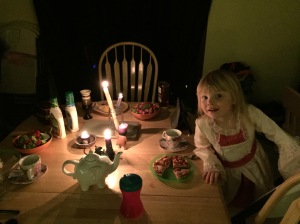 The last few days, which were supposed to be days off, wound up being impromptu work days for me. When I came home this evening, my 3 year old attacked me with pleas for attention and play time. It’s important to understand that as a dad and a follower of Jesus, I consider it my duty to love my daughter in a way that shows her who Jesus is. It’s a job I take very seriously. So, I spent some time playing, but I had to start making dinner. It was late and I was tired, so dinner was not going to be anything spectacular. I put a frozen pizza in the oven and made sandwiches and salads for my wife and I, all the while my daughter was danced around me in an effort to get my attention. Then, I had an idea. I put on the kettle to boil and made tea in her teapot, one I picked up specifically for tea parties with her. As soon as she saw it out and me filling it with water, she started squealing about having a tea party. I set the table with candles, put out teacups and saucers, put her in her fancy dress, and put on my suit. My wife quickly joined the act, putting on a dress. The result was a
  tea party with our little girl over a regular dinner of frozen pizza and salads. It’s not an elaborate daddy-daughter date night, but throughout dinner she repeatedly exclaimed how excited she was to have a tea party for dinner. It wasn’t my preferred daddy-daughter day together. However, given the brief time I had available to plan dinner, our impromptu candlelit tea party was a huge hit with one of the people who matters most to me.


 While watching my kids play at the park yesterday, my daughter came running to me from under play structure, crying and rubbing her forehead. She had bumped her head on the underside of of the fire engine jungle gym. A hug, a kiss on the forehead, and and a few comforting words later, she was running around again. The most natural response to my little girl’s feeling pain, is offering comfort and doing the best I can to make it better. This is a natural response for parents. Protecting our children is programmed into our DNA. The most natural thing in the world is to hurt when our kids hurt and to try to fix it. Unfortunately, as time goes on, this instinct can get in the way of healthy development into adulthood. There are times when parents need to reign in their instinct and allow their children to struggle or hurt sometimes because its whats best for them.
 then the natural consequence is a poor grade. All too often, parents see their child panicked the day before, and bail them out. At times this involves doing the work for them or calling them in sick for school the next day. These situations are teachable opportunities. Parents must decide if they will teach their child that someone else will always be there to bail them out, or if they will learn the hard lesson: “If you don’t do the work, you will fail.” This is one example, but of a huge area of teaching. If you watch people long enough, you will witness parents who attack teachers because their kids aren’t getting A’s, or demanding their kid gets to play a starting position on the soccer team, or any other situation where a parent shields their child from the consequences of their actions or failures. I’m not saying that helping your kid deal with consequences isn’t okay sometimes. Rather, I am saying that protecting them from everything teaches them to be sheltered.
 After 16 years of marriage, my wife and I have noticed that it has become easy to fall into a rut with the time we spend together. For example, since the kids came along we have had begun doing the “grocery store date”, which involved going out for dinner, then going grocery shopping. This date pattern came about for fairly obvious reasons. It’s easier to go to the grocery store without the kids. If we already have a babysitter, why not have an easy night of buying groceries? On the plus side, it meets the basic requirement of spending time alone together. The problem is that this outing isn’t particularly exciting and is really just doing home maintenance without the kids along. Dating your spouse should be about enjoying each other’s company and spending quality time together, unfortunately its easy for it to devolve into an obligation or routine.Because of this, we have put effort into coming up with new and novel activities to engage in on date nights that shift us out of our rut. Here are a few of our favorites:
 reflect something that you think your spouse might find interesting, something that is a sort of project or activity work on together, or anything else that might spark conversation. Afterward we spend time talking about why we picked the book we picked and our reactions to the book we received. The important part of this game is spending time talking about it afterward and sharing reasons for picking the book. It can be adapted to other settings if you aren’t a reader. The game can be played in a mall or almost anywhere else.
 Patching Cracks