Category Archives: Life Application

Why Self Help Doesn’t Help

2427949527_37cee71670_zThe world of publishing has witnessed an interesting phenomena over the last few years. Sales of print books have slumped in almost every category as ebooks sales have surged. The only arm of book printing that has experienced growth over the last several years has been in the area of self-help. Self improvement book sales have defied the trend in the industry by experiencing a boom. Between books on weight loss, ways to improve your marriage, methods for overcoming depression, improve your career standing, and all manner of other do-it-yourself-to-yourself books; Americans are still buying. In our self-obsessed culture, feeling bad or inadequate is simply unacceptable. This has prompted a veritable gold rush of publishing in this area. The world of Christian books has not missed out on this trend. “Christian self-help” books are extraordinarily popular. I include quotation marks because far too often these books are simply christian flavored versions of their secular counterparts. Rather than being a distinct worldview, self-help Christianity has a tendency toward nearly identical in approach with bible verses attached to the ideas at strategic locations. At issue isn’t the notion of working to improve our health, emotional wellbeing, income prospects, or anything else we feel discontentedness toward. The issue is related to a basic philosophical incompatibility that exists between Biblical Christianity and most self-help approaches to the world.

One of the basic theological tenants of Christianity is the concept of total depravity. Basically, this teaches the because man is sinful from birth, he is incapable of following God of his own accord. Man’s natural bent is rebellion against his creator. The only way we are able to have a relationship with God is through the intervention of the Holy Spirit. When a person becomes a believer, the Holy Spirit enables us to follow God and to overcome sin in our lives. One of the foundational concepts behind most self-help systems is that you can overcome any challenges you may face in life. The solution to life’s ills is found by unlocking potential within you. The conflict between this philosophy and depravity make the two positions incompatible. One points to our inborn ability to do right, while the other points to our dependency on God’s provision to overcome. The incompatibility of the two makes the self-help approach problematic from the Christian worldview.

Romans 7 offers the best comment on the matter, when Paul writes about his ongoing frustration that the good he desires to do is seldom reflected in his actions, because sin rules his body. Ultimately, his comfort for this condition is found in Christ’s saving work on the cross. Believers finding themselves in unfortunate life circumstances or trapped in destructive patterns, recognize that relief is only obtained in Christ’s redeeming work and sanctification through the Spirit’s working in their lives.

Self-help can be a band-aid solution for some problems, but can never fix the core problem that all men face. Only God’s redeeming and recreating work can fix the problems that lay at in the hearts of all men.
Tagged , , , , , , , , , , , , , , , , , , , , ,

6 Simple Practices to Help Overcome Depression

part 2One of the central realities of depression, and any mood, is that neurotransmitters in the brain affect how we feel. One of the most concrete ways to effect positive change in mood and attitude is by taking up activities that encourage healthy levels of of chemicals like serotonin, dopamine, insulin, etc. This does not necessarily mean taking anti-depressants. There are all manner of ways to affect brain chemistry positively. Here are several simple things that can make a huge difference:

• Exercise: Exercising, even just going for a 20-minute walk, can trigger the release of endorphins, which make you feel good. Exercising enough to raise your heart rate 3 times a week for at least 20 minutes at a time is all that is needed. Exercising outside in the sunlight is even better, as exposing yourself to sunlight tends to trigger the release of chemicals that promote feeling better. Part of what makes this difficult is that depression makes you feel tired and unmotivated. Starting this will be difficult, but it is very effective.

• Spending time with friends and family: Depression often results in aversion toward spending time with others. It takes energy to engage others, while isolating is so much easier. The problem is that isolating tends to make things so much worse. Spending quality, low stress time with loved ones has a positive impact on mood. It’s difficult, but it works.

• Diet: Diet affects mood. While consuming comfort foods may be pleasant in the short term, poor diet can negatively impact mood. A poor diet can result in lower energy, which helps further drag you into depression. In addition, certain supplements can help improve mood. One example is fish oil, which studies have suggested can improve mood. This can be challenging because eating junk food can easily become a “go to” method of coping and it works in the short term. However, it can potentially have the opposite effect in the long term when insulin crashes after sugar binges deflate our good mood or with lowered energy levels as a result of poor nutrition. There are all sorts of books and websites devoted to eating habits and depression. Pursuing positive changes in eating habits are best undertaken with as much education as possible.

• Prayer and religious observance: Praying and engaging God over your feelings can be effective toward shifting mood. In addition, meditating over scripture and reading the Bible can help shift focus away from the sorts of thinking that perpetuates depression. In addition, keeping yourself in a frame of mind that is rooted in hope, based on God’s provision and plan, presents a more optimistic view of the future. Finally, religious observance in the form of serving others, loving your neighbor, and regular worship can impact mood and mental state in a positive way. Part of why this works is that it shifts attention away from self and toward others. This can help alleviate depression.

• Monitor thinking: There is a degree to which thinking effects brain chemistry. If you sit and think miserable thoughts, given enough time your brain will react by shifting toward depression. The opposite is also true. As a result, monitoring thoughts to ensure that you avoid dwelling on topics that can worsen the depression is a valuable habit to develop.

• Talking: Talking through depression can be helpful. There are a few reasons this is true. In the short term, talking about feelings can help with overcoming them. Further, it is not unusual for depression to be the result of past hurts that have been buried with the intent of forgetting them. The lasting effect of the undigested emotions can be depression, anger, or other unpleasant feelings. Talking through situations helps to digest the emotions attached.

This is by no means a definitive list. There are all sorts of other ways options for dealing with depression. Severe depression may require professional counseling or medication. As stated earlier, the beginning of dealing with the problem is making the decision to start dealing with it.

Tagged , , , , , , , , , , , , ,

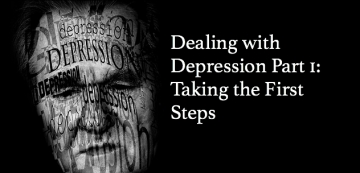
Dealing With Depression Part 1: Taking the First Steps

depression part 1Earlier this summer, I was out running. A few miles into my run, my right hip started to bother me. A little research provided me with a several stretches, which alleviated my discomfort. Further investigation has led me to understand that I need to do core exercises and more stretches, or I can expect further trouble down the line. Pain, like the “check engine” light on a car, lets us know that something is wrong. In this way, pain is a good thing. Without pain we would not know when we sustain injuries that need our attention. Depression is one way our brain lets us know that something is not right. We experience this discomfort and it reveals to us that we are not operating the way we were made to operate, as such, something needs to be attended to. Simply ignoring the problem won’t serve as a consistent, long-term solution, but many people choose to respond to warning signs with attempts to ignore the problem. I knew a young woman who put a piece of electrical tape over the maintenance lights in her car, so that she couldn’t see them and wouldn’t worry about what might be wrong. This is essentially what we are doing when we find ways to ignore what ourbrains are telling us through our emotions.

Unlike automotive problems, which are often much simpler to diagnose and repair, depression can be a more daunting task to take on because it is less cut-and-dry. Emotions tend to be harder to figure out and deal with.  The other challenge in finding the root of persistent depression is the malaise that accompany depression. Symptoms of depression also tend to perpetuate the problem, particularly low energy and difficulty concentrating. These tendencies make it difficult to take the steps necessary to begin climbing out of the hole that depressed people often find themselves in. Because of these difficulties, the first concrete step that must be taken by an individual suffering from depression is acknowledging the problem to themselves and, if possible, another person. Following closely at the heels of this first step is making a decision to deal with the problem. This involves recognizing that there is hope for a better tomorrow and that living with depression doesn’t have to be the norm. God designed us for better and promises comfort for those who hurt. Recognizing that God will help us is valuable because He is the great physician, who is capable of healing us of these hurts. None of these steps is easy. It is difficult, particularly for men, to acknowledge depression because there is a stigma associated with emotional struggles.  Unfortunately, this first obstacle is daunting enough that many suffer in silence, sometimes for years, until they reach the point that their emotional discomfort outweighs the dread of being labeled as personally weak or defective in some way. These labels are unfair and inaccurate, but the stigma remains.

Once the decision to work toward overcoming has been made, the groundwork has been laid for the work toward freedom from anguish to commence.

Tagged , , , , , , , , , , , , , , , , , , , ,

A Boy Named Sue and A Different Point of View on Pain

A Boy Named Sue is one of my favorite Johnny Cash songs. Most people are familiar with the tune, but for those who have never encountered Cash’s humorous song, it tells the story of a man whose father was a worthless drunk who abandoned his family. Just before leaving, the drunk cruelly named his son “Sue.” The monicker brought teasing and mockery from an early age, which forced Sue to get tough, fighting anyone who picked on him. Intent on revenge for his unfortunate name, Sue hunts down his father with murder in his heart. Eventually, Sue finds and attempts to kill his father. Before he dies, Sue’s dad explains that the name was intended to toughen his son up, because he knew he wouldn’t stick around to help him learn to be a man. Sue realizes that as much as he hates the terrible name, it has made him into the man he is. The song ends with Sue walking away with a different point of view, thankful that he learned to fight and win through his difficulty.
I relate the content of the song because, though humorous, it makes an interesting point. Over the years, I have counseled with many people who curse bad parents, lament difficult circumstances they went through at different points of their lives, or rage against God for past hurts. Often, these hard circumstances in their lives resulted in them growing resentful or carrying a grudge. In such cases, I usually point to Johnny Cash’s song. I have never met a person who went through difficulty without growing strong, learning important skills, developing a deep sense of empathy, encountering God in a meaningful way, or developing a deep and abiding spirituality. Often, these qualities remain unnoticed in the individual because they simply accept them as a part of surviving hardship. In reality, some of the best qualities in people develop from going through difficulty. Diamonds are formed with intense heat and pressure and gold is refined with intense heat that burns away impurities. Further, God often uses our areas of brokenness to minister to the needs of others with similar issues. There’s a reason Alcoholics Anonymous is so effective. It’s because God is able to us alcoholics’ past brokenness to help deliver other alcoholics from their addictions. I have spoken to all sorts of believers who have effectively ministered from their own broken past, regardless of what the brokenness in their past is.
imagesThere is an important principal in this. Comfort, a sense of meaning, and purpose for difficulty in relation to hard circumstances in our past can be discovered by recognizing God’s refining us through the pain we experienced, reflecting on the good it produced in us, and reflecting on how our experiences have shaped us into the person that we are. Doing so requires that we learn to take a different point of view in relation to our past. This can be terribly difficult, because hardship often creates bitterness, which tends to blind us to anything positive that may come of unfortunate incidents. It can also be hard because it’s easy to confuse finding positive outcomes with being glad a bad thing happened. We don’t have to be happy that tragedy has been present in our lives in order to recognize how hardship has shaped us. We can be thankful for what we have become without having joy at what made us the way we are. Learning to shift our perspective in relation to past pain can bring great comfort and release. As difficult as it is, it becomes easier to shift our perspective the further displaced we are from the events. This is often the first step toward healing.
Tagged , , , , , , , , , , , , , , , , , , , , , , , , , , ,

Understanding Pornography Addiction

Cycle_of_AbuseIt’s easy to understand how alcohol or cocaine are addictive substances, but when it comes to pornography addiction understanding the issues involved can be more difficult for a variety of reasons. For starters, discovering a hidden pornography habit can result in significant feelings of betrayal for a wife and can make understanding the addiction component very difficult. In addition, pornography use carries some stigma, which clouds perspective and makes understanding the addiction more difficult. However, pornography addiction is a real illness, it’s diagnosable, and it’s treatable. Looking at pornography produces similar brain functions that take place with using cocaine. It is highly addictive for the same reasons as any other drug. This is not to excuse the betrayal of a spouse or anything of the sort. Rather, it is to say that an individual can develop an illness, which prevents them from quitting the behavior. Let there be no mistake, addicts cannot stop a behavior on their own. Denial, thinking errors, shame, and an out-of-control reward response system in their brains literally result in the addictive patterns becoming compulsive.


A behavior is an addiction, rather than just being a set of sinful decisions, if it features certain common qualities:
  1. Increased tolerance– Increased tolerance as it relates to pornography use involves getting into increasingly harder-core porn or much more of it in order to achieve the same results that were achieved with less before. Increased frequency of use can also be associated with increased tolerance.
  2. Withdrawal- Withdrawal from pornography use can involve cravings, restlessness, anxiety, depression, etc. Withdrawal doesn’t necessarily happen instantly. It can take as much as a week or more to fire up.
  3. Continued use despite harm- When an addict recognizes that their addiction is hurting them, they continue to use. They may get caught, feel shame, or other negative effects, but they do not stop, largely because they cannot.
  4. Using more or for longer periods than intended- This is essentially a loss of control. A pornography addict will struggle with limiting their use. They may intend to look for only a few minutes, but then spend hours using porn. Addicts often comment that they are never really sure how long their using episodes may last.
  5. Attempts to control use- Pornography addicts may swear over and over again that they will never use again, but they will inevitably find themselves using again. They may try to come up with ways to prevent themselves from looking at porn, but they will inevitably find ways around these measures.
  6. Excessive time spent acquiring pornography or thinking about using– People who become addicted to pornography find themselves spending more and more time thinking about using it or hunting for new and different porn. This is especially the case for those who are hiding their addiction from family members, which then requires them to spend enormous amounts of time protecting their addiction by hiding it.
  7. Reduced involvement in work, social, or family obligations- Pornography addiction becomes increasingly time consuming as the addiction advances in severity,  withdrawing from obligations as they get in the way of using.

In order to be diagnosed as an addiction, the individual must exhibit three or more of these criteria.

Dealing with the problem is uniquely difficult for pornography addiction for several reasons. For starters, hiding pornography use from a spouse is much easier than hiding substance abuse. As a result, treating the addiction can involve revealing some huge and hurtful secrets. In addition, pornography addiction is far less recognized and exists more in the shadows of our culture. Consequently, there are far fewer support group and treatment options. This is not to say that pornography addiction is a hopeless situation. Dealing with it begins with acknowledging that the problem has gotten out of control and turning control of your life over to God. Seeking help from an addictions counselor, a pastor, or a support group is a good next step. There are several terrific resources available as well. I highly recommend the book: Sampson and the Pirate Monks: Calling Men to Authentic Brotherhood by Nate Larkin. It is the best book I have read on the subject that is written for the average man.

Pornography addiction is treatable and there is hope. Further, as long as the addiction is out of control and untreated, the addict will live with a significant degree of fear and shame. There is also a constant danger of discovery, particularly by any children who live in the home. Early exposure to pornography by a parent is very common among addicts, largely because kids find their way into all sorts of things that you never intend for them to get into. Taking the first difficult steps toward dealing with addiction are difficult, but worthwhile once the painful early stages have been worked through.

For its part, the church needs to learn to look past the inclination to judge, protect the privacy of those seeking help, and learn to offer help to addicts who are seeking help. This may require specialized training and some uncomfortable topics being addressed from the pulpit at times, but its part of our calling to be salt and light to the world.
Tagged , , , , , , , , , , , , , , , , , , , , , , , , , , , ,

UnCommon Sense: Is Your Wisdom Godly or Worldly?

James 3

Everyone assumes that they have common sense and are wise. Recently, I have noticed that self-assuredness is incredibly common in our culture. You see it in memes on Facebook, proclamations that the poster has more sense than the rest of the world. Bumper stickers proudly proclaim the driver’s amazing sense compared to the population at large. At the foundation of many arguments and articles is the assumption that the wisdom drives the position of the author, whereas the other political party’s adherents live with their heads in the sand. This self-assuredness, often without reflection, is spoken of in the book of James. James uses the word “wisdom”, rather than common sense, though the concept is similar. Wisdom is knowledge that translates into action.

James 3:13-18 describes two kinds of wisdom: worldly wisdom and wisdom that is from God. These two kinds of wisdom differ in their orientation and in their results. Noting the results of wisdom is important because in the passages preceding, James writes at length about the tongue and how loosely spoken words can create havoc in the church, comparing these loosely spoken words to sparks that ignite a forest fire. Wisdom is the source of the thinking that drives our words. As such, we can look at the result of our spoken words and get a hint as to what sort of wisdom lies behind them.
2 wisdomWords that create chaos can be easily identified because they breed conflict, anger, and infighting in the body of Christ. Words that create chaos and destruction are likely rooted in worldly wisdom.
Words that make peace tend to spread the gospel, and create unity in the body of Christ.  These are the sorts of things James points to as coming from words that are steeped in Gods wisdom.
The major focus of verses 13-18 is the source and characteristics of worldly and Godly wisdom.
Worldly wisdom: Wisdom that is worldly is self-centered. James describes this as bitter envy and selfish ambition. Both of these are focused on what the individual wants for themselves and the emotional drives that motivate the individual. If the desire to be right breeds misery and anger over others not recognizing the value, rightness, awesomeness, or importance of you or your words, worldly wisdom is at play. The final component described here is boasting, which is essentially bragging over how smart, sensible, or right you   are. Such self-aggrandizing is described as a lie, because it is proclaiming wisdom that isn’t Godly Wisdom. James goes on to describe this sort of wisdom as being essentially the opposite in origin from Godly wisdom. James closes his comments regarding worldly wisdom by pointing out that wherever wisdom is driven by self-interest, you will find sinful behavior and disorder. The fruit of worldly wisdom is chaos.
Heavenly wisdom: Heavenly wisdom is first described as “pure” meaning “not sinful.” If wisdom arises out of any sort of rebellion against God, it isn’t heavenly. He goes on to describe it as peace-loving, considerate, submissive, impartial, and sincere. These qualities essentially point toward heavenly wisdom creating peace and harmony in the body. “Considerate” is best understood as flexible, or not rigid in personal preferences or opinions, something worth considering when a fight breaks out over whether the organ belongs in every song in the worship service. “Submissive” refers to submission to scriptural truth. Wisdom that is Godly essentially takes God’s design as the template for the world. “Impartiality and sincerity” refer to honest, loving treatment of others, regardless of their past, wealth, social status, etc. The final two ways James uses to describe heavenly wisdom are “merciful and full of good fruit.” “Mercy” refers to love for neighbors that translates into action, which consistently produces good fruit.
The final comment James offers on the matter of wisdom is “Peacemakers who sow in peace reap a harvest of righteousness.” Wise people seek peace and plant seeds of peace in the lives of others. The harvest they reap is right relationship with God and their family in Christ.
Self Examination: Earlier in his letter, James urges believers to look at the scriptures as though they were a mirror. We are directed to look at the scriptures and compare our own behavior and life to the ideal. The passage offers a few great pointers regarding what we are to look for in considering whether or not our wisdom is spiritual or worldly. Do we consider our own wants and interests first or those of others and of God? Does our aclick herettitude create chaos and conflict or do we make peace and encourage unity in the body of Christ? The answers to these questions tell us where our wisdom comes from. Most folks are wise in their own eyes, but this is very different from being truly wise.

Tagged , , , , , , , , , , , , , ,

5 Ways for Husbands to Sacrificially Serve Their Wives

husbands 2

Ephesians 5 is perhaps one of the most argued about scriptures in terms of male/female relationships. Arguments over who is in charge, what submission means, who owes who what, whether or not it is even relevant to modern matrimony, and all manner of other junk dominate the landscape of popular discussion of this passage. Interestingly, much of the discussion centers around a philosophical assumption regarding our rights in the marital setting. The question of who is owed what and what are my rights demonstrates something significant about how the discussion is being engaged. Namely, that the discussion is missing the point of Paul’s words. Paul isn’t talking about what each spouse is due. He is explaining how imitating Christ looks in the context of marriage. I’d love it if my wife submitted me, always treated me with respect, and had Proverbs 31 tattooed on her soul, but that is between her and Jesus. My job, and the job of every husband, is to love their wives like Christ loved the church and to prepare her to be presented to God as a pure, spotless individuals.

The specific meaning of this phrase cannot be missed. I cannot look at my wife as a subject, or someone who owes me something. Instead, I need to love and serve her sacrificially. I need to give of myself, selflessly and set aside my own desires for her benefit. Jesus washed his disciples feet to demonstrate the lowness of our attitude of service. In addition, he died for the church. As husbands, our job is to serve and to aid our spouse in spiritual growth. We are to help our wives become Christlike. If we spend time concerning over her responsibilities and what she owes us, we cannot fulfill this directive. Such thinking runs counter to it. This raises an important question of how do we follow through with this in a concrete way. I, like most men, like “to do” lists and concrete directives. Its easy to act when we know what we are supposed to do. Here are 5 things I have come up with for selflessly serving our wives:

Maintain our own spiritual health. The reality is that this is a humanly impossible task. People are naturally self-centered and selfish. Giving of self is not gonna be our strength for the long term. God understands this and makes a way for us through his Holy Spirit working in our lives. This is not instant, it requires spiritual growth. A decent place to start is reading about Jesus and talking to God. We must grow if we are to love and lead our wives.

Lead spiritually. Leading spiritually begins with praying for our wives. This is a daily task that prepares us to sacrificially love them. Worshipping with our wives is another important part. Far too often I see wives who bring their kids to church while husbands sleep in on Sundays. Leading spiritual growth in the family requires participation in the spiritual practices. A final component worth implementing is leading the spiritual development of the family through study, discussion, and family prayer.

Doing chores, without ulterior motives. Finding things that need to be done and doing them is service. Changing toilet paper rolls, doing laundry, bathing kids, or any other chore efforts are concrete shows of love and grace. It’s important that as these are taken on, it is with a heart of service and not in an effort to receive a reward. I cannot tell you how many men I have spoken with, who are frustrated when they do dishes, vacuum, or undertake any other household chore only to be angered when their wives don’t amorously reward them for their efforts. I’ll admit that I am guilty of this too. Serving selflessly means not seeking reward. Its a gift, not a job done in search of a reward. Wives aren’t stupid, they generally see through these ploys. Further, it ruins the blessing we bestow in our act of service. Selfless is the watchword here.

Giving them time away. It is easy for wives to feel overwhelmed by the constant demands that are made of them. This is particularly the case when kids arrive, because their demands on mommy’s attention can be nearly constant. I’ve found that one of the best acts of service I undertake is letting my wife nap or spend time to herself. Taking the kids to the park or out for an evening is one way. There are all sorts of others, like taking care of chores so she has no pressing concerns or planning time away from the house.

Courting her. After marriage it is so easy to stop romancing our wives. We don’t need to convince her to marry us, so we stop buying flowers, taking her out for dinner, talking for hours, listening to her share her feelings, hugging, kissing, holding hands, etc. There are many ways to demonstrate affectionate attention that show her how important she is to you. There is a caveat here. If these things are always done with selfish motives and in an effort to get her to reciprocate physically, it will ruin the whole thing. I’m not saying that sex isn’t important to marriage. Rather, that selflessly serving is just that. Shifting service and affection from being a gift we give to a commodity we trade is sort of the antithesis of Christlike behavior.

This is a brief list. It is by no means all encompassing. Its purpose is to get your brain moving in the direction of how to serve. The biggest key is doing it with right motive, which is a product of prayer and the Holy Spirit working in us.

Tagged , , , , , , , , , , , , , , , , , , , , , , , , , ,

6 Ways to Deal with Anxiety

Timageshis afternoon, I was sitting in the pharmacy in town reading. Something that I read, which was minor and not offensive, triggered an anxiety attack. Anyone who has ever had an anxiety attack can attest that they are no picnic. Typically, mine begin with my heart racing, my chest tightening, my brain shifting into high gear, jaws clenching shut, and my breath shortening. Sometimes these anxiety attacks pass quickly, but sometimes they leave me agitated for hours. I don’t have these attacks often, perhaps once a month or less, though in the past I’ve had them daily. Most folks I know who experience them recognize them as a little slice of hell.
Learning to deal with anxiety attacks has been a slow process. I tend to approach problems by wanting to know as much as possible, so I’ve researched the topic to death and have found that most materials are less than helpful. Through trial and error, I have found a handful of things that make a difference. Here is my top 6 and one to avoid:
man-114437_640Recognizing that anxiety is not the same thing as being crazy. The stigma associated with these sorts of issues can often be the biggest challenge that prevents you from dealing with the issue. Anxiety is not craziness. Anxiety attacks can be connecting to a handful of things. Often they are connected with the fight or flight mechanism in your brain. Certain stimuli become associated with the fear/fight or flight response and trigger it. That’s all. It’s actually a natural defense mechanism that part of your brain employs to protect you from danger. It’s just sometimes that mechanism is terribly inconvenient.
Exercise: Very little ends an anxiety attack for me as quickly as quickly as lifting weights, going running, or even going for a brisk walk. There are a few reasons that this is an effective strategy. For starters, exercise triggers the release of endorphins, which are a sort of happy chemical in your brain. Endorphins will usually calm you and lift your mood. Regular exercise can actually help alleviate depression and decrease the frequency of anxiety attacks. The other thing that exercise does for you is physiological. Getting your heart rate up and using energy can burn off some of the nervous energy that causes anxiety attacks. Further, heavy breathing can help cleanse adrenaline and other chemicals from your blood.
Prayer, meditation, and deep breathing: I hate this one. Not because I hate prayer, meditation, or deep breathing in and of themselves. Rather, I wonder if the guys suggesting it have ever had an anxiety attack. It’s really hard to stop and be calm enough to pray or meditate. In general, however, regular prayer and meditation can help decrease the frequency of attacks. This is particularly the case when individual people or situations are triggers for anxiety attacks. Praying for those people can help lessen fear of dealing with them. In addition, learning to slow down and focus during anxious episodes, though difficult, can be effective. I suggest starting with deep breathing. It’s the easiest place to begin and, as I stated earlier, can help lessen symptoms. From focused breathing, prayer or meditating over scripture is a short step.
w8ytvvDiet: I have read that decreasing caffeine consumption can decrease frequency of anxiety issues. I’m not sure if giving up coffee would be worse than the attacks, so I have’t tried. I take fish oil pills, which research suggests can help reduce anxiety and encourages the production of serotonin.

Exposure: I’m gonna say it: this one is miserable, but can be effective. If a particular identifiable trigger causes anxiety attacks, you can actually decrease its impact on your by slowly exposing yourself to the stimuli in small doses. As you do so, you will eventually harden yourself to the trigger. For example, anxiety that is triggered by certain social situations can be lessened by increasingly exposing yourself to those situations. Doing so will slowly decrease the fear response. It’s essentially facing your fear. There are ways to do this more effectively, and a counselor might be helpful to guide you through the process.
Counseling and Medication: Unfortunately, the stigma associated with seeking help from a counselor often prevents folks from talking to them until the pain associated with anxiety becomes overwhelming. A good counselor can help a client learn skills that can effectively help a person cope with or eliminate anxiety issues or deal with the emotional issues that are at the root of the matter.
Self Medicating: Folks who suffer from anxiety problems sometimes resort to self medicating with alcohol or illicit substances. While alcohol can alleviate symptoms of anxiety, this approach is problematic because using mood altering substances as a primary coping response can lead to dependency. In general, developing a lifestyle that lessens their frequency and learning to cope with anxiety is a better strategy.
Tagged , , , , ,

5 Principles for Disciplining Children

10362863_10152240653161599_2278280600722933084_n  The day after my daughter’s second birthday, something crazy happened. My sweet little princess almost instantly transformed. She went to bed a cute ball of sugar and cuteness. She woke up the next day a tiny tyrant, complete with temper tantrums, stomping and screaming, throwing herself on the floor, and occasionally pulling handfuls of hair out. I haven’t figured out what caused the change, I’m pretty sure there was something in the cake. The terrible twos had begun and there was no going back.

I’ll admit that deep down I wonder if she will grow out of it, or if I will raise her into one of those adults who throws tantrums at the grocery store because the line is too long. This shift has prompted a number of discussions between my wife and I on the matter of proper discipline. We don’t always agree on the right way to discipline, but we agree that correction is important to raising a child who has learned how to live and act properly. Here are some of the basic concepts that come into play in our discipline strategy.

Discipline is an act of love. As tough as it seems, discipline is a loving response to incorrect behaviors. The author of Hebrews points this out.

And have you completely forgotten this word of encouragement that addresses you as a father addresses his son? It says, “My son, do not make light of the Lord’s discipline, and do not lose heart when he rebukes you, because the Lord disciplines the one he loves, and he chastens everyone he accepts as his son.”   Hebrews 12:5-6

God demonstrates wise parenting by redirecting behaviors to change the direction of those he loves. Discipline turns us from decisions, behaviors, and attitudes that could potentially cause us great harm. Ignoring destructive behavior or responding in a manner that is inadequate to change the behavior may feel nicer than punishment, but it brings more pain when ingrained behaviors need to be relearned later.

IMG_2431Discipline is best when it instructs. One of the clearest memories I have of being disciplined as a child was that it was always followed by my parents sitting with me and explaining the purpose for the correction and basic instruction on how to behave.

Discipline must be proportional. There is a hard balance to manage with children and discipline. Micromanaging a child crushes them. Responding to minor infractions with huge punishments is out of proportion and will only result in either a crushed sense of independence or resentment. The real objective is a chance of direction. Paul presents this idea in the household code he included in his epistle to the Ephesians.

Fathers, do not exasperate your children; instead, bring them up in the training and instruction of the Lord.  Ephesians 6:4

Discipline must be timely. Discipline must be clearly associated with the behavior for it to be effective. The age of a child is important to take into account when determining timely discipline. A 3-year old doesn’t do as well associating consequences with behaviors the further apart they take place. Correcting a toddler for behaviors that took place a week ago simply won’t be effective. They don’t think that way. Teenagers, on the other hand, are a little more mentally advanced and can associate consequences with actions that are a little more removed. Another important component of timeliness is the emotional state of the child at the time of correction. It always makes me scratch my head when I watch a parent trying to reason with a child in the middle of a full tilt tantrum. Tantrums are the point where thinking isn’t going to happen. Period. Instruction at this time will not correct the behavior.

IMG_0912Consistency is key. Children are keenly aware of how you are going to respond. They know if they can get away with things because you aren’t going to respond. Further, sending mixed messages will only confuse them. There is a degree to which discipline is classical conditioning. Inconsistency will undermine the conditioning component. If you make a threat of punishment and don’t follow through, you will have more trouble in the future. If parents are openly divided on discipline issues, the child will recognize it and figure out how to work the division to their advantage. It’s necessary to figure out your approach and stick with it.

Remember that you love your kid. When your child picks the worst possible moment and way to act out, it’s hard to remember that you are responding out of a desire to correct their behavior so they will be successful adults. Kids have an innate skill for driving their parents nuts. The only reason they can do this is because they are so precious to us. When other people’s kids have tantrums, I don’t pull my hair out the same way I do with my own. It’s harder because we love them.

Tagged , , , , , , , , , , , , , , , , , , ,

Dad’s Rest Day: 5 Basic Rest Realities

935835_10151451295271599_1447668726_nIt’s Sunday afternoon. My wife and daughter are at a baby shower. My son is taking his standard, extremely long, post-church nap. My standard Sunday afternoon counseling appointments all cancelled for the day. No family, no work, no honey-do projects. I don’t have anything I HAVE to do. I am in the strange position of having no seriously pressing obligations, apart from some writing I’d like to get done, which I could reasonably do tomorrow. Because of the odd demands of being a small town, small church pastor I work most days. When I am not working, I am being a dad or a husband. I am not complaining about these things. I love them. The real trick is that I don’t often take time to rest because I am so busy being busy.
Rest is a need that is built in to all of us. We need to stop and breath periodically. It’s so important that God requires that we rest in the 10 Commandments. We are literally commanded to take time to rest and spend with God. Rest is important because it gives time for our souls to recharge. We need to discharge our stress and be replenished by God in order to continue to be sharp. I often talk to folks who struggle with keeping their spiritual fervor active and vital in their lives. In every incidence of this struggle, the folks in question don’t take time to rest and be intimate with God. Really problematic is the sad reality that, in many cases, we have forgotten how to rest and recharge, instead choosing to always zone out and escape. Over the years, I have learned a few things about rest, largely because I don’t slow down all that much.

UnknownRest is more than shutting off:
 Rest isn’t just napping in the hammock, though that’s one of my favorite leisure activities. Rest includes, among other things, mindless detached time, investment in relationship for the purpose of refilling personally, time spent with God for the purpose of maintaining spiritual health and peace, and times of reflection and quiet. Each of these components has a place in rest, though for many the detachment of TV time has become the sole focus or rest.

Rest needs to be regular and intentional. If you are not naturally inclined to slow down and take it easy, it is necessary to be intentional about resting weekly. It’s no coincidence that the Bible directs us to take a Sabbath day of rest. If we run too long, we wear out. Once a week is an appropriate interval for resting, though down time on a daily basis is good if you can manage it.

Time with God is important! One of the major components of rest is time spent with God, praying, meditating, worshipping, or reading His word. This is important because we were designed to be in relationship with God. Maintaining intimate relationship with God is vital to maintaining our spiritual vitality. It’s a little like  tuning up a car. The car may continue to run if it’s not tuned up, but it won’t run right. We are similar. We may be able to maintain our spiritual lives without regular visits with God, but we won’t run as well. Eventually, a lack of regular maintenance will result in breakdowns.

It’s important for men to spend time with other men. It’s pretty common for men with careers and families to fall off from interaction with other guys. However, men challenge each other to excellence in ways that really doesn’t happen in other relationships. It’s worth noting that this time needs to be significant. Many men have only surface relationships with each other that never delve any deeper than opinions on sports or politics. Deeper personal connection is important. This is somewhat taboo in our culture where guys are encouraged to be unfeeling and as deep as most kiddie pools. The reality is that deeper personal connection leads to recharging and growth in ways that simply does not happen in other relationships.

Family time is important. Spending leisure time talking and playing with family is an important component of rest. Family relationships are central to a man’s life and occupy a center point in his relationship sphere. Spending time with family playing and enjoying the relationship is a big deal. This needs to take place as a whole family and also with spouses only, because the marital relationship ought to be the source of significant relief as well. This is a big deal because family relationships can often be a source of enormous stress due to obligations and responsibilities. Without leisure time, it’s easy to grow resentful of the personal toll that accompanies family obligations. Intentional rest together can fall to the wayside in this sort of environment.
Tagged , , , , , , , , , , , , , , , , , , ,