
A Boy Named Sue is one of my favorite Johnny Cash songs. Most people are familiar with the tune, but for those who have never encountered Cash’s humorous song, it tells the story of a man whose father was a worthless drunk who abandoned his family. Just before leaving, the drunk cruelly named his son “Sue.” The monicker brought teasing and mockery from an early age, which forced Sue to get tough, fighting anyone who picked on him. Intent on revenge for his unfortunate name, Sue hunts down his father with murder in his heart. Eventually, Sue finds and attempts to kill his father. Before he dies, Sue’s dad explains that the name was intended to toughen his son up, because he knew he wouldn’t stick around to help him learn to be a man. Sue realizes that as much as he hates the terrible name, it has made him into the man he is. The song ends with Sue walking away with a different point of view, thankful that he learned to fight and win through his difficulty.
I relate the content of the song because, though humorous, it makes an interesting point. Over the years, I have counseled with many people who curse bad parents, lament difficult circumstances they went through at different points of their lives, or rage against God for past hurts. Often, these hard circumstances in their lives resulted in them growing resentful or carrying a grudge. In such cases, I usually point to Johnny Cash’s song. I have never met a person who went through difficulty without growing strong, learning important skills, developing a deep sense of empathy, encountering God in a meaningful way, or developing a deep and abiding spirituality. Often, these qualities remain unnoticed in the individual because they simply accept them as a part of surviving hardship. In reality, some of the best qualities in people develop from going through difficulty. Diamonds are formed with intense heat and pressure and gold is refined with intense heat that burns away impurities. Further, God often uses our areas of brokenness to minister to the needs of others with similar issues. There’s a reason Alcoholics Anonymous is so effective. It’s because God is able to us alcoholics’ past brokenness to help deliver other alcoholics from their addictions. I have spoken to all sorts of believers who have effectively ministered from their own broken past, regardless of what the brokenness in their past is.
 There is an important principal in this. Comfort, a sense of meaning, and purpose for difficulty in relation to hard circumstances in our past can be discovered by recognizing God’s refining us through the pain we experienced, reflecting on the good it produced in us, and reflecting on how our experiences have shaped us into the person that we are. Doing so requires that we learn to take a different point of view in relation to our past. This can be terribly difficult, because hardship often creates bitterness, which tends to blind us to anything positive that may come of unfortunate incidents. It can also be hard because it’s easy to confuse finding positive outcomes with being glad a bad thing happened. We don’t have to be happy that tragedy has been present in our lives in order to recognize how hardship has shaped us. We can be thankful for what we have become without having joy at what made us the way we are. Learning to shift our perspective in relation to past pain can bring great comfort and release. As difficult as it is, it becomes easier to shift our perspective the further displaced we are from the events. This is often the first step toward healing.
 It’s easy to understand how alcohol or cocaine are addictive substances, but when it comes to pornography addiction understanding the issues involved can be more difficult for a variety of reasons. For starters, discovering a hidden pornography habit can result in significant feelings of betrayal for a wife and can make understanding the addiction component very difficult. In addition, pornography use carries some stigma, which clouds perspective and makes understanding the addiction more difficult. However, pornography addiction is a real illness, it’s diagnosable, and it’s treatable. Looking at pornography produces similar brain functions that take place with using cocaine. It is highly addictive for the same reasons as any other drug. This is not to excuse the betrayal of a spouse or anything of the sort. Rather, it is to say that an individual can develop an illness, which prevents them from quitting the behavior. Let there be no mistake, addicts cannot stop a behavior on their own. Denial, thinking errors, shame, and an out-of-control reward response system in their brains literally result in the addictive patterns becoming compulsive.
 Several months ago, my wife and I ran in the Montana Spartan Race, a 5-mile obstacle course race. I ran in the race last year and initially signed up again to try to beat my time. My wife signed up as well and we both set out to prepare for event. About halfway through the training process, my wife asked me if I would run the race with her. My initial response was “no.” I had set out with a goal and was quite intent on achieving it. Running with my wife would not likely make my goal reachable. As time passed, I began to reflect on this decision in relation to my job as a husband. Ultimately, I realized that the decision came down to whether it was better to try to accomplish my own goals or to help my wife reach her goals.
 There is a line in Ephesians that talks about the idea that husbands are the head of the wife as Christ is the head of the church. Many folks have read this as meaning that men have the right of dictatorship in their marriage. I would argue that to understand the passage in this way is to ignore the context. Scripturally, Jesus’ role in relation to the church is that He dies for it. Jesus demonstrates leadership by serving. He lives out the attitude He has toward the church when He washes his disciples feet at the last supper, literally doing the job reserved for the lowest servant in the household. Jesus instructs His followers to emulate His attitude. If this is the attitude of the head of the church and the Bible says that husbands are to emulate the head of the church in relation to their wives, then it follows that husbands ought to have an attitude of service and humility in relation to their spouse. This attitude of service is rooted in love. Further, it is an attitude that is aimed, not just toward serving, but toward preparing the church to be found holy and sinless before the Father. Jesus’ ultimate act of service is to offer his life as a sacrifice from the sins of the world. Certainly no husband can imitate that example, but husbands can live their lives to help their wives grow into the sort of clean spotless bride they were designed to be.
 I would argue that this is not an easy task for husbands. Men are hard-wired to strive for accomplishments and to compete. Even further than this, our culture highly values accomplishment and success. These are not inherently bad things. They can be negative if the accomplishments and measures of success are misaligned. The Bible presents the idea that the greatest among Jesus’ followers are those who happily assume the position of the least and the servant of all. For husbands and fathers, this is the path assigned to them by the scriptures. We are to serve our families and sacrifice of ourselves for their benefit. We are to help our families grow personally and spiritually.
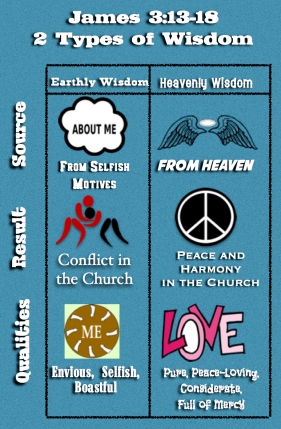 Words that create chaos can be easily identified because they breed conflict, anger, and infighting in the body of Christ. Words that create chaos and destruction are likely rooted in worldly wisdom.
 ttitude create chaos and conflict or do we make peace and encourage unity in the body of Christ? The answers to these questions tell us where our wisdom comes from. Most folks are wise in their own eyes, but this is very different from being truly wise.
 While watching my kids play at the park yesterday, my daughter came running to me from under play structure, crying and rubbing her forehead. She had bumped her head on the underside of of the fire engine jungle gym. A hug, a kiss on the forehead, and and a few comforting words later, she was running around again. The most natural response to my little girl’s feeling pain, is offering comfort and doing the best I can to make it better. This is a natural response for parents. Protecting our children is programmed into our DNA. The most natural thing in the world is to hurt when our kids hurt and to try to fix it. Unfortunately, as time goes on, this instinct can get in the way of healthy development into adulthood. There are times when parents need to reign in their instinct and allow their children to struggle or hurt sometimes because its whats best for them.
 then the natural consequence is a poor grade. All too often, parents see their child panicked the day before, and bail them out. At times this involves doing the work for them or calling them in sick for school the next day. These situations are teachable opportunities. Parents must decide if they will teach their child that someone else will always be there to bail them out, or if they will learn the hard lesson: “If you don’t do the work, you will fail.” This is one example, but of a huge area of teaching. If you watch people long enough, you will witness parents who attack teachers because their kids aren’t getting A’s, or demanding their kid gets to play a starting position on the soccer team, or any other situation where a parent shields their child from the consequences of their actions or failures. I’m not saying that helping your kid deal with consequences isn’t okay sometimes. Rather, I am saying that protecting them from everything teaches them to be sheltered.
 After 16 years of marriage, my wife and I have noticed that it has become easy to fall into a rut with the time we spend together. For example, since the kids came along we have had begun doing the “grocery store date”, which involved going out for dinner, then going grocery shopping. This date pattern came about for fairly obvious reasons. It’s easier to go to the grocery store without the kids. If we already have a babysitter, why not have an easy night of buying groceries? On the plus side, it meets the basic requirement of spending time alone together. The problem is that this outing isn’t particularly exciting and is really just doing home maintenance without the kids along. Dating your spouse should be about enjoying each other’s company and spending quality time together, unfortunately its easy for it to devolve into an obligation or routine.Because of this, we have put effort into coming up with new and novel activities to engage in on date nights that shift us out of our rut. Here are a few of our favorites:
 reflect something that you think your spouse might find interesting, something that is a sort of project or activity work on together, or anything else that might spark conversation. Afterward we spend time talking about why we picked the book we picked and our reactions to the book we received. The important part of this game is spending time talking about it afterward and sharing reasons for picking the book. It can be adapted to other settings if you aren’t a reader. The game can be played in a mall or almost anywhere else.

 Discipline is best when it instructs. One of the clearest memories I have of being disciplined as a child was that it was always followed by my parents sitting with me and explaining the purpose for the correction and basic instruction on how to behave.
 Consistency is key. Children are keenly aware of how you are going to respond. They know if they can get away with things because you aren’t going to respond. Further, sending mixed messages will only confuse them. There is a degree to which discipline is classical conditioning. Inconsistency will undermine the conditioning component. If you make a threat of punishment and don’t follow through, you will have more trouble in the future. If parents are openly divided on discipline issues, the child will recognize it and figure out how to work the division to their advantage. It’s necessary to figure out your approach and stick with it.

 Attempting to sustain our happiness through temporary means produces the same result in our soul. We scratch the itch over and over again, only to find that the practice changes us. It leaves us emptier than we were when we started. The reason that this pathway to happiness can never work is because it is an attempt to fill an emptiness in the soul. Philosopher Blaise Pascal describes it as a void that God had intended to occupy. Everyone has it. The problem is that only God can properly fill it. We can mask the emptiness with possessions, experiences, or alcohol, but in the end, it always comes back. Paul wrote in his letter to the Philippians that he had learned the secret to living in any circumstance, whether he was poor or rich, hungry or well fed. It’s worth noting that he wrote this while sitting in a maximum security prison facing the possibility and being executed for preaching about Jesus. He still was able to point to a contentment that was not based on his experience. That contentment was found in his relationship with Jesus and the hope he had for eternity with Christ. Paul relied on God for all of his needs. He recognized physical discomfort as a temporary condition that would pale in comparison to heaven. When he was hungry or in pain, he looked to God for context and relief. Ultimately, this resulted in Paul becoming the sort of person that could be content and joyful no matter what befell him. This lasting joy stands in stark contrast to the temporary satisfaction we feel when we get a new toy, eat a delicious meal, or go on a stellar vacation. Even more impressive is that this lasting joy is free and available to anyone who would simply choose to engage in relationship with Christ.
 Patching Cracks