 The city of Butte Montana is built over a mine which had been on fire for over twenty years. This was not a roaring blaze, but rather a smoldering fire that simply kept burning year after year. The fire was accidentally set by a fellow named Henshaw, who left a candle burning unattended on a pine beam. The beam caught fire. The fire spread to other beams and kept burning for decades. This is at least partially due to the miners managing to deprive the fire of oxygen, which kept it from burning out of control but also prolonged the burn.
As the holidays approach and family gathers to celebrate, it is often the case that old smoldering resentments can flare up and create chaos in their wake. Similarly, small disagreements can quickly spread and get out of control. Both of these possibilities are increased during holidays because of the stress rising from increased financial pressures, stress related to having guests or traveling, and the addition of new chores to already-busy routines. These flare ups can ruin meals, holidays, and even families.
Be conscious of the folks who make you angry: The surest way to avoid this potentiality is by being conscious of what needs to be done in order to prevent fires. For starters, it is necessary for folks to be aware of their own stress levels, particularly when spending time with folks who tend to push buttons, whether consciously or unconsciously. Self-awareness leads to an increased ability to avoid conflict.
Be quick to apologize and let things go: Often, conflicts that arise keep going because everyone involved holds tight to resentment. When people in conflict dig in and refuse to budge or demand apologies for slights, resolution becomes impossible. Finishing the fight often means someone has to let go and say sorry. This may feel like losing, but its far better to lose a little face in the name of harmony than becoming entrenched in bitterness or ruining family time together with pettiness. Pairing the aforementioned self awareness with a willingness to apologize first for any negativity will quickly smooth over most problems.
Knowing the right way to respond: Years ago, a pastor I worked with gave me a guide for the next step for dealing with flare-ups when they arise. The pastor told me that everyone has two options when they encounter the beginnings of an angry exchange. It’s like having 2 buckets, one in each hand. A gas bucket and a water bucket. When we see a fire, we have a choice to make as to which bucket we will throw at the blaze. Our gas bucket will spread the flames with a vengeance. This is like encouraging gossip or answering insult with angry words. Throwing your gas bucket at the wrong time can result in a fire that will go in forever. If we choose to throw the water bucket, we squelch the fire before it spreads. Throwing the water bucket looks like an apology or quieting gossip or simply saying nothing in response to a slight.
The book of James compares the tongue to a spark that can cause fires that burn up people’s lives. James goes on to say that the tongue is so tough to tame that it usually just tames us. This effort to intentionally throw the right bucket when people upset you is far from easy. It takes effort, forgiveness, prayer, and a great deal of intentionally planning to respond the right way. This effort may seem like a headache, but it is worth it to avoid living over 20 years of smoldering fires in the form of family conflict.

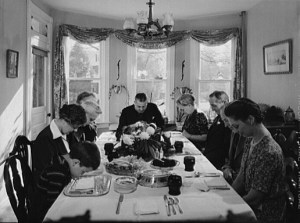 In 1863, President Lincoln declared the final Thursday in November the official Thanksgiving holiday. While Thanksgiving had been celebrated irregularly for several hundred years, it was not an official holiday in the United States and was not annually celebrated until this point. It is significant that Lincoln chose to establish the holiday in 1863 because the American Civil war had been raging for several years. Hundreds of thousands of Americans were dead, the United States was united no more, the nation lay in shambles, and it appeared as though the North wouldn’t win the Civil War. To top it off, Lincoln’s son had died less than a year previous. It was in the midst ofone of the darkest points in American history, and certainly Lincoln’s own life, that he declared that Americans would dedicate a day to thank God for the blessings that they had received. This is a powerful testimony to the degree of faith and dedication Lincoln had toward God. It is also an attitude that is difficult to muster during times of tragedy.
 It is tough to stop and say thanks for what God has given you when everything seems to be falling apart. Often, disaster prompts people to turn and ask: “Where is God in all of this difficulty?” or “Why Doesn’t God do something to fix this for me?” Lincoln offers us a terrific model for our attitudes toward God in times of trial. This attitude can seem almost superhuman, and certainly unattainable for normal people. I’d suggest that this is probably the case. But, while it may be impossible for men to be thankful in all circumstances, it is certainly isn’t impossible for God to create an attitude of thanks in man’s heart. I’d argue that this is a product of intentional effort and practice, that God aids us in accomplishing.
 The world of publishing has witnessed an interesting phenomena over the last few years. Sales of print books have slumped in almost every category as ebooks sales have surged. The only arm of book printing that has experienced growth over the last several years has been in the area of self-help. Self improvement book sales have defied the trend in the industry by experiencing a boom. Between books on weight loss, ways to improve your marriage, methods for overcoming depression, improve your career standing, and all manner of other do-it-yourself-to-yourself books; Americans are still buying. In our self-obsessed culture, feeling bad or inadequate is simply unacceptable. This has prompted a veritable gold rush of publishing in this area. The world of Christian books has not missed out on this trend. “Christian self-help” books are extraordinarily popular. I include quotation marks because far too often these books are simply christian flavored versions of their secular counterparts. Rather than being a distinct worldview, self-help Christianity has a tendency toward nearly identical in approach with bible verses attached to the ideas at strategic locations. At issue isn’t the notion of working to improve our health, emotional wellbeing, income prospects, or anything else we feel discontentedness toward. The issue is related to a basic philosophical incompatibility that exists between Biblical Christianity and most self-help approaches to the world.
 My kids spent last weekend on a ranch in the foothills of the mountain range near our town. The ranch is the home of one of the elders from my church and his family. The kids love spending time there chasing cows, riding horses, feeding chickens, and doing all the other things they do on the ranch. With the children away for a couple days, my wife and I were free to take a weekend away mini-vacation. We spent the night at a bed and breakfast situated in a ghost town; we then spent the day christmas shopping; and finally spent a night at home alone together. We do these mini-vacations twice a year, and have found that they are a perfect opportunity to spend time together, focusing on each other. We love our kids, but they demand a great deal of attention. I don’t begrudge them that attention, and in fact, feel that it’s our duty as parents to love our children and meet their emotional and relational needs. The challenge that comes with meeting the hefty attention and emotional needs of children is in maintaining a healthy relationship with each other. It’s easy for the marriage to go on the back burner when you’ve got kids to attend to. I’ve written several articles on the importance of date nights. The mini-vacation is a step beyond date night. It’s taking a day or two away to be together, alone. I know couples who haven’t spent days alone together in years, since they were first married, because of the demands of parenting. My wife and I agreed that keeping our relationship vital was good for us and for the kids, so we are intentional about planning these overnight dates a couple times a year. The trick is that it’s not an instant success. Weekends away need to be approached with appropriate expectations and with a degree of careful planning to ensure their success. Here are a few things we have recognized and learned from our experiences:
 Make Careful arrangements for Your Children: As important as the time together is, your first responsibility is for the safety and care of your children. The plans you come up with for their care need to be carefully considered. They need to be comfortable with the arrangement. The person watching them needs to be responsible and knowledgable in caring for kids. There needs to be plans in place in the case of an emergency, and you need to plan for their care and comfort. Family is ideal for this sort of arrangement, particularly grandparents. Another possibility is utilizing a sitter. I know couples who take turns watching each others children to support date nights. Taking turns with another couple watching watching kids is another way to make the weekend away possible.
 It probably won’t fix the problem for good. It may help, but you’ll likely still need to work at it. Another way that realism is important is in the area of romance. Wives, frustrated with their husband’s lack of romantic efforts, may not find that their husband is instantly transformed into Don Juan. Husbands who are looking for their wives to suddenly have a supercharged libido, may wind up frustrated. In both cases, unrealistic expectations can sour the weekend. Both of these problems are best dealt with through communicating with each other about the frustrations. The best plan is to be realistic and have realistic expectations about your time away.
 One of the biggest blessings I have experienced during my 2 years as a small town pastor has happened during my visits to the local nursing home. While there, I have met several married couples who have been together for decades longer than I have been alive. I have enjoyed watching couples eat together and spend time visiting. I am inspired by these folks and aspire to be together with my wife decades after we both said “I do.” To this end, I have been reading about the difference between couples who divorce and those who remain married for years. One of the interesting tidbits I came across in my reading was related to a decades-long study observing married couples. This study produced an interesting revelation regarding communication between spouses. Couples who exchanged insults or harsh words 5 out of every 100 verbal exchange tended to not divorce. If you increase the number of disparaging remarks to 10 out of every 100 exchanges, the likelihood of divorce increased dramatically. It hardly seems like a big deal, but careless words can take a toll on any relationship. Perhaps this is more so the case with marriage because husbands and wives make themselves vulnerable to each other as a part of their intimate relationship. In that setting, it doesn’t take much to wound each other significantly. The book of Proverbs makes a great comment on this matter: “The words of the reckless pierce like swords, but the tongue of the wise brings healing.”
 Early in my career, I worked at a facility for children with emotional disorders. We provided services for children ranging in age from 8 to 18. Many of our clients came from juvenile detention and it wasn’t unusual for them to have received little parental discipline or direction. One of the major challenges of the job was getting our adolescent clients through their everyday routine without major blowups, violence, or even having them just sit down and refuse to do anything at all. This was particularly challenging when it came to doing chores, going to school, and going to bed on time. During the first few months at the agency the training regimen is excessive, between behavior intervention techniques, therapeutic crisis intervention, and basic relational techniques. During that time I learned a grab bag of techniques for convincing kids to follow directions or to stop acting badly without resorting to physical intervention. As a parent, I’m increasingly discovering how useful these techniques are in raising and disciplining my own children. Having options when it comes to kids is great because they can be incredibly frustrating. Being able to choose an approach gives you a sense of control that can feel like it’s in short supply when you have only one or two approaches. The following are the interventions that I have found most useful in parenting:
 Planned Ignoring/Positive Attention– This technique is based on the assumption that kids sometimes act out in an effort to get your attention or to get you to act in a particular way. Simply put, you do not reward undesirable behavior at all. You don’t cater to it or even acknowledge it. When they do what you want, you lavish praise and attention on them. One of the most obvious examples of this is the temper tantrum. Every morning I dress my 3 year old daughter and take her to work with me. Since she reached the age of 2 she has begun to disagree with me regarding the right wardrobe choices. This sometimes results in a fit of screaming and carrying on. Since it’s in my own home, I’m under no pressure to engage it. So, I usually walk away and let her yell. When she realizes that it’s not working she stops. On the other hand, when she asks for different clothes appropriately, I praise her and listen to her opinion. This approach works best with annoying behaviors when there are no time pressures. It essentially allows the child to figure out that what they are doing isn’t working. If they have a fit in the middle of the grocery store, ignoring it isn’t the right choice. If they are playing with knives, ignoring it is a bad idea.

 I take my daughter with me to the office every day. She goes on nursing home visitation with me. Sometimes she goes with me when I visit parishioners in their homes. She spends about 8 hours of every day with me. Unfortunately, there is a difference between time when she is playing with dolls in my office while I work and quality time. I’ve spent some time in previous posts discussing daddy-daughter date nights and tea parties. Those sorts of activities are great, but tend to be spread out. It’s important to spend time with your kids daily. I encourage dads to try to spend at least an hour with their kids daily, just focusing on them. This sort of invested time is important to children and will impact them well into the future. This time investment may seem difficult, but I’ve discovered that it’s all about how you spend the time. It’s easy to look at an energetic kid at the end of a long work day and cringe at the thought of trying to keep up with them for 5 minutes, let alone an hour. Or to look at your daughter’s Frozen dolls with horror at the thought of reenacting a few of the dance numbers. However, there are a few tricks that work well for making the time more enjoyable for both you and your child.
 Focus on the Big Picture– Everything is about the mindset you bring to it. It’s important to remember that the time you are spending is an investment in the life of a person you love and who loves you unconditionally. That investment will help shape their sense of self worth, confidence, and your influence on their values and beliefs. Further, your child is also a child of God, one who you are preparing for a life of knowing Him. Part of how they perceive God will be shaped by their relationship with you. This isn’t time wasted when you’d rather be unwinding. It’s time spent on a job that is far more important than the one you get your paycheck for doing.
 Be Creative- I recently found myself playing with my daughter’s frozen castle and toys on the living room floor. I cannot stress enough how little interest I have in princesses. Rather than phoning the time I was spending with her in, I took out some batman toys I had picked up during one of our trips to the comic books store. Before long, Batman was saving Elsa from the Joker. There was fighting and adventure and princess stuff. She loved the silliness of it, though I suspect that my enthusiasm and energy was what she really appreciated. Kids like being the center of their parents’ attention. Bringing a little creativity to the table is important for making sure that you are able to enjoy the time as well. Don’t hear me saying that spending time with your kids is dull or that it’s all about you. What I am saying is that adult men don’t necessarily enjoy the same activities as small children. Bringing your own interests into the mix can raise the entertainment factor and make it easier to consistently put the time in every day.
 Pay attention to them– Kids catch on pretty quickly when you aren’t interested in what they are doing. If you sit and surf the internet on your phone while you play with them, they’ll notice. If you ignore the stories they tell you, they’ll catch on. It won’t make them hate you. It’ll adjust where they think they land on your priority list. While you are giving the time they are getting from you, give them your undivided attention. Ask questions. Tell them things. Take the time to teach them new things.
 One of the newest trends in men’s grooming is premium shaving gear. This includes all sorts of oils, different shaving cream styles, suggested variations in shaving ritual, and assorted styles of razors. Most of these products are marketed with the basic premise that they are part of rediscovering manhood or some aspect of being a man that is authentically male. A few weeks ago, I came across an old safety razor at an antique sale, and having read all sorts of material on how they were more of a Mercedes shaving experience compared to my Pinto experience with the disposable razor, I invested $3 on a 60-year old shaver. After thoroughly researching the technique involved, I made my first few attempts at grooming with my antique razor. Incidentally, I also learned all about the proper use of a styptic pencil. For those unfamiliar with the styptic pencil, it is used to staunch blood flow for minor cuts and nicks. I also learned that the reason that multi-bladed modern razors exist is because shaving with a safety razor is difficult, more time consuming, and potentially much harder on your face. The other thing I discovered is that shaving with an antique razor, the way my grandfather probably did, didn’t make me feel more manly. I didn’t feel like I had discovered some secret to manhood. Really, all of the mystique of the experience seems to be a little overstated. Perhaps I am doing it wrong. Perhaps when I have completed the hazing period and have the scars to prove it, then I will understand. More likely, I suspect that the ads are attempting to tap into a deep-seated need in our culture. Many men are searching for a definition of manhood because they aren’t certain as to what it really means to be a man. They don’t have a clear definition or standard by which to measure themselves, and as a result, they struggle with a core component of their identity. We live in a culture that is uncomfortable with manhood and where fathers being estranged from their sons is increasingly common. Boys learn to be men by watching their fathers. They observe, imitate, and learn. Without a father who models manhood, many young men grow up with no real concept of what it means to be a man. Such young men must teach themselves about manhood. Self-taught men often grow up with learning about manhood from pop culture, peers, or not at all. Many live with a need, whether it is conscious or not, to be validated as a man or find manhood standards to live up to. These often materialize as success at work, sexual dominance, or even being the opposite of their own dads. They need not be so overt, as some men live out this need by simply swallowing it or drifting in their life course.
 Ultimately, if you ask most males what it means to be a man you will get a hodgepodge of activities that men associate with manhood and even some isolated values that are associated with male identity. What is far less common is a clear definition of the foundational values or focus of manhood and from where they are derived. This results in some perplexing behaviors that are labeled “being a man” that are likely far from a complete male identity.
 In Genesis 5:3, after the fall of man into sin, Adam has a son. Interestingly, the text says that Adam’s son was in Adam’s likeness. The reason for this shift is that man is now sinful. Instead of being as we were created to be, we are fallen. All people fall short of what they were meant to be. However, in Jesus we see the perfect representation of God and man without sin. In Him, we see what we were meant to be. Men may wander, chasing after images of manhood that fall well short of the ideal, because in Adam, we are fallen. In Christ, we can be what we were created to be. In fact, Paul writes that those who are in Christ are new creations. They become new for the purpose of imitating Christ. We can rediscover manhood in Him. The beginning of recovering real manhood is recognizing that He is the perfect model for us to emulate.
 After 15 years as a professional minister, working with kids for 13 of those years, I have watched all sorts of young people grow up and make decisions to continue in the faith of their youth or opt to walk away. I have also read arguments as to who or what is usually at fault for the exodus of young people from the church. Colleges with secular agendas, public high schools, federal education standards, pop culture, and television are among the favorite targets. While all of these things may play a part in the trend, one of the major factors that gets far less attention is parental involvement. While there is no guarantee that anything will guarantee that kids will continue in the faith after growing up, there are several common factors I have observed that influence outcomes enormously.
 Pray with and for them. Prayer is like breathing to spiritual life and development. It’s also powerful and effective. Going before God and raising up your kids daily is important. It’s also important to teach them how to pray and its importance. Thanking God together, praising Him in prayer, learning to confess our sins against Him, and seeking His assistance in our lives are all practices we teach our children when we pray for them.
 Patching Cracks