
 One of my favorite books and movies of all time is Charlie and the Chocolate Factory. I particularly love the way that the story depicts the children who visit the chocolate factory for the tour, with four of the five children suffering from glaring personality flaws. For example, Verruca Salt is a spoiled brat who gets everything she wants, but still wants more, or Augustus Gloop, who eats ravenously and is never satisfied. Several times while I was working as a youth pastor, I showed this film to groups of kids and asked them which of the children was probably happiest. Typically, the kids would respond that the characters who got whatever they wanted were the happiest. The reasoning seems obvious: If you always get what you want, you’ll be happy. After further discussion, most students recognize that the characters who always get whatever they want aren’t truly happy. Whenever they get what they want, their bliss passes quickly and they move on to the next want. Their happiness never lasts. For example, Verruca would decide she wanted a pony or some toy. Her father would give it to her and she would respond by asking for something else. When she got what she wanted, she would again ask for something else. All happiness that is found in possessions or circumstances is temporary. It must then be followed up with some new possession or experience in order to sustain the happiness. Verruca is a bit of a caricature, but demonstrates the concept well. In addition, we see real life examples of this every Christmas, when the internet has been replete with examples of teenagers complaining to Twitter and Facebook about how terrible their parents are for giving them the wrong color of iPod or that they received gifts instead of cash. Another common example is found in folks that run up huge debts buying new cars, clothes, and toys that they will never be able to pay for. They keep doing it because they need more stuff to be ok in life, as the happiness passes from their original purchase.
It’s like a mosquito bite. You scratch the itch and it feels better momentarily, only to begin itching again. The more you scratch the itch, the worse it gets, until your skin is raw and bleeding. Attempting to sustain our happiness through temporary means produces the same result in our soul. We scratch the itch over and over again, only to find that the practice changes us. It leaves us emptier than we were when we started. The reason that this pathway to happiness can never work is because it is an attempt to fill an emptiness in the soul. Philosopher Blaise Pascal describes it as a void that God had intended to occupy. Everyone has it. The problem is that only God can properly fill it. We can mask the emptiness with possessions, experiences, or alcohol, but in the end, it always comes back. Paul wrote in his letter to the Philippians that he had learned the secret to living in any circumstance, whether he was poor or rich, hungry or well fed. It’s worth noting that he wrote this while sitting in a maximum security prison facing the possibility and being executed for preaching about Jesus. He still was able to point to a contentment that was not based on his experience. That contentment was found in his relationship with Jesus and the hope he had for eternity with Christ. Paul relied on God for all of his needs. He recognized physical discomfort as a temporary condition that would pale in comparison to heaven. When he was hungry or in pain, he looked to God for context and relief. Ultimately, this resulted in Paul becoming the sort of person that could be content and joyful no matter what befell him. This lasting joy stands in stark contrast to the temporary satisfaction we feel when we get a new toy, eat a delicious meal, or go on a stellar vacation. Even more impressive is that this lasting joy is free and available to anyone who would simply choose to engage in relationship with Christ.
 We didn’t live near family, weren’t comfortable with leaving our baby with anyone, were constantly tired from late night feedings, and were so busy with family and work obligations that we just didn’t go out. We didn’t have time, lacked opportunities, and really lacked the energy necessary to go anywhere. As time went by, we began to go out together again, until our second baby came along. This time, as our time together began to wane, we both noticed the trend and agreed to make changes. Spending time together -and alone- is important to the health of our relationship in the long term. It’s a basic maintenance practice for a healthy relationship. Without time spent focusing on each other, the relationship can eventually grow stale and cold.
 The need for intentional planning: The big key to ongoing, active dating life after kids is intentionality. When we don’t have a pattern to follow, we tend to let it fall to the wayside, behind parenting, work, or church obligations. Our solution was to agree that we needed dedicated one-on-one time at least once a week. We also agreed that this time should not consist primarily of engaging in life maintenance activities, though it is tempting to go grocery shopping without the kids along. We agreed that we would take turns planning the weekly date night. I plan one week, she plans the next. This way we are given a little time between having to put a bunch of effort into organizing and plan an evening together. In addition, planning the date is a simple way of serving each other.
 The Spirit, Rather than the Letter: I wish I could say we are consistent, or that every date night is the stuff of fairy tales. In reality, we are doing our best for each other. It’s difficult to invest in your marriage when there is so much other stuff that is demanding time, energy, and money. The dividends paid out on this investment is worth the effort. In the end, we try to approach the whole thing with grace and commitment. Sometimes, I plan more than one week in a row. Sometimes I’m too busy or tired to do much of anything. We don’t judge, we work together as a team to improve our relationship. Marriage is a team effort.
 Denial is the component of addiction that is actually fatal. This seems counterintuitive, because addiction typically features all sorts of destructive patterns and practices that seem to the part of addiction that kills you, but the reality is that what kills the addict is the inability to recognize the severity of the situation.
 During the late summer, a persistent Sunday morning prayer request is for no fires and for safety when they do break out. The interesting thing is that it takes very little to start a blaze. The heat from the exhaust of a car parked in tall grass is more than sufficient to light a fire. A thrown cigarette or a lightning strike can destroy hundreds of acres. Dry wheat, chaff, brush, high winds, and farm equipment make for a dangerous combination during the dry season. One of the most impressive things about these fires is the response from the farmers and ranchers. When a fire breaks out in the hills, the farmers call each other, load into trucks, and put the fire out. The fire department is also called, but with 30 miles of travel to put in before they fight the fire, every set of hands matters. Most farms have water trucks and backpacks for spraying water on fires. There is a perfect model here for the church.
 gas on the blaze, every member should leap into action to put out the fire before the harvest is set ablaze. Friends, family, and neighbors wouldn’t sit around and listen to the newest juicy gossip. Instead, they would recognize the danger of a fire catching and respond by lovingly correcting the behavior and stopping the fire before it spreads. When a fire catches and begins to spread, members of the church community would charge in and make peace, throwing water on the situation. They would respond to the fire alarm with a sense of urgency that is in harmony with the danger that is presented to the body of Christ.
 comes with it. I had never replaced a clutch and had no idea how important the tool was, so I said “no problem” and was on my way. I discovered that it actually was a problem when I attempted to put the engine back into the car with the misaligned clutch. The engine simply would not fit the transmission. I tried several improvised fixes, but had no success. Finally, I pulled off the clutch and went back to the shop, where a different guy was now at the counter. He looked at the clutch and stated firmly that they didn’t sell the alignment tools separately and that the part was not returnable because I had attempted installation. After some arguing and effort, I realized I wasn’t going to make any progress. I then turned to the internet and discover that no one was selling my alignment tool. Finally, after days of working on the problem, I took the engine to the dealer and paid an hour’s worth of labor to a technician, who spent 3 minutes aligning my part. The little plastic alignment tool, that seemed so unimportant at the time, was vital to properly installing my clutch. Without the tool, the engine, which produces power, simply couldn’t connect to the transmission, which transfers power to the tires.
 but struggle with making the ideal version in their head transfer into relationship reality. They want to communicate without arguing, agree on financial decisions, experience perfect harmony in their physical relationship, and find that spark of excitement that was present when they first started dating. The problem arises when the idea as to how marriage ought to be fails to translate into forward and harmonious movement in the relationship. This misalignment is a product of the fallen nature, which inclines us toward self-centeredness. If you take a look at Paul’s description of love in 1 Corinthians 13, you will find the antithesis of the sinful inclination of man. It’s natural for people to struggle with making their behavior match their convictions. Paul describes this struggle in Romans 7,
 sons and educate them as to how God calls them to act toward women. In a culture that is increasingly hostile to the dignity of women, treating them as sex objects, humiliating them in pop culture, or glorifying their mistreatment; it is vital that we make our stance clear and stand firm on the matter. Raising a young man into a superhero requires more than just teaching him to carry a football; it involves teaching him to act with integrity toward women, whether that woman is his wife, sister, date, neighbor, or a stranger.
 as remarriage was difficult and there were limited employment and property ownership rights. This resulted in poverty, indentured servitude, or prostitution as the only options for women who did not have a husband. God’s declaration of anger toward men who do not love and take care of their spouse is no small matter. God expected men to care, protect, and provide for their wives. Further, the act of abandoning her is described as an act of great violence. The message seems clear, violence against your wife isn’t okay. Even more so, husbands are expected to not only to abstain from violence toward wives, God considers not taking care of them as being on par with violence. Men are to treat women with an extra measure of gentleness and protection.

 When Abbey and I go on dates, she gets to pick everything we do. This usually begins with her picking what dinner will be. For some reason, she has decided that Chinese food and eating with sticks is the best thing in the world. A year ago, she loved eating at McDonalds and playing in the play land. I don’t like McDonalds, but I eat where she wants because I want her to know it’s special. We eat and talk. She tells me stories. I ask her questions. She gets my full attention. When given a choice as to what she wants to do after eating out, sometimes she wants to go to the comic book store, or to the book store, or to buy bows at the girl stuff store. She picks and she gets my attention the whole time. Please note that I don’t buy her everything she wants, but she does get my full attention.
 2. Tea parties: I am not a fan of tea parties, but we do them regularly. Stuffed toys usually attend. There is usually cookies and snacks. We drink tea, eat cookies, pretend, play, and talk. Usually setting up the tea party is as fun for her as having the party. Sometimes I read her stories. Most tea parties last about an hour, and she loves them.
 some gals from church. This left me home alone with the kids. We rented a cartoon movie and I let her pick dinner. She decided we would eat popcorn for dinner, drink soda, and eat cookie dough for dessert. We talked about the cartoon, she hid under the blanket at scary parts, and she told me she loved the whole evening.
 Comments ranged from dismay over the loss of family to frustration over newfound awkwardness in parental relationships to consternation at their parents’ inability to just stop being so cruel to each other. It was seldom the case that a class went without a child breaking down and crying. Interestingly, I never once saw any of the children tease each other over tears shed in that setting. Except in instances of an absent, addicted, or exceptionally abusive parent, I never heard a child say that the divorce was a welcome change.
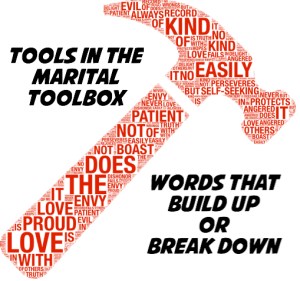 n specific application. I have a hammer for knocking dents out of metal, one for driving nails, a sledge hammer for demolishing things, even a slide hammer that pulls things outward instead of pushing things forward. Like any weekend warrior mechanic, my hammer also does double and triple duty for all sorts of other tasks that aren’t necessarily hammer specific. In the marital toolbox, there is a similar tool that can be used in a wide variety of ways, both constructive and destructive. That tool is the power of our words. This tool is not dissimilar to the hammer in that it is frequently the most powerful tool we employ. The book of Proverbs speaks of the tongue as possessing the power of life and death. James speaks of the tongue as a spark with the power to set the world on fire. I am certain that most married couples can recall instances when a few poorly chosen words set their world on fire with arguments that went on for days. The key to using a hammer properly is using at the right time and in the right way.
 manner in which the family of God operates. In Acts, we see the early church gathering for meals daily, largely because eating together as a family is a somewhat intimate activity. We also see Jesus teaching important lessons and engaging in fellowship at meals with groups of people. His final meeting with his disciples before the crucifixion took place over dinner. His first extended meeting with them after the resurrection happened over breakfast. The Lord’s Supper is a modified ceremony from the Jewish faith, the passover meal. The passover was only one of many meal-centered religious observances the Jewish people engaged in. Holidays, sacrifices, and all sorts of other activities were surrounded by meals. This is not because of a supernatural spiritual quality associated with eating. Rather, it is because eating together is a basic act of community. Community behaviors encourage close relationships and interpersonal openness.
 their thoughts and feelings. However, the reality is that self-expression is a skill that develops over time. Parents can encourage development of these skills by modeling them and asking questions. Children learn communication patterns largely from their parents. They emulate what they see. If you talk and share with them, they will learn to talk and share with you. This will pay dividends during the frustrated and angst-filled teenage years when they really need to talk things through. Asking children questions encourages them to share their thoughts and experiences. It teaches them to share thoughts/feelings that they will not instinctively share. In addition, it demonstrates interest in the life of your child. They will notice that interest and they will thrive on it. Nothing is more important to children than their parents. When parents demonstrate interest in their children, it means the world to them. This will also pay in the long run when that cute child is a fuming teenager and you’re trying to get them to talk it out or hoping that they will come to you with serious problems and major decisions.
 Patching Cracks