
In my shop, there is a large toolbox with a wide variety of tools for various applications. I am well equipped to repair cars, electronics, plumbing, and all manner of other household “honey-do” type jobs. Perhaps the simplest and most versatile of the tools I own is my hammer. To be fair, I have several different hammers, each with its ow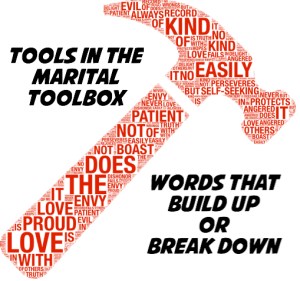 n specific application. I have a hammer for knocking dents out of metal, one for driving nails, a sledge hammer for demolishing things, even a slide hammer that pulls things outward instead of pushing things forward. Like any weekend warrior mechanic, my hammer also does double and triple duty for all sorts of other tasks that aren’t necessarily hammer specific. In the marital toolbox, there is a similar tool that can be used in a wide variety of ways, both constructive and destructive. That tool is the power of our words. This tool is not dissimilar to the hammer in that it is frequently the most powerful tool we employ. The book of Proverbs speaks of the tongue as possessing the power of life and death. James speaks of the tongue as a spark with the power to set the world on fire. I am certain that most married couples can recall instances when a few poorly chosen words set their world on fire with arguments that went on for days. The key to using a hammer properly is using at the right time and in the right way.
- Words of Affirmation: Perhaps one of the most powerful ways we can use our words to positively impact our marriage is through affirmation. Compliments, expressions of thanks, “I love you,” questions about our partner’s day that show genuine interest, and all manner of other affirmations can build good will and encourage a more positive relationship environment.
- Knocking Down Conflicts: Conflicts are often a result of poor communication. Misunderstandings often lead to hurt feelings, which lead to resentments. Talking out issues in a calm and loving manner can dismantle this sort of destructive trend in relationships.
- Apology: Conflict can harden our hearts and lead to ongoing issues in a relationship. This is particularly the case when reconciliation doesn’t take place after fights. Apologizing and taking responsibility for words and actions can soften a hardening heart.
- Reminders: It’s easy to reach a point, when arguing, that both spouses take a me-against-you stance. Over the years, one or both partners become entrenched and constantly assume an adversarial attitude. Strategically reminding your spouse that you are on the same team is vital.
- Tone: In the same way a hammer can be used to tap or pound, our tone of voice alters the message that our words convey. This is particularly important to note while arguing. Anger raises our voices, shouting leads to chemical/emotional responses in our partner, which escalates the situation. Learning to control our volume and tone is key to using our words properly.
 These are just a few of the ways the well chosen words can positively shape a marriage. The real challenge is in learning to control our words. This is far from easy. In reality, poorly chosen words can act as a hammer in their ability to inflict damage on a relationship. Angry words, cutting remarks, and forcing your way through aggressive arguing can destroy a relationship in the same manner a sledge hammer is used to demolish. Perhaps the book of James puts it best when it directs us to put a bridle on our tongues. Bridles are used to restrain and direct horses. The same is true of our words. They are powerful and need to be restrained. However, their power can be directed to great effect.
 manner in which the family of God operates. In Acts, we see the early church gathering for meals daily, largely because eating together as a family is a somewhat intimate activity. We also see Jesus teaching important lessons and engaging in fellowship at meals with groups of people. His final meeting with his disciples before the crucifixion took place over dinner. His first extended meeting with them after the resurrection happened over breakfast. The Lord’s Supper is a modified ceremony from the Jewish faith, the passover meal. The passover was only one of many meal-centered religious observances the Jewish people engaged in. Holidays, sacrifices, and all sorts of other activities were surrounded by meals. This is not because of a supernatural spiritual quality associated with eating. Rather, it is because eating together is a basic act of community. Community behaviors encourage close relationships and interpersonal openness.
 their thoughts and feelings. However, the reality is that self-expression is a skill that develops over time. Parents can encourage development of these skills by modeling them and asking questions. Children learn communication patterns largely from their parents. They emulate what they see. If you talk and share with them, they will learn to talk and share with you. This will pay dividends during the frustrated and angst-filled teenage years when they really need to talk things through. Asking children questions encourages them to share their thoughts and experiences. It teaches them to share thoughts/feelings that they will not instinctively share. In addition, it demonstrates interest in the life of your child. They will notice that interest and they will thrive on it. Nothing is more important to children than their parents. When parents demonstrate interest in their children, it means the world to them. This will also pay in the long run when that cute child is a fuming teenager and you’re trying to get them to talk it out or hoping that they will come to you with serious problems and major decisions.
 his is just one of several mantras she recites when facing difficult situations. Another one that is fairly common is: “Daddy will keep me safe.” I typically hear this comment when she has bad dreams or is afraid of the dark. She believes, with a kind of faith that children are amazingly capable of, that her dad can do anything. This is not unusual. Most children grow to believe that their dads are a sort of superhero. As they grow older and wiser, they come to recognize that dad isn’t a sort of superman, but for now we are both enjoying this phase of her relational development. She feels comfort at the reassurance that I can take care of her. I love having my child look at me as a hero of sorts, and hope to live up to that perception as much as possible. Even more so, I hope to raise kids who my grandkids can look at with awe as children. Raising children who can be superheroes to their own children is a product of intentional effort and an awareness of a basic reality regarding God’s design for the family.
 while the second deals with interacting with men. The first law in each table is important and offers a glimpse into God’s design for the world. The first law is: Do not have any other gods. Basically, the command is to honor God. The first law in the second table is somewhat similar: Honor your mother and father. The two laws strongly parallel in concept because parents have a special role in the lives of their children. Specifically, parents stand in the place of God in the lives of their children for the first several years until children reach the point of being able to understand God. Perhaps the English novelist, William Thackeray, put it best when he wrote: “Mother is the name for God on the lips and hearts of little children.” Parents shoulder an enormous responsibility by standing in the position they stand in, because they stand as representatives of God. This is a bit of a double-edged sword. A strong, loving parent can provide their child with an amazing first impression of God’s identity. The downside is that an absent, abusive, or deeply flawed parent can give children an inaccurate perspective on who God is. This is most easily seen with abusive or absent fathers, whose children often grow up with a sense of God being distant or perpetually angry and out to get them. Mind you, this is not a hard and fast rule for all people. Rather, it is an observable trend.
 uired that I take the front of the engine off to replace the sensor. After digging through my glove compartment, I found a wrench and a screwdriver. I began working with my meager collection of tools by removing every screw and bolt that matched the phillips head screwdriver and 13 mm wrench. Unfortunately, I had reached an impasse. I walked to a nearby K-Mart and purchased a socket wrench and a couple of sockets. With my new socket wrench in hand, I removed every bolt that matched my new sockets, until I encountered a small bolt that I did not have a socket to fit. Another trip to K-Mart had me working again, until I came across a bolt that required a box end wrench. Another trip and another tool purchase. This continued for the better part of a day, until I had completed the repairs. By the fourth or fifth visit to the store the cashiers started teasing me. Eventually, it became evident that my effort to avoid purchasing an entire set of tools had cost me a great deal of time. The whole process would have been much easier had I possessed all of the tools I needed at the outset of the project. The same is true of many married couples, who start their lives together without adequate relationship tools. When trouble arises and breakdowns occur, they simply do not have the relationship tools and skills they need to fix the issue. Unresolved issues, if they become plentiful enough, can lead to larger and larger problems. Ultimately, too many problems can lead to communication breakdowns, resentments, and divorce.
 times, every spouse must be equipped with the tools necessary to fix the problems that emerge in the relationship. There are all manner of these tools: effective communication skills, healthy arguing, and mutual submission to name a few. Perhaps the most important tools in the marital toolbox are “grace” and “selflessness.” Grace refers to forgiving without reservation. The Bible uses the term to refer to God forgiving people without them having to earn it. It is an act of love. Just think over the history of arguing with your spouse and reflect on how often “old arguments” have come up and extended the conflict. Or consider the times when resentment over some slight has lingered in the relationship. As time passes and these resentments accumulate, a marriage will naturally drift apart. The cure for this is simple: grace. There is an old saying about marriage: “Before you wed, look as critically at the imperfections as possible. After, do your best to ignore them.” Or better yet, do your best to forgive them, even if they don’t deserve it. Many a married man (or woman) will read the previous paragraph and find themselves saying: “Easier said than done! You don’t know my husband (or wife)!” Ultimately, forgiveness requires that the second tool comes into play. Selflessness is the primary attribute of love. One of the most popular Bible verses read at weddings is 1 Corinthians 13: “Love is patient. Love is kind… it is not self-seeking, it is not easily angered, it keeps no record of wrongs…” For all of the qualities given in the chapter, there is the shared condition of selflessness. Real love cannot be about “me.” Real love focuses on the partner in the relationship. This is love that is more than just a warm feeling that fades after the honeymoon ends. It is a life direction that endures even when the marriage is just plain tough. Forgiveness is far easier when I don’t need to win every fight or get my revenge for hurt feelings. Grace is only possible when it arises from selflessness. While these two concepts may seem to be simple enough, they require commitment and hard work. The Bible goes so far as to suggest that we can only accomplish them with God’s help. At a minimum, learning to selflessly consider your partner’s needs and forgive their failings involves repeatedly committing to do so. It is hard enough that the only reason to take on the task is out of love.

 with the problem. His response made me angry. He asked me how praying for them was going, also reminding me that Jesus directs his followers to pray for their enemies. I didn’t argue, because I knew I was stuck. This began a process of prayer that changed my life. It was hard to pray for the men in question, largely because I didn’t want to do it. The idea of praying for these guys who had made me miserable for months scalded me. It offended me through and through. Praying for my enemies, and as dramatic as it sounds, they were my enemies, was difficult at first. As time progressed, it became increasingly easier and I learned several important lessons.
 n though the kids sometimes tried to punch you, at least they were attacking you out in the open and to your face. It took my wife and I years to decide to agree to take on ministry employment in a church again. There is a terrible truth about churches that has to be faced by anyone who is (or was) ever a part of one. The people who are meant to become like Jesus through their lives together in the church community, often bear little resemblance to Jesus or what He taught. Over the years, I have spoken with and visited with all sorts of folks who have shared tough stories, ones that I can relate to all too well. Folks were burned by people that were supposed to love and support them. It’s a tragedy that such experiences are so common. While talking with a friend earlier this afternoon, I realized how blessed I was to have been surrounded and supported by some awesome believers who helped my wife and I find rest and healing after a tumultuous time in our lives and relationship with God. The basic lessons and realizations we came to were powerful and important.
 ons I learned was from the Apostle Paul. While studying the second letter to Corinth, I realized that Paul had come to visit the church there and been humiliated and run out of town. A group of preachers, who were more concerned with making money than preaching the gospel, had made a fool of Paul in a debate. Paul then sent Titus to salvage his relationship with the church. He was eventually reconciled with them and the false teachers run off. The thing that’s worth observing here is that Paul was stabbed in the back, mocked, and mistreated by folks who were supposed to be his brothers in Christ. His response was stern, but loving. He did not back down off of the truth, but throughout the whole ordeal he pointed to Jesus as the truth. He did not want payback. He wanted the church to be reconciled. Ultimately, he was just following the example of Christ, who reinstated Peter after he denied even knowing Christ. The lesson to be learned here isn’t that we should jump back into the mess after walking away from those who abused us. Rather, it is a model of forgiveness and grace. It is very easy to fall into bitterness after we are hurt. It is easy to attack and judge. In the end, we need to forgive in order to heal. Nothing keeps a wound fresh more effectively than picking at it forever. I do not believe that Paul simply forget when individuals proved themselves to be untrustworthy. Rather, I’d suggest that he acted “as wise as a serpent and as innocent as a dove.” Love and grace need to rule our attitude and decisions, particularly when dealing with fellow believers.
  Patching Cracks