
Ephesians 5 is perhaps one of the most argued about scriptures in terms of male/female relationships. Arguments over who is in charge, what submission means, who owes who what, whether or not it is even relevant to modern matrimony, and all manner of other junk dominate the landscape of popular discussion of this passage. Interestingly, much of the discussion centers around a philosophical assumption regarding our rights in the marital setting. The question of who is owed what and what are my rights demonstrates something significant about how the discussion is being engaged. Namely, that the discussion is missing the point of Paul’s words. Paul isn’t talking about what each spouse is due. He is explaining how imitating Christ looks in the context of marriage. I’d love it if my wife submitted me, always treated me with respect, and had Proverbs 31 tattooed on her soul, but that is between her and Jesus. My job, and the job of every husband, is to love their wives like Christ loved the church and to prepare her to be presented to God as a pure, spotless individuals.
The specific meaning of this phrase cannot be missed. I cannot look at my wife as a subject, or someone who owes me something. Instead, I need to love and serve her sacrificially. I need to give of myself, selflessly and set aside my own desires for her benefit. Jesus washed his disciples feet to demonstrate the lowness of our attitude of service. In addition, he died for the church. As husbands, our job is to serve and to aid our spouse in spiritual growth. We are to help our wives become Christlike. If we spend time concerning over her responsibilities and what she owes us, we cannot fulfill this directive. Such thinking runs counter to it. This raises an important question of how do we follow through with this in a concrete way. I, like most men, like “to do” lists and concrete directives. Its easy to act when we know what we are supposed to do. Here are 5 things I have come up with for selflessly serving our wives:
Maintain our own spiritual health. The reality is that this is a humanly impossible task. People are naturally self-centered and selfish. Giving of self is not gonna be our strength for the long term. God understands this and makes a way for us through his Holy Spirit working in our lives. This is not instant, it requires spiritual growth. A decent place to start is reading about Jesus and talking to God. We must grow if we are to love and lead our wives.
Lead spiritually. Leading spiritually begins with praying for our wives. This is a daily task that prepares us to sacrificially love them. Worshipping with our wives is another important part. Far too often I see wives who bring their kids to church while husbands sleep in on Sundays. Leading spiritual growth in the family requires participation in the spiritual practices. A final component worth implementing is leading the spiritual development of the family through study, discussion, and family prayer.
Doing chores, without ulterior motives. Finding things that need to be done and doing them is service. Changing toilet paper rolls, doing laundry, bathing kids, or any other chore efforts are concrete shows of love and grace. It’s important that as these are taken on, it is with a heart of service and not in an effort to receive a reward. I cannot tell you how many men I have spoken with, who are frustrated when they do dishes, vacuum, or undertake any other household chore only to be angered when their wives don’t amorously reward them for their efforts. I’ll admit that I am guilty of this too. Serving selflessly means not seeking reward. Its a gift, not a job done in search of a reward. Wives aren’t stupid, they generally see through these ploys. Further, it ruins the blessing we bestow in our act of service. Selfless is the watchword here.
Giving them time away. It is easy for wives to feel overwhelmed by the constant demands that are made of them. This is particularly the case when kids arrive, because their demands on mommy’s attention can be nearly constant. I’ve found that one of the best acts of service I undertake is letting my wife nap or spend time to herself. Taking the kids to the park or out for an evening is one way. There are all sorts of others, like taking care of chores so she has no pressing concerns or planning time away from the house.
Courting her. After marriage it is so easy to stop romancing our wives. We don’t need to convince her to marry us, so we stop buying flowers, taking her out for dinner, talking for hours, listening to her share her feelings, hugging, kissing, holding hands, etc. There are many ways to demonstrate affectionate attention that show her how important she is to you. There is a caveat here. If these things are always done with selfish motives and in an effort to get her to reciprocate physically, it will ruin the whole thing. I’m not saying that sex isn’t important to marriage. Rather, that selflessly serving is just that. Shifting service and affection from being a gift we give to a commodity we trade is sort of the antithesis of Christlike behavior.
This is a brief list. It is by no means all encompassing. Its purpose is to get your brain moving in the direction of how to serve. The biggest key is doing it with right motive, which is a product of prayer and the Holy Spirit working in us.

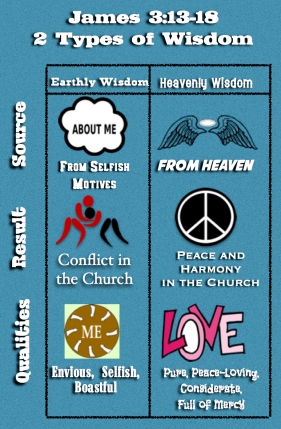 Words that create chaos can be easily identified because they breed conflict, anger, and infighting in the body of Christ. Words that create chaos and destruction are likely rooted in worldly wisdom.
 ttitude create chaos and conflict or do we make peace and encourage unity in the body of Christ? The answers to these questions tell us where our wisdom comes from. Most folks are wise in their own eyes, but this is very different from being truly wise.
 While watching my kids play at the park yesterday, my daughter came running to me from under play structure, crying and rubbing her forehead. She had bumped her head on the underside of of the fire engine jungle gym. A hug, a kiss on the forehead, and and a few comforting words later, she was running around again. The most natural response to my little girl’s feeling pain, is offering comfort and doing the best I can to make it better. This is a natural response for parents. Protecting our children is programmed into our DNA. The most natural thing in the world is to hurt when our kids hurt and to try to fix it. Unfortunately, as time goes on, this instinct can get in the way of healthy development into adulthood. There are times when parents need to reign in their instinct and allow their children to struggle or hurt sometimes because its whats best for them.
 then the natural consequence is a poor grade. All too often, parents see their child panicked the day before, and bail them out. At times this involves doing the work for them or calling them in sick for school the next day. These situations are teachable opportunities. Parents must decide if they will teach their child that someone else will always be there to bail them out, or if they will learn the hard lesson: “If you don’t do the work, you will fail.” This is one example, but of a huge area of teaching. If you watch people long enough, you will witness parents who attack teachers because their kids aren’t getting A’s, or demanding their kid gets to play a starting position on the soccer team, or any other situation where a parent shields their child from the consequences of their actions or failures. I’m not saying that helping your kid deal with consequences isn’t okay sometimes. Rather, I am saying that protecting them from everything teaches them to be sheltered.
 After 16 years of marriage, my wife and I have noticed that it has become easy to fall into a rut with the time we spend together. For example, since the kids came along we have had begun doing the “grocery store date”, which involved going out for dinner, then going grocery shopping. This date pattern came about for fairly obvious reasons. It’s easier to go to the grocery store without the kids. If we already have a babysitter, why not have an easy night of buying groceries? On the plus side, it meets the basic requirement of spending time alone together. The problem is that this outing isn’t particularly exciting and is really just doing home maintenance without the kids along. Dating your spouse should be about enjoying each other’s company and spending quality time together, unfortunately its easy for it to devolve into an obligation or routine.Because of this, we have put effort into coming up with new and novel activities to engage in on date nights that shift us out of our rut. Here are a few of our favorites:
 reflect something that you think your spouse might find interesting, something that is a sort of project or activity work on together, or anything else that might spark conversation. Afterward we spend time talking about why we picked the book we picked and our reactions to the book we received. The important part of this game is spending time talking about it afterward and sharing reasons for picking the book. It can be adapted to other settings if you aren’t a reader. The game can be played in a mall or almost anywhere else.
 Denial is the component of addiction that is actually fatal. This seems counterintuitive, because addiction typically features all sorts of destructive patterns and practices that seem to the part of addiction that kills you, but the reality is that what kills the addict is the inability to recognize the severity of the situation.
 During the late summer, a persistent Sunday morning prayer request is for no fires and for safety when they do break out. The interesting thing is that it takes very little to start a blaze. The heat from the exhaust of a car parked in tall grass is more than sufficient to light a fire. A thrown cigarette or a lightning strike can destroy hundreds of acres. Dry wheat, chaff, brush, high winds, and farm equipment make for a dangerous combination during the dry season. One of the most impressive things about these fires is the response from the farmers and ranchers. When a fire breaks out in the hills, the farmers call each other, load into trucks, and put the fire out. The fire department is also called, but with 30 miles of travel to put in before they fight the fire, every set of hands matters. Most farms have water trucks and backpacks for spraying water on fires. There is a perfect model here for the church.
 gas on the blaze, every member should leap into action to put out the fire before the harvest is set ablaze. Friends, family, and neighbors wouldn’t sit around and listen to the newest juicy gossip. Instead, they would recognize the danger of a fire catching and respond by lovingly correcting the behavior and stopping the fire before it spreads. When a fire catches and begins to spread, members of the church community would charge in and make peace, throwing water on the situation. They would respond to the fire alarm with a sense of urgency that is in harmony with the danger that is presented to the body of Christ.
 comes with it. I had never replaced a clutch and had no idea how important the tool was, so I said “no problem” and was on my way. I discovered that it actually was a problem when I attempted to put the engine back into the car with the misaligned clutch. The engine simply would not fit the transmission. I tried several improvised fixes, but had no success. Finally, I pulled off the clutch and went back to the shop, where a different guy was now at the counter. He looked at the clutch and stated firmly that they didn’t sell the alignment tools separately and that the part was not returnable because I had attempted installation. After some arguing and effort, I realized I wasn’t going to make any progress. I then turned to the internet and discover that no one was selling my alignment tool. Finally, after days of working on the problem, I took the engine to the dealer and paid an hour’s worth of labor to a technician, who spent 3 minutes aligning my part. The little plastic alignment tool, that seemed so unimportant at the time, was vital to properly installing my clutch. Without the tool, the engine, which produces power, simply couldn’t connect to the transmission, which transfers power to the tires.
 but struggle with making the ideal version in their head transfer into relationship reality. They want to communicate without arguing, agree on financial decisions, experience perfect harmony in their physical relationship, and find that spark of excitement that was present when they first started dating. The problem arises when the idea as to how marriage ought to be fails to translate into forward and harmonious movement in the relationship. This misalignment is a product of the fallen nature, which inclines us toward self-centeredness. If you take a look at Paul’s description of love in 1 Corinthians 13, you will find the antithesis of the sinful inclination of man. It’s natural for people to struggle with making their behavior match their convictions. Paul describes this struggle in Romans 7,
 sons and educate them as to how God calls them to act toward women. In a culture that is increasingly hostile to the dignity of women, treating them as sex objects, humiliating them in pop culture, or glorifying their mistreatment; it is vital that we make our stance clear and stand firm on the matter. Raising a young man into a superhero requires more than just teaching him to carry a football; it involves teaching him to act with integrity toward women, whether that woman is his wife, sister, date, neighbor, or a stranger.
 as remarriage was difficult and there were limited employment and property ownership rights. This resulted in poverty, indentured servitude, or prostitution as the only options for women who did not have a husband. God’s declaration of anger toward men who do not love and take care of their spouse is no small matter. God expected men to care, protect, and provide for their wives. Further, the act of abandoning her is described as an act of great violence. The message seems clear, violence against your wife isn’t okay. Even more so, husbands are expected to not only to abstain from violence toward wives, God considers not taking care of them as being on par with violence. Men are to treat women with an extra measure of gentleness and protection.
 Comments ranged from dismay over the loss of family to frustration over newfound awkwardness in parental relationships to consternation at their parents’ inability to just stop being so cruel to each other. It was seldom the case that a class went without a child breaking down and crying. Interestingly, I never once saw any of the children tease each other over tears shed in that setting. Except in instances of an absent, addicted, or exceptionally abusive parent, I never heard a child say that the divorce was a welcome change.
 Patching Cracks