
For around three years, I ran a class designed to help children whose parents were going through divorce cope with the emotional strain they were experiencing. During the years I ran those classes, I was frequently struck by the recurring comments made by the young people who participated in the classes.  Comments ranged from dismay over the loss of family to frustration over newfound awkwardness in parental relationships to consternation at their parents’ inability to just stop being so cruel to each other. It was seldom the case that a class went without a child breaking down and crying. Interestingly, I never once saw any of the children tease each other over tears shed in that setting. Except in instances of an absent, addicted, or exceptionally abusive parent, I never heard a child say that the divorce was a welcome change.
In contrast, on the occasions that I ran the adult version of the class or interacted with parents before or after the class, I frequently heard parents say things to the effect of: they were ready to move on or anxious to close that chapter in their lives. The prospect of freedom from the unpleasantness of the marriage relationship was a breath of fresh air that would free them up to find someone new. It’s interesting that few parents acknowledged that their new found freedom would not be shared by their child, who would hence forth live in the far more difficult circumstance of trying to navigate their adolescent years with two families, rather than one.
There is an old adage: “When the elephants fight, the ants lose.” For all the unpleasantness spouses experience in disintegrating marriages, children are the ones who are unintentionally stepped on. The most important element in the life of every child is stability. They need it in order to thrive and are usually poorly equipped to deal with the stress of such a major life change. This is why children of divorce are statistically more likely to turn to drugs or alcohol, perform poorly in school, have behavioral difficulties, and be incarcerated. Worse still is that children from divorced homes are far more likely to get divorced themselves. The biggest loser in divorce is the one member who did not ask to join the family, and is the least equipped to cope with change.
The responsibility in the parenting/married relationship belongs to the parents. This often elicits the response: “So I’m supposed to stay in a miserable relationship forever?” This is a case of asking the wrong question. Parents are not responsible to be tied to a miserable relationship. They are burdened with the responsibility to work together to make certain that the relationship is durable. This is easy to do while dating because courting is hard work. Couples have to listen, say nice things, buy gifts, go on dates, talk through problems, and try to be romantic/attractive in order to get to the altar in the first place. The trick is that the work doesn’t end there. It goes on for life. This is also the responsibility of married parents. A happy and stable marriage/family takes as much hard work as a career and it is a commitment requiring daily effort that we vow to take on from the moment we say “I do.”
This is not to say that everyone who gets a divorce ruins their children forever or that they will instantly go to hell. Though the Bible presents a pretty negative view on the topic of divorce, there are instances in which provision is made. There are circumstances in which the protection of the child or one of the spouses may be at stake, infidelity, abandonment, and so forth simply force the issue. The larger point here isn’t to attack those who are divorced. Rather, it is to encourage those who are married and raising kids to put in the work to keep their relationship healthy. Divorce hurts children deeply. It is important that parents make every effort to maintain a healthy relationship as a protection against the potential for hurting their children.
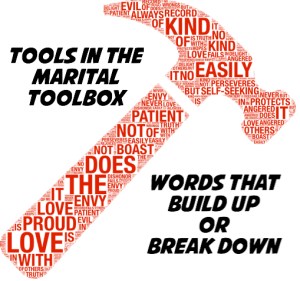 n specific application. I have a hammer for knocking dents out of metal, one for driving nails, a sledge hammer for demolishing things, even a slide hammer that pulls things outward instead of pushing things forward. Like any weekend warrior mechanic, my hammer also does double and triple duty for all sorts of other tasks that aren’t necessarily hammer specific. In the marital toolbox, there is a similar tool that can be used in a wide variety of ways, both constructive and destructive. That tool is the power of our words. This tool is not dissimilar to the hammer in that it is frequently the most powerful tool we employ. The book of Proverbs speaks of the tongue as possessing the power of life and death. James speaks of the tongue as a spark with the power to set the world on fire. I am certain that most married couples can recall instances when a few poorly chosen words set their world on fire with arguments that went on for days. The key to using a hammer properly is using at the right time and in the right way.
 uired that I take the front of the engine off to replace the sensor. After digging through my glove compartment, I found a wrench and a screwdriver. I began working with my meager collection of tools by removing every screw and bolt that matched the phillips head screwdriver and 13 mm wrench. Unfortunately, I had reached an impasse. I walked to a nearby K-Mart and purchased a socket wrench and a couple of sockets. With my new socket wrench in hand, I removed every bolt that matched my new sockets, until I encountered a small bolt that I did not have a socket to fit. Another trip to K-Mart had me working again, until I came across a bolt that required a box end wrench. Another trip and another tool purchase. This continued for the better part of a day, until I had completed the repairs. By the fourth or fifth visit to the store the cashiers started teasing me. Eventually, it became evident that my effort to avoid purchasing an entire set of tools had cost me a great deal of time. The whole process would have been much easier had I possessed all of the tools I needed at the outset of the project. The same is true of many married couples, who start their lives together without adequate relationship tools. When trouble arises and breakdowns occur, they simply do not have the relationship tools and skills they need to fix the issue. Unresolved issues, if they become plentiful enough, can lead to larger and larger problems. Ultimately, too many problems can lead to communication breakdowns, resentments, and divorce.
 times, every spouse must be equipped with the tools necessary to fix the problems that emerge in the relationship. There are all manner of these tools: effective communication skills, healthy arguing, and mutual submission to name a few. Perhaps the most important tools in the marital toolbox are “grace” and “selflessness.” Grace refers to forgiving without reservation. The Bible uses the term to refer to God forgiving people without them having to earn it. It is an act of love. Just think over the history of arguing with your spouse and reflect on how often “old arguments” have come up and extended the conflict. Or consider the times when resentment over some slight has lingered in the relationship. As time passes and these resentments accumulate, a marriage will naturally drift apart. The cure for this is simple: grace. There is an old saying about marriage: “Before you wed, look as critically at the imperfections as possible. After, do your best to ignore them.” Or better yet, do your best to forgive them, even if they don’t deserve it. Many a married man (or woman) will read the previous paragraph and find themselves saying: “Easier said than done! You don’t know my husband (or wife)!” Ultimately, forgiveness requires that the second tool comes into play. Selflessness is the primary attribute of love. One of the most popular Bible verses read at weddings is 1 Corinthians 13: “Love is patient. Love is kind… it is not self-seeking, it is not easily angered, it keeps no record of wrongs…” For all of the qualities given in the chapter, there is the shared condition of selflessness. Real love cannot be about “me.” Real love focuses on the partner in the relationship. This is love that is more than just a warm feeling that fades after the honeymoon ends. It is a life direction that endures even when the marriage is just plain tough. Forgiveness is far easier when I don’t need to win every fight or get my revenge for hurt feelings. Grace is only possible when it arises from selflessness. While these two concepts may seem to be simple enough, they require commitment and hard work. The Bible goes so far as to suggest that we can only accomplish them with God’s help. At a minimum, learning to selflessly consider your partner’s needs and forgive their failings involves repeatedly committing to do so. It is hard enough that the only reason to take on the task is out of love.
 that I hate doing maintenance work. I will happily replace a water pump, but cringe at the thought of changing oil or doing a tuneup. It’s just easier to not do maintenance. The problem, of course, is that not doing maintenance results in frequent breakdowns, poor fuel economy, and shorter lifespan for the vehicle in general. The same is often true of many men. Solving a problem is more interesting to them than working to maintain things. Unfortunately, this tendency often translates into married life.

 with the problem. His response made me angry. He asked me how praying for them was going, also reminding me that Jesus directs his followers to pray for their enemies. I didn’t argue, because I knew I was stuck. This began a process of prayer that changed my life. It was hard to pray for the men in question, largely because I didn’t want to do it. The idea of praying for these guys who had made me miserable for months scalded me. It offended me through and through. Praying for my enemies, and as dramatic as it sounds, they were my enemies, was difficult at first. As time progressed, it became increasingly easier and I learned several important lessons.
 n though the kids sometimes tried to punch you, at least they were attacking you out in the open and to your face. It took my wife and I years to decide to agree to take on ministry employment in a church again. There is a terrible truth about churches that has to be faced by anyone who is (or was) ever a part of one. The people who are meant to become like Jesus through their lives together in the church community, often bear little resemblance to Jesus or what He taught. Over the years, I have spoken with and visited with all sorts of folks who have shared tough stories, ones that I can relate to all too well. Folks were burned by people that were supposed to love and support them. It’s a tragedy that such experiences are so common. While talking with a friend earlier this afternoon, I realized how blessed I was to have been surrounded and supported by some awesome believers who helped my wife and I find rest and healing after a tumultuous time in our lives and relationship with God. The basic lessons and realizations we came to were powerful and important.
 ons I learned was from the Apostle Paul. While studying the second letter to Corinth, I realized that Paul had come to visit the church there and been humiliated and run out of town. A group of preachers, who were more concerned with making money than preaching the gospel, had made a fool of Paul in a debate. Paul then sent Titus to salvage his relationship with the church. He was eventually reconciled with them and the false teachers run off. The thing that’s worth observing here is that Paul was stabbed in the back, mocked, and mistreated by folks who were supposed to be his brothers in Christ. His response was stern, but loving. He did not back down off of the truth, but throughout the whole ordeal he pointed to Jesus as the truth. He did not want payback. He wanted the church to be reconciled. Ultimately, he was just following the example of Christ, who reinstated Peter after he denied even knowing Christ. The lesson to be learned here isn’t that we should jump back into the mess after walking away from those who abused us. Rather, it is a model of forgiveness and grace. It is very easy to fall into bitterness after we are hurt. It is easy to attack and judge. In the end, we need to forgive in order to heal. Nothing keeps a wound fresh more effectively than picking at it forever. I do not believe that Paul simply forget when individuals proved themselves to be untrustworthy. Rather, I’d suggest that he acted “as wise as a serpent and as innocent as a dove.” Love and grace need to rule our attitude and decisions, particularly when dealing with fellow believers.
  Patching Cracks