

Anyone who has ever visited my office knows that it has always been filled with odds and ends. Little collections and keepsakes. A big part of the reason I collect things is to spur my thought processes. Being surrounded by odds and ends sort of feeds my short attention span and sometimes results in interesting thoughts. #OfficeArtifactWednesday is a weekly Facebook/Twitter posting I am doing to share a bit of what I’ve accumulate and some of how it makes me think. Let me know if you find it interesting.
For my first Office Artifact Wednesday item, I decided to share a picture of my redneck fish finder. 15 years ago I preached my first sermon in a church. During the sermon I told a joke about fishing with dynamite. The next morning, when I came into my office I found a bundle of wooden dynamite with the label: “Redneck Fish Finder.” There was no card or label. No one ever took credit for the gift. Someone thought enough of the anecdote (or me) to bring the knick-knack by and gift it to me. It has been a part of my office collection everywhere I have gone since. It is the very first office artifact.
Over the the last decade and a half of looking at the redneck fish finder on my desk everyday, my thoughts on it have changed. In the beginning I was encouraged that my story had caught someone’s attention. It was very encouraging for me as a young preacher. It’s not often that sermons illicit responses, so this has served as a bit of a reminder that folks are listening.
As time passed my perspective changed. The dynamite began to serve as a reminder of how powerful stories can be in conveying a point. I love telling stories and bridging them into principles or lessons. I’ll admit that I do this almost constantly, looking at things and considering how they can be used to illustrate an idea. I do this because stories can create deeper understanding. They can help people identify with what is being conveyed. They also draw in the listener’s attention. My fish finder always brings my mind back to this concept.
In the last few years, as I have finished seminary, studied the Bible more deeply, and worked with people more seriously, the fish finder has grown to reflect the reality that the things I say from the pulpit have the potential to make a huge impact on those I serve. I’ve spoken carelessly to folks and regretted it on more than one occasion. This is especially the case when preaching, because it involves standing in a spot where folks look to you to learn truth about God. The responsibility involved ought not to be taken lightly. Over the years I’ve known people whose words were like a carelessly tossed bomb in any situation: inflicting pain, provoking anger, and breeding dissension. I’ve also watched as preachers ignore the scriptures in favor of their own agenda and opinion, misleading folks for selfish gain. Being a professional talker (and a guy who tends to to talk too much) it’s important to remember the power of words and to choose them accordingly. Jesus once said: I tell you that everyone will have to give account on the day of judgment for every empty word they have spoken. (Matt. 12:36) He also taught: “It is inevitable that stumbling blocks come, but woe to him through whom they come! It would be better for him if a millstone were hung around his neck and he were thrown into the sea, than that he would cause one of these little ones to stumble.” (Luke 17:1-20)
The words of the reckless pierce like swords, but the tongue of the wise brings healing. Proverbs 12:18
Even fools are thought wise if they keep silent, and discerning if they hold their tongues. Proverbs 17:28
Like a maniac shooting flaming arrows of death is one who deceives their neighbor and says, “I was only joking!” Without wood a fire goes out; without a gossip a quarrel dies down. Proverbs 26:18-20

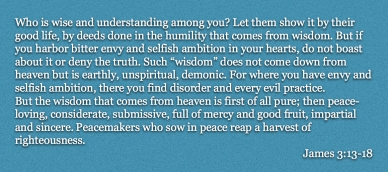
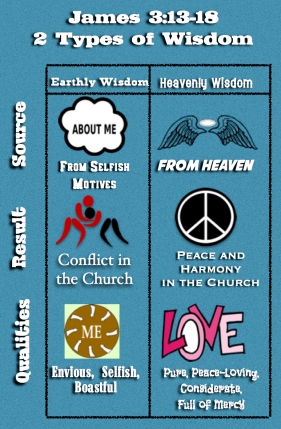 Words that create chaos can be easily identified because they breed conflict, anger, and infighting in the body of Christ. Words that create chaos and destruction are likely rooted in worldly wisdom.
 ttitude create chaos and conflict or do we make peace and encourage unity in the body of Christ? The answers to these questions tell us where our wisdom comes from. Most folks are wise in their own eyes, but this is very different from being truly wise.
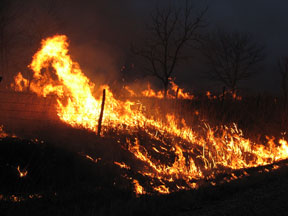 During the late summer, a persistent Sunday morning prayer request is for no fires and for safety when they do break out. The interesting thing is that it takes very little to start a blaze. The heat from the exhaust of a car parked in tall grass is more than sufficient to light a fire. A thrown cigarette or a lightning strike can destroy hundreds of acres. Dry wheat, chaff, brush, high winds, and farm equipment make for a dangerous combination during the dry season. One of the most impressive things about these fires is the response from the farmers and ranchers. When a fire breaks out in the hills, the farmers call each other, load into trucks, and put the fire out. The fire department is also called, but with 30 miles of travel to put in before they fight the fire, every set of hands matters. Most farms have water trucks and backpacks for spraying water on fires. There is a perfect model here for the church.
 gas on the blaze, every member should leap into action to put out the fire before the harvest is set ablaze. Friends, family, and neighbors wouldn’t sit around and listen to the newest juicy gossip. Instead, they would recognize the danger of a fire catching and respond by lovingly correcting the behavior and stopping the fire before it spreads. When a fire catches and begins to spread, members of the church community would charge in and make peace, throwing water on the situation. They would respond to the fire alarm with a sense of urgency that is in harmony with the danger that is presented to the body of Christ.
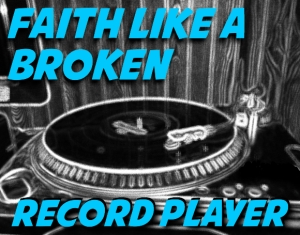 but do not have a decent player for my stereo in the living room. Last week I was volunteering at a community rummage sale and I came across an older, but fairly high end turntable. I was giddy as a school kid when I plugged it in and hit the play button. My heart sank when the turntable remained still. I quickly dismantled it and discovered the belt was broken. Further investigation revealed that the motor worked. The record player worked, but the turntable didn’t spin. No matter how well the motor ran, it didn’t matter, because the power didn’t transfer to meaningful motion. This record player sat on my desk all week while I was studying the book of James for last Sunday’s message. I believe that this is why that broken record player came to mind when I read James 2:14-17.
 e challenge as part of our James sermons series. Since then I have had several members approach me to tell me that they are reading James daily. This has sparked some interesting conversations about how the book has pushed them to reflect on their own lives. It has also prompted me to consider the whole idea of the challenge, particularly as I prepare the 3rd sermon, dealing with James 1:19-27. Several things have come to mind and I hope to explain them in this essay.
 ange that takes place in any person happens as a result of the Holy Spirit convicting you and prompting change. Further still, we are made new and changed as the Spirit aids us in overcoming our sinful behaviors and habits. This change is a process that is rooted in the Holy Spirit’s action in us. God’s actions aside, we cannot read as a passive audience. We must act in response to what we read.
 Patching Cracks
