
 One of the central realities of depression, and any mood, is that neurotransmitters in the brain affect how we feel. One of the most concrete ways to effect positive change in mood and attitude is by taking up activities that encourage healthy levels of of chemicals like serotonin, dopamine, insulin, etc. This does not necessarily mean taking anti-depressants. There are all manner of ways to affect brain chemistry positively. Here are several simple things that can make a huge difference:
• Exercise: Exercising, even just going for a 20-minute walk, can trigger the release of endorphins, which make you feel good. Exercising enough to raise your heart rate 3 times a week for at least 20 minutes at a time is all that is needed. Exercising outside in the sunlight is even better, as exposing yourself to sunlight tends to trigger the release of chemicals that promote feeling better. Part of what makes this difficult is that depression makes you feel tired and unmotivated. Starting this will be difficult, but it is very effective.
• Spending time with friends and family: Depression often results in aversion toward spending time with others. It takes energy to engage others, while isolating is so much easier. The problem is that isolating tends to make things so much worse. Spending quality, low stress time with loved ones has a positive impact on mood. It’s difficult, but it works.
• Diet: Diet affects mood. While consuming comfort foods may be pleasant in the short term, poor diet can negatively impact mood. A poor diet can result in lower energy, which helps further drag you into depression. In addition, certain supplements can help improve mood. One example is fish oil, which studies have suggested can improve mood. This can be challenging because eating junk food can easily become a “go to” method of coping and it works in the short term. However, it can potentially have the opposite effect in the long term when insulin crashes after sugar binges deflate our good mood or with lowered energy levels as a result of poor nutrition. There are all sorts of books and websites devoted to eating habits and depression. Pursuing positive changes in eating habits are best undertaken with as much education as possible.
• Prayer and religious observance: Praying and engaging God over your feelings can be effective toward shifting mood. In addition, meditating over scripture and reading the Bible can help shift focus away from the sorts of thinking that perpetuates depression. In addition, keeping yourself in a frame of mind that is rooted in hope, based on God’s provision and plan, presents a more optimistic view of the future. Finally, religious observance in the form of serving others, loving your neighbor, and regular worship can impact mood and mental state in a positive way. Part of why this works is that it shifts attention away from self and toward others. This can help alleviate depression.
• Monitor thinking: There is a degree to which thinking effects brain chemistry. If you sit and think miserable thoughts, given enough time your brain will react by shifting toward depression. The opposite is also true. As a result, monitoring thoughts to ensure that you avoid dwelling on topics that can worsen the depression is a valuable habit to develop.
• Talking: Talking through depression can be helpful. There are a few reasons this is true. In the short term, talking about feelings can help with overcoming them. Further, it is not unusual for depression to be the result of past hurts that have been buried with the intent of forgetting them. The lasting effect of the undigested emotions can be depression, anger, or other unpleasant feelings. Talking through situations helps to digest the emotions attached.
This is by no means a definitive list. There are all sorts of other ways options for dealing with depression. Severe depression may require professional counseling or medication. As stated earlier, the beginning of dealing with the problem is making the decision to start dealing with it.
 Earlier this summer, I was out running. A few miles into my run, my right hip started to bother me. A little research provided me with a several stretches, which alleviated my discomfort. Further investigation has led me to understand that I need to do core exercises and more stretches, or I can expect further trouble down the line. Pain, like the “check engine” light on a car, lets us know that something is wrong. In this way, pain is a good thing. Without pain we would not know when we sustain injuries that need our attention. Depression is one way our brain lets us know that something is not right. We experience this discomfort and it reveals to us that we are not operating the way we were made to operate, as such, something needs to be attended to. Simply ignoring the problem won’t serve as a consistent, long-term solution, but many people choose to respond to warning signs with attempts to ignore the problem. I knew a young woman who put a piece of electrical tape over the maintenance lights in her car, so that she couldn’t see them and wouldn’t worry about what might be wrong. This is essentially what we are doing when we find ways to ignore what ourbrains are telling us through our emotions.
 After 15 years as a professional minister, working with kids for 13 of those years, I have watched all sorts of young people grow up and make decisions to continue in the faith of their youth or opt to walk away. I have also read arguments as to who or what is usually at fault for the exodus of young people from the church. Colleges with secular agendas, public high schools, federal education standards, pop culture, and television are among the favorite targets. While all of these things may play a part in the trend, one of the major factors that gets far less attention is parental involvement. While there is no guarantee that anything will guarantee that kids will continue in the faith after growing up, there are several common factors I have observed that influence outcomes enormously.
 Pray with and for them. Prayer is like breathing to spiritual life and development. It’s also powerful and effective. Going before God and raising up your kids daily is important. It’s also important to teach them how to pray and its importance. Thanking God together, praising Him in prayer, learning to confess our sins against Him, and seeking His assistance in our lives are all practices we teach our children when we pray for them.
 Willard F. Harley’s excellent marriage book His Needs Her Needs, is an exploration of the major emotional needs of husbands and wives. He asserts that the major cause of extramarital affairs is unmet needs, spouses rely on each other to have their needs met. When one partner goes long enough without major needs being met, they are more susceptible to temptation. He presents the 5 most important needs for each spouse, interestingly demonstrating how the corresponding need in the opposite gender can either compliment or conflict with it. For example, the most important emotional need for wives is affection. They need shows of affection, like touching, thoughtful gifts, loving words, etc. The corresponding need in men is sexual fulfillment. Men tend to do well meeting their wive’s affection need during the courting phase of the relationship. However, after marriage meeting the affection need becomes less urgent, though for most men having their own sexual needs met becomes a more pressing concern. As focus on fulfilling the wife’s need for affection dwindles, wives tend to be less in the mood for meeting their husband’s sexual needs, largely because affection in other areas of life is a large part of foreplay. It’s important to note that this cuts both ways. When women become less interested in ensuring their husband’s sexual fulfillment, men become frustrated and are less inclined to put effort toward showing their wives affection. When both parties take a stance of intentional selflessness toward their partner, the system works better. When one or both become overly focused on their own needs, things tend to break down.
 Recreational Companionship- Recreational companionship refers to engaging in activities together. Where women need conversational connection, men need to do fun things with their spouse. During the courting phase of the relationship, this is easier. Dating usually revolves around engaging in activities together. After marriage it’s not uncommon to find it easy to engage in their own hobbies and activities, going their own ways. Men have a need for companionship in activities. They like it when their spouse does things with them. This is largely because men tend to be doers and enjoy action over discussion. Relational companionship need not be active participation, though it’s a good thing when husbands and wives engage in activities together. Wives can watch their husbands, support them, or take an active interest in order to meet this need.
 One of the better books I have read on marriage is His Needs, Her Needs by Willard F. Harley. Harley’s text deals with the major emotional needs that are typical of husbands and wives. He argues that one of the major causes of extramarital affairs is unmet needs in the relationship. Spouses cheat because they are looking to have their needs met. The books operates on the premise that meeting each other’s needs is a way of affair-proofing your marriage. Aside from affair-proofing, meeting the needs of your spouse is a good way of helping to ensure happiness in the marriage. Further, knowing the needs of your spouse is important for selflessly serving her or him.
 Affection– Affection is the expression of care and attention. Acts of affection include hugs, touching (generally non-sexual), holding hands, giving flowers, going for walks, writing love notes, thoughtful gestures, etc. Women largely experience love through shows of affection. During the courting and early stages of the relationship, this need is usually well met. However, as time passes, men often shift out of courting mode and affection wanes.
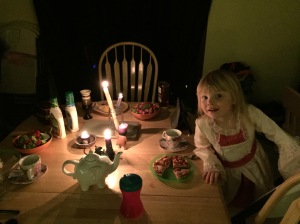 The last few days, which were supposed to be days off, wound up being impromptu work days for me. When I came home this evening, my 3 year old attacked me with pleas for attention and play time. It’s important to understand that as a dad and a follower of Jesus, I consider it my duty to love my daughter in a way that shows her who Jesus is. It’s a job I take very seriously. So, I spent some time playing, but I had to start making dinner. It was late and I was tired, so dinner was not going to be anything spectacular. I put a frozen pizza in the oven and made sandwiches and salads for my wife and I, all the while my daughter was danced around me in an effort to get my attention. Then, I had an idea. I put on the kettle to boil and made tea in her teapot, one I picked up specifically for tea parties with her. As soon as she saw it out and me filling it with water, she started squealing about having a tea party. I set the table with candles, put out teacups and saucers, put her in her fancy dress, and put on my suit. My wife quickly joined the act, putting on a dress. The result was a
  tea party with our little girl over a regular dinner of frozen pizza and salads. It’s not an elaborate daddy-daughter date night, but throughout dinner she repeatedly exclaimed how excited she was to have a tea party for dinner. It wasn’t my preferred daddy-daughter day together. However, given the brief time I had available to plan dinner, our impromptu candlelit tea party was a huge hit with one of the people who matters most to me.


 There is an important principal in this. Comfort, a sense of meaning, and purpose for difficulty in relation to hard circumstances in our past can be discovered by recognizing God’s refining us through the pain we experienced, reflecting on the good it produced in us, and reflecting on how our experiences have shaped us into the person that we are. Doing so requires that we learn to take a different point of view in relation to our past. This can be terribly difficult, because hardship often creates bitterness, which tends to blind us to anything positive that may come of unfortunate incidents. It can also be hard because it’s easy to confuse finding positive outcomes with being glad a bad thing happened. We don’t have to be happy that tragedy has been present in our lives in order to recognize how hardship has shaped us. We can be thankful for what we have become without having joy at what made us the way we are. Learning to shift our perspective in relation to past pain can bring great comfort and release. As difficult as it is, it becomes easier to shift our perspective the further displaced we are from the events. This is often the first step toward healing.
 It’s easy to understand how alcohol or cocaine are addictive substances, but when it comes to pornography addiction understanding the issues involved can be more difficult for a variety of reasons. For starters, discovering a hidden pornography habit can result in significant feelings of betrayal for a wife and can make understanding the addiction component very difficult. In addition, pornography use carries some stigma, which clouds perspective and makes understanding the addiction more difficult. However, pornography addiction is a real illness, it’s diagnosable, and it’s treatable. Looking at pornography produces similar brain functions that take place with using cocaine. It is highly addictive for the same reasons as any other drug. This is not to excuse the betrayal of a spouse or anything of the sort. Rather, it is to say that an individual can develop an illness, which prevents them from quitting the behavior. Let there be no mistake, addicts cannot stop a behavior on their own. Denial, thinking errors, shame, and an out-of-control reward response system in their brains literally result in the addictive patterns becoming compulsive.
 Several months ago, my wife and I ran in the Montana Spartan Race, a 5-mile obstacle course race. I ran in the race last year and initially signed up again to try to beat my time. My wife signed up as well and we both set out to prepare for event. About halfway through the training process, my wife asked me if I would run the race with her. My initial response was “no.” I had set out with a goal and was quite intent on achieving it. Running with my wife would not likely make my goal reachable. As time passed, I began to reflect on this decision in relation to my job as a husband. Ultimately, I realized that the decision came down to whether it was better to try to accomplish my own goals or to help my wife reach her goals.
 There is a line in Ephesians that talks about the idea that husbands are the head of the wife as Christ is the head of the church. Many folks have read this as meaning that men have the right of dictatorship in their marriage. I would argue that to understand the passage in this way is to ignore the context. Scripturally, Jesus’ role in relation to the church is that He dies for it. Jesus demonstrates leadership by serving. He lives out the attitude He has toward the church when He washes his disciples feet at the last supper, literally doing the job reserved for the lowest servant in the household. Jesus instructs His followers to emulate His attitude. If this is the attitude of the head of the church and the Bible says that husbands are to emulate the head of the church in relation to their wives, then it follows that husbands ought to have an attitude of service and humility in relation to their spouse. This attitude of service is rooted in love. Further, it is an attitude that is aimed, not just toward serving, but toward preparing the church to be found holy and sinless before the Father. Jesus’ ultimate act of service is to offer his life as a sacrifice from the sins of the world. Certainly no husband can imitate that example, but husbands can live their lives to help their wives grow into the sort of clean spotless bride they were designed to be.
 I would argue that this is not an easy task for husbands. Men are hard-wired to strive for accomplishments and to compete. Even further than this, our culture highly values accomplishment and success. These are not inherently bad things. They can be negative if the accomplishments and measures of success are misaligned. The Bible presents the idea that the greatest among Jesus’ followers are those who happily assume the position of the least and the servant of all. For husbands and fathers, this is the path assigned to them by the scriptures. We are to serve our families and sacrifice of ourselves for their benefit. We are to help our families grow personally and spiritually.
 Patching Cracks