
Over the last few weeks, you can hardly turn on a news program without coming across an opinion piece or news story about Ray Rice, the professional football player whose career has been ruined after a video surfaced of him punching his fiancee. Having seen the clip, I can’t fathom how anyone can call it anything but reprehensible. As the larger culture debates what sort of action should be taken and whether or not the league acted appropriately, fathers need to take the opportunity to talk with our  sons and educate them as to how God calls them to act toward women. In a culture that is increasingly hostile to the dignity of women, treating them as sex objects, humiliating them in pop culture, or glorifying their mistreatment; it is vital that we make our stance clear and stand firm on the matter. Raising a young man into a superhero requires more than just teaching him to carry a football; it involves teaching him to act with integrity toward women, whether that woman is his wife, sister, date, neighbor, or a stranger.
sons and educate them as to how God calls them to act toward women. In a culture that is increasingly hostile to the dignity of women, treating them as sex objects, humiliating them in pop culture, or glorifying their mistreatment; it is vital that we make our stance clear and stand firm on the matter. Raising a young man into a superhero requires more than just teaching him to carry a football; it involves teaching him to act with integrity toward women, whether that woman is his wife, sister, date, neighbor, or a stranger.There are all sorts of biblical passages that describe the importance of men protecting women and treating them with a special degree of gentleness. The prophet Malachi offers a strong statement on the subject when he writes:
“The man who hates and divorces his wife,” says the LORD, the God of Israel, “does violence to the one he should protect,” says the LORD Almighty. So be on your guard, and do not be unfaithful.Malachi 2:16
In the ancient world, women who were divorced were put in a difficult situation,  as remarriage was difficult and there were limited employment and property ownership rights. This resulted in poverty, indentured servitude, or prostitution as the only options for women who did not have a husband. God’s declaration of anger toward men who do not love and take care of their spouse is no small matter. God expected men to care, protect, and provide for their wives. Further, the act of abandoning her is described as an act of great violence. The message seems clear, violence against your wife isn’t okay. Even more so, husbands are expected to not only to abstain from violence toward wives, God considers not taking care of them as being on par with violence. Men are to treat women with an extra measure of gentleness and protection.
as remarriage was difficult and there were limited employment and property ownership rights. This resulted in poverty, indentured servitude, or prostitution as the only options for women who did not have a husband. God’s declaration of anger toward men who do not love and take care of their spouse is no small matter. God expected men to care, protect, and provide for their wives. Further, the act of abandoning her is described as an act of great violence. The message seems clear, violence against your wife isn’t okay. Even more so, husbands are expected to not only to abstain from violence toward wives, God considers not taking care of them as being on par with violence. Men are to treat women with an extra measure of gentleness and protection.Another powerful verse that is worth considering is found in Peter’s comments on how various groups ought to act. Interestingly, Peter’s list offers special concern to groups who were less powerful and more likely to be oppressed. His instruction to men is sometimes misread:
Husbands, in the same way be considerate as you live with your wives, and treat them with respect as the weaker partner and as heirs with you of the gracious gift of life, so that nothing will hinder your prayers.1 Peter 3:7
It’s easy to see the phrase “weaker partner” and assume that it’s a condescending statement. What Peter means here is that women are typically physically smaller and not as physically strong. Peter’s wording refers to loving, considerate, and gentle treatment of the wife. This is based on the reality that the husband is physically capable of hurting his wife. Peter’s direction is for Christian men to be gentle. Peter also points out that women are heirs of eternity, in the same way that men are. This puts women and men on equal footing before God. As such, they are to be treated as equals in all other respects.
A final passage worth considering is from the Sermon on the Mount. Jesus specifically directs His followers not to look at women lustfully, because in doing so, he commits adultery in his heart. This passage explicitly teaches that men are to remain sexually pure in their thought lives. However, it is reasonable to read the passage as also teaching that treating women as sex objects is not acceptable.
Raising a young man, one who stands apart as a hero to those around him, requires that he learn to treat women right. It is vital that the fathers persistently talk to their sons about God’s directions for us to treat women gently and with respect. Sons need to be taught that they are supposed to physically protect women, as is their responsibility before God. Treating a woman roughly or violently is totally apart from God’s direction for them. Further, God repeatedly describes Himself as a protector of those who are most exploitable. This is an example Christian men are to emulate. We should not engage in any activity that treats women with less dignity than is afforded to God’s beloved creation. This is foundational for raising a young man to be a real world superhero. Beyond teaching them, fathers must model the behavior in their relationship with their wife and the women around them. Boys learn to be men by watching their fathers and the other strong male figures in their lives. A father must model right behavior to raise a superhero son.
their responsibility before God. Treating a woman roughly or violently is totally apart from God’s direction for them. Further, God repeatedly describes Himself as a protector of those who are most exploitable. This is an example Christian men are to emulate. We should not engage in any activity that treats women with less dignity than is afforded to God’s beloved creation. This is foundational for raising a young man to be a real world superhero. Beyond teaching them, fathers must model the behavior in their relationship with their wife and the women around them. Boys learn to be men by watching their fathers and the other strong male figures in their lives. A father must model right behavior to raise a superhero son.
 When Abbey and I go on dates, she gets to pick everything we do. This usually begins with her picking what dinner will be. For some reason, she has decided that Chinese food and eating with sticks is the best thing in the world. A year ago, she loved eating at McDonalds and playing in the play land. I don’t like McDonalds, but I eat where she wants because I want her to know it’s special. We eat and talk. She tells me stories. I ask her questions. She gets my full attention. When given a choice as to what she wants to do after eating out, sometimes she wants to go to the comic book store, or to the book store, or to buy bows at the girl stuff store. She picks and she gets my attention the whole time. Please note that I don’t buy her everything she wants, but she does get my full attention.
 2. Tea parties: I am not a fan of tea parties, but we do them regularly. Stuffed toys usually attend. There is usually cookies and snacks. We drink tea, eat cookies, pretend, play, and talk. Usually setting up the tea party is as fun for her as having the party. Sometimes I read her stories. Most tea parties last about an hour, and she loves them.
 some gals from church. This left me home alone with the kids. We rented a cartoon movie and I let her pick dinner. She decided we would eat popcorn for dinner, drink soda, and eat cookie dough for dessert. We talked about the cartoon, she hid under the blanket at scary parts, and she told me she loved the whole evening.
 way, which demonstrates that their brains learned to associate the ringing of bells with eating even when there was no food present. Human brains have the same tendency. We learn to associate stimuli with certain feelings or having needs met. As the behavior is learned, they develop ingrained patterns, which become become compulsive. Understanding classical conditioning is an important first step to grasping how addiction works in human beings.
 o quit, but when they get into certain situations their stimulus-response takes over and they become like passengers in their own bodies, watching passively as they act out their learned behavior. This is because the mechanism of addiction happens in the “old brain”, where things like fight or flight take place. This is the portion of the brain that takes over when thought isn’t the best response to a situation, like with fight or flight responses. It has the ability to take over the body and force the person to behave in predetermined ways. This is the same sort of thing that soldiers train to achieve. When combat happens, thinking turns off and the training kicks in. Addicts are similar, except that their training has been unhealthy and is now destructive.
 Comments ranged from dismay over the loss of family to frustration over newfound awkwardness in parental relationships to consternation at their parents’ inability to just stop being so cruel to each other. It was seldom the case that a class went without a child breaking down and crying. Interestingly, I never once saw any of the children tease each other over tears shed in that setting. Except in instances of an absent, addicted, or exceptionally abusive parent, I never heard a child say that the divorce was a welcome change.
 but do not have a decent player for my stereo in the living room. Last week I was volunteering at a community rummage sale and I came across an older, but fairly high end turntable. I was giddy as a school kid when I plugged it in and hit the play button. My heart sank when the turntable remained still. I quickly dismantled it and discovered the belt was broken. Further investigation revealed that the motor worked. The record player worked, but the turntable didn’t spin. No matter how well the motor ran, it didn’t matter, because the power didn’t transfer to meaningful motion. This record player sat on my desk all week while I was studying the book of James for last Sunday’s message. I believe that this is why that broken record player came to mind when I read James 2:14-17.
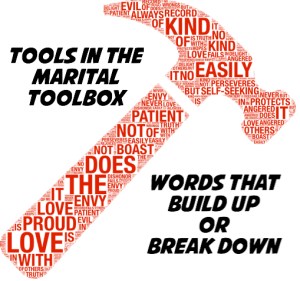 n specific application. I have a hammer for knocking dents out of metal, one for driving nails, a sledge hammer for demolishing things, even a slide hammer that pulls things outward instead of pushing things forward. Like any weekend warrior mechanic, my hammer also does double and triple duty for all sorts of other tasks that aren’t necessarily hammer specific. In the marital toolbox, there is a similar tool that can be used in a wide variety of ways, both constructive and destructive. That tool is the power of our words. This tool is not dissimilar to the hammer in that it is frequently the most powerful tool we employ. The book of Proverbs speaks of the tongue as possessing the power of life and death. James speaks of the tongue as a spark with the power to set the world on fire. I am certain that most married couples can recall instances when a few poorly chosen words set their world on fire with arguments that went on for days. The key to using a hammer properly is using at the right time and in the right way.
 manner in which the family of God operates. In Acts, we see the early church gathering for meals daily, largely because eating together as a family is a somewhat intimate activity. We also see Jesus teaching important lessons and engaging in fellowship at meals with groups of people. His final meeting with his disciples before the crucifixion took place over dinner. His first extended meeting with them after the resurrection happened over breakfast. The Lord’s Supper is a modified ceremony from the Jewish faith, the passover meal. The passover was only one of many meal-centered religious observances the Jewish people engaged in. Holidays, sacrifices, and all sorts of other activities were surrounded by meals. This is not because of a supernatural spiritual quality associated with eating. Rather, it is because eating together is a basic act of community. Community behaviors encourage close relationships and interpersonal openness.
 their thoughts and feelings. However, the reality is that self-expression is a skill that develops over time. Parents can encourage development of these skills by modeling them and asking questions. Children learn communication patterns largely from their parents. They emulate what they see. If you talk and share with them, they will learn to talk and share with you. This will pay dividends during the frustrated and angst-filled teenage years when they really need to talk things through. Asking children questions encourages them to share their thoughts and experiences. It teaches them to share thoughts/feelings that they will not instinctively share. In addition, it demonstrates interest in the life of your child. They will notice that interest and they will thrive on it. Nothing is more important to children than their parents. When parents demonstrate interest in their children, it means the world to them. This will also pay in the long run when that cute child is a fuming teenager and you’re trying to get them to talk it out or hoping that they will come to you with serious problems and major decisions.
 uired that I take the front of the engine off to replace the sensor. After digging through my glove compartment, I found a wrench and a screwdriver. I began working with my meager collection of tools by removing every screw and bolt that matched the phillips head screwdriver and 13 mm wrench. Unfortunately, I had reached an impasse. I walked to a nearby K-Mart and purchased a socket wrench and a couple of sockets. With my new socket wrench in hand, I removed every bolt that matched my new sockets, until I encountered a small bolt that I did not have a socket to fit. Another trip to K-Mart had me working again, until I came across a bolt that required a box end wrench. Another trip and another tool purchase. This continued for the better part of a day, until I had completed the repairs. By the fourth or fifth visit to the store the cashiers started teasing me. Eventually, it became evident that my effort to avoid purchasing an entire set of tools had cost me a great deal of time. The whole process would have been much easier had I possessed all of the tools I needed at the outset of the project. The same is true of many married couples, who start their lives together without adequate relationship tools. When trouble arises and breakdowns occur, they simply do not have the relationship tools and skills they need to fix the issue. Unresolved issues, if they become plentiful enough, can lead to larger and larger problems. Ultimately, too many problems can lead to communication breakdowns, resentments, and divorce.
 times, every spouse must be equipped with the tools necessary to fix the problems that emerge in the relationship. There are all manner of these tools: effective communication skills, healthy arguing, and mutual submission to name a few. Perhaps the most important tools in the marital toolbox are “grace” and “selflessness.” Grace refers to forgiving without reservation. The Bible uses the term to refer to God forgiving people without them having to earn it. It is an act of love. Just think over the history of arguing with your spouse and reflect on how often “old arguments” have come up and extended the conflict. Or consider the times when resentment over some slight has lingered in the relationship. As time passes and these resentments accumulate, a marriage will naturally drift apart. The cure for this is simple: grace. There is an old saying about marriage: “Before you wed, look as critically at the imperfections as possible. After, do your best to ignore them.” Or better yet, do your best to forgive them, even if they don’t deserve it. Many a married man (or woman) will read the previous paragraph and find themselves saying: “Easier said than done! You don’t know my husband (or wife)!” Ultimately, forgiveness requires that the second tool comes into play. Selflessness is the primary attribute of love. One of the most popular Bible verses read at weddings is 1 Corinthians 13: “Love is patient. Love is kind… it is not self-seeking, it is not easily angered, it keeps no record of wrongs…” For all of the qualities given in the chapter, there is the shared condition of selflessness. Real love cannot be about “me.” Real love focuses on the partner in the relationship. This is love that is more than just a warm feeling that fades after the honeymoon ends. It is a life direction that endures even when the marriage is just plain tough. Forgiveness is far easier when I don’t need to win every fight or get my revenge for hurt feelings. Grace is only possible when it arises from selflessness. While these two concepts may seem to be simple enough, they require commitment and hard work. The Bible goes so far as to suggest that we can only accomplish them with God’s help. At a minimum, learning to selflessly consider your partner’s needs and forgive their failings involves repeatedly committing to do so. It is hard enough that the only reason to take on the task is out of love.
 that I hate doing maintenance work. I will happily replace a water pump, but cringe at the thought of changing oil or doing a tuneup. It’s just easier to not do maintenance. The problem, of course, is that not doing maintenance results in frequent breakdowns, poor fuel economy, and shorter lifespan for the vehicle in general. The same is often true of many men. Solving a problem is more interesting to them than working to maintain things. Unfortunately, this tendency often translates into married life.
 love sleep. Perhaps the biggest blessing I have experienced as a parent is the opportunity to see another human being in a similar light to how God sees humanity. As I sit with my cranky child, the verse that keeps running through my head is from Psalm 8.
 Patching Cracks