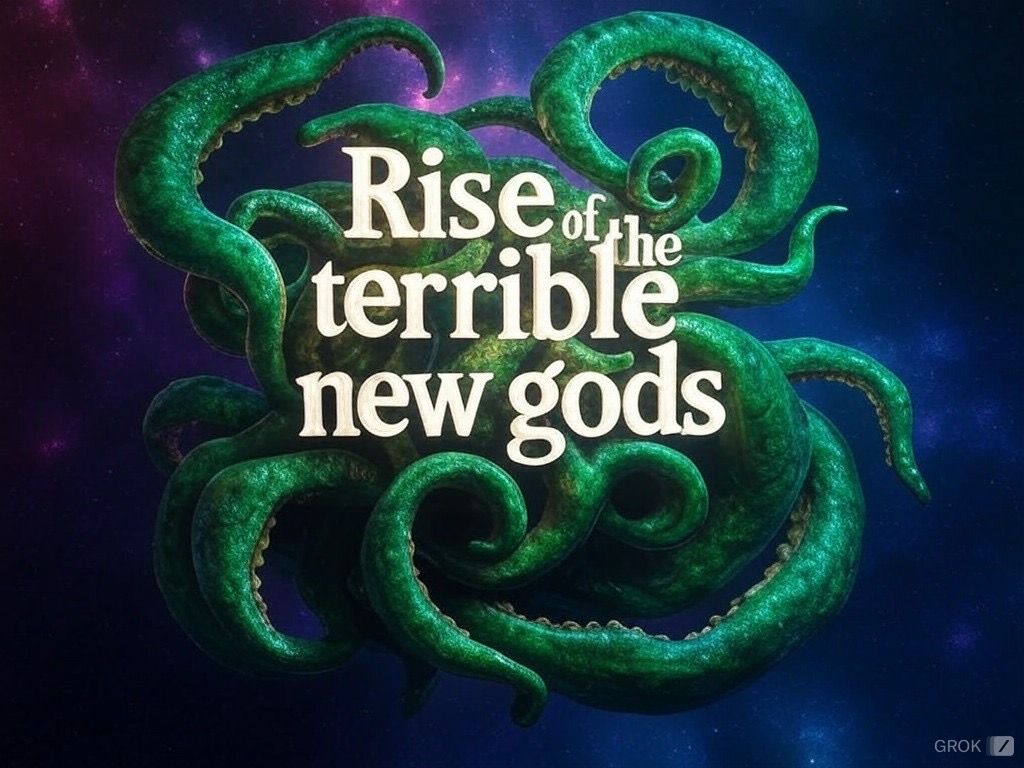
In the blizzard of memes, conspiracy theories, political finger pointing, and tons of folks celebrating a wicked act of murder as though it was righteousness personified I spotted a screenshot from Mario Mangione’s twitter feed. In it, he shared a link to a Telegraph article prophetically titled: “Christianity’s Decline Has Unleashed Terrible New Gods.”
The post caught my attention because I recognized the article and was taken aback at the dark bit of foreshadowing, not just in the title, but also in the content/thought behind the article itself.
The Telegraph piece dealt with evolutionary biologist Richard Dawkins’ laments over the state of post-Christian UK. Dawkins published several anti-theistic books, acting as a champion of new atheism throughout his career. In an interverview, he explained that he had assumed that the decline of Christianity would result in a value neutral, enlightened, secular culture would emerge to replace it. He was wrong.
Instead, the vacuum left by Christianity’s absence was filled by something worse: the unleashing of the terrible new gods, as the Telegraph article describes them. Had Dawkins spent time studying philosophy instead of writing terrible philosophy books, he would have known that Nietzsche’s predicted something akin to this very outcome.
Specifically, Nietzsche predicted that the post-Christian western world would hold on to elements of the Christian ethical system for a while, but that it would gradually shed them as the people realized that the rules and constrains have nothing behind or beneath them. Nietzsche went on to predict that pagan ethical systems would flow into the void left behind.
The “terrible new gods” Dawkins lamented are, in fact, neither new nor gods. They are the old pagan moral systems. For those unfamiliar with ancient pagan moral systems, it is important to recognize that they were not religious in nature. In fact, Judaism and Christianity were wholly unique in their connection of moral imperatives and life purpose to deity in the western world. The Bible describes this ethical approach as simply: “Doing what is right in your own eyes.”
Philosophy, household codes, legal systems, Aristotle’s virtues, and other external restraints were the source of most ethical norms. Self and family interests were often the only thing that mattered. Human rights or humane treatment were nonexistent. The ancient pagan world was a brutal place, where life had little value, and the tears of another man’s family were nothing more than water.
The reality is that the terrible old gods are going to return as our culture abandons its Christian moral & ethical roots. In the Telegraph piece, Dawkins exclaimed that he was happy about the death of Christianity but wanted to remain a cultural Christian, not realizing that such a thing is unsustainable over the long term. Christian ethics only work when paired with the Christianity.
Mario Mangione’s cold blooded murder, his justification for doing so, and the public reaction are early, very public tremors created by the new (old) gods as they crawl from the sewers they have resided in for millennia. Mario decided that he was the arbiter of right and wrong, declared that a husband and father deserved execution without due process or anything resembling a fair hearing, then he shot the man in the back, murdering him in cold blood. He “did what was right in his own eyes.”
The response of far too many internet spectators and media personalities was to see a murder committed in cold blood and applaud it. Reporters and late night talk show hosts gushed over Mario like schoolgirls with crushes. Mangione has been elevated to the level of hero in some circles, where what he was right in their eyes. They applauded what they saw as an act of righteousness on behalf of their terrible new gods.
Note: I am not commenting on the health insurance industry. I agree that the system is broken. I also have been paying attention long enough to know that it has a lot to do with the fact that the whole industry is a Frankenstein’s monster of regulations, laws, self-seeking industry insiders, and politicians all pretending they can make a limited resource unlimited. I also know that Mario shooting that man solved nothing in the healthcare industry. It was an angry, bitter, self-righteous act of a man who followed his own moral compass.
The particularly alarming aspect of this event is that it isn’t all that isolated. It is a growing pattern of morally reprehensibly actions that are applauded broadly by one group or another. The attitude all too often seems to be “It’s ok as long as our side is doing it.” It’s just another sign that the terrible new gods are coming out in force.
Do not read me as an alarmist or predicting that the sky is falling. It is not. What is happening is a gradual change that has been happening since the 19th century is beginning to become far more visible in the western world. There are other signs, but the devaluing of human life is a major river to cross. God is still in control and the gates of hell will not prevail against his church. But, the terrible new gods are going to reign out in the open in increasingly overt ways in our culture. It is best to be aware that it is coming.
HP Lovecraft stories often depict insane cultists conjuring the old gods to our world, revealing them to be tentacle covered horrors that consume their worshipers along with everything else in their path. I often imagine the looks on the cultists’ faces as they realize that the god they’ve summoned is a monster that cares nothing about its worshippers and proceeds to consume or destroy them and everything else in its path.
The nature of the new gods, which in truth are just the old pagan gods, is exactly that. They care nothing for humanity and the new morality is the old sinful nature we project onto them. Dawkins woke up to the terrible new gods and realized they were not the pretty pets he expected. Mario shared the story and 6 months later summoned the new gods before the whole world.
Now we all get to watch and hope they won’t be released in full force just yet. For on that day, to paraphrase (and rewrite) Kipling:
“…after this is accomplished, and the brave new world begins
When all men are paid for existing and no man must pay for his sins,
As surely as Water will wet us, as surely as Fire will burn,
The new gods of old pagan origin with terror and slaughter return.”
One of the most popular arguments you’ll encounter if you google “Why is Christmas December 25th” is that early Christians simply co-opted the Roman pagan holidays that also lands on December 25th. This post is going to dig into this idea, weigh the evidence, and offer some potential theories to explain the coinciding dates.
Didn’t Christianity steal the 25th/winter solstice from a handful of pagan holidays?
In fact, there are a few ancient pagan feasts that land around the 25th. Sometimes these days, like Saturnalia, are included with accusations that Christianity took pagan festival dates. The biggest problem with including something like Saturnalia is that it took place between December 17th and the 23rd. Though, at the time the first liturgical calendar was written placing Christmas on the 25th, the 23rd was the date of the winter solstice. There are theories that associate the observance of Saturnalia with the Solstice itself. Though, there is no ancient documentation that asserts this directly. Either way, I will not be digging into the event because Saturnalia ended several days before Christmas.
What Pagan Holiday was on December 25th?
The most substantial argument for the theory points to the co-opting of Natalis Sol Invictus specifically because of the 25th date and the “birth” aspect. Natalis Sol Invictus (birth of the invincible sun) was established as a state holiday in 274 AD honoring a pagan sun god by Emperor Aurelian.
In older scholarly works I encountered the idea that Aurelian’s mother was a priestess in the Col Invictus cult, though all of the references to this idea are immediately dismissed as likely fiction based on the utter lack of supporting evidence.
In terms of the December 25th date, the emperor made Sol Invictus the official religion of the emperors, built a temple in his honor, and ordered 30 public games be held every year. The winter solstice was chosen for Natalis Sol Invictus based on the belief that the days got longer after the solstice because Sol Invictus began to claim victory over the darkness. I’ve read that Romans burned candles at night in an effort to aid Sol Invictus in his fight. Though, I get the sense that later scholars argue this based on the Saturnalia practice of candle lighting during their festival rather than based on early sources.
What is Sol Invictus?
Sol Invictus was a relatively new religion in Rome at the time of it’s adoption by Aurelian. It was only introduced around 25 years earlier. This is important for later discussion of the theory. Though, the religion itself originated in Syria and is one of several examples of sun god worship from the area. It is possible that the Roman version is an amalgamation of the Syrian religions.
There is a school of thought that says that Sol Invictus and the Mithras mystery religion blended together early on. It is hard to find dates or solid sources for this assertion, as Mithraism did not produce any written works at all. Most of what we know about the religion is based on excavating temples devoted to the faith. Frankly, the lack of specifics has led to a lot of (sometimes wild) conjecture about Mithraism. I tend to look at its mention with a lot of skepticism as a result.
But don’t Christmas and Natalis Sol Invictus land on the Winter Solstice?
The answer isn’t as obvious as you might expect. They fall on the winter solstice on the calendar system we currently use. When Aurelian set the date for the celebration on the 25th, it was after the solstice.
At this point it is necessary to take a moment to address the weird issue with that pops up in relation to the Julian Calendar and how its inaccuracy skews the discussion somewhat.
The Julian Calendar, so named because it was proposed by Julius Caesar as a reform of the old Roman Calendar, took effect in 45 BC and remained the standard until it was replaced by the Gregorian Calendar in 1582. The issue with the Julian Calendar is that the days are .0075 too long. This results in the calendar gaining a day every 128 years.
Today the Julian calendar is about 13 days ahead of the more commonly used Gregorian.
For our discussion the discrepancy is relevant because it resulted in the Winter Solstice changing dates on the calendar. By the time the Depositio Martirum was created to document the Christian liturgical calendar, the solstice was on the 23rd. When Natlis Sol Invictus was established as an official holiday, the solstice landed on the 24th.
Why did Aurelian establish the holiday and make Sol Invictus the emperor’s deity?
Much of the reasoning behind Aurelian’s move was to strengthen his position as emperor and encourage unity. Aurelian’s reign took place during a chaotic time in Roman history. Quite a few scholars agree that he was attempting to unify the empire through religious revival. His efforts were aimed at breathing new life into pagan religions, which were in sorry shape among the average citizen.
Will Durant’s Caesar and Christ, describes the integration of paganism into every facet of society as well as the plethora of temples, holidays, and associated community norms. He then goes on to say “Despite these appearances the ancient faith was diseased any the bottom and at the top. The deification of emperors revealed not how much the upper classes thought of their rulers, but how little they thought of their gods. Among educated men philosophy was whittling away belief even while patronizing it.” He goes on to describe how Greek and Roman poets mocked the gods in their work and the common men simply didn’t fear the them. This doesn’t mean that the population abandoned the temples or fortune tellers. Rather, much of the ritual observances were observed primarily out of superstition. Everyone consulted the signs and made sacrifices, but there was little in the way of devotion.
Elsewhere Durant connects the phenomena to the popularity of Judaism in the Roman world. Despite it being illegal to evangelize, the Jewish faith attracted large numbers of adherents and converts, which are typically known as “God fearers” in jewish writings and the Bible. Arguably, the same reasoning applies to Christianity which was growing rapidly despite it being illegal and actively persecuted.
By adding a new religion to the Roman Empire and filling it with enormous pomp and spectacle, Aurelian hoped to unify the nation under their pagan heritage. He was personally devoted to the Sol Invictus cult, which would explain his choice.
‘Did Christians adopt the day of Sol Invictus and why?
I’m going to go ahead and say that they did not adopt the pagan holiday. My reasoning will be laid out in the rest of this post. As to why they would do it, the theory that the church coopted the pagan festival did so because of it’s popularity among pagans. The theory itself doesn’t appear until the 1800s.
Most supporters of this position support some variant of the belief that Christianity and the story of the life of Jesus adopted other religious traditions and beliefs in order to create Christianity. The underlying assumption is that the gospel accounts of the life of Jesus are fictional, late creations. Full disclosure: I don’t agree with this perspective. Archeology and ancient documentary evidence stand in strong contradiction to the idea that the church was invented from whole cloth after the 2nd century. It’s a nonsense position.
Another version of the theory is that Christians simply adopted Roman Pagan days in order to make it more palatable to pagans who Constantine forced to convert. It is also sometimes that the adoption of the holidays made it easier for pagans to convert.
Finally, there are scholars that suggest that Christians took the dates of pagan holidays for their feast days because it made it possible for them to observe their celebrations without raising the ire of their neighbors or the government.
Is there any evidence supporting the arguments that Christians adopted pagan days?
There are no actual documents, neither primary or secondary sources, asserting that any of the stuff preceding section took place. As best I can tell the idea that Christianity simply took on a pagan holiday began with the fact that the earliest mention of December 25th was in the codex that contained various calendars from the ancient Roman Empire. The codex, which is called the Chronograph, dates to around 354 AD and contains the Depositio Martirum. Because they have no earlier mentions of the date, the assumption is that the church started celebrating around that time.
In terms of arguments, this one is not particularly compelling for several reasons. The first is that the Chronograph, is also the first time we find Natalis Sol Invictus documented as being observed own December 25th. This means that the same argument could be applied in the reverse with exactly the same amount of evidence to support the conclusion.
The second reason the argument lacks strength is that it ignores the the extensive documentary evidence that the early church was very careful to avoid any associations with paganism or idolatry. Early Christians did not attend public games or any festivals.
The 1st century church struggled with whether or not believers could eat meat that had been sacrificed to idols, lest it be perceived as paganism. Many of the documented battles with heresies, beginning with the late 1 century on, deal with attempts to integrate the mystery religions into the church beliefs and practices.
The culture of the early church simply did not have the sort of attitude
that would allow them to change to make it easier for pagans to convert. To summarize: not only is there no evidence that they integrated paganism for popularity sake, the truth is quite the opposite. There is tons of evidence that they did not.
Any arguments about Constantine making Christianity the official religion or altering the holidays to attract pagans are utterly lacking in any basis in reality. Constantine converted and made the church legal. He did not force the faith on empire. Further, the early church fathers did not suddenly become different people with the Edict of Milan. There is also no evidence that he tampered with the liturgical calendar.
My thoughts on the coinciding dates:
Though this is certainly not an exhaustive treatment of the matter, I will offer final points regarding the coinciding dates. I encountered some interesting arguments suggesting that it was possible that Aurelian actually adopted the December 25th date based on the growing popularity of Christianity.
The reasoning goes that Aurelian chose the date to blunt the impact of a significant Christian feast day. Durant described the decline of paganism in the ancient world as well as the growth of Judaism (which did not evangelize) and Christianity (which was illegal outright).
Christianity did not need to adopt paganism to attract followers, as it was attracting them despite everything that was done to stop it. Ancient paganism, on the other hand, was not growing. Aurelian sought to create a pagan revival to staunch the bleeding and prop up the old faiths specifically to create stability.
Further, adopting pagan practices was out of character for the early church, but it was quite common for ancient pagan religions to adopt pieces of other faiths. Though, as compelling as this argument is, it is inferred based on events rather than received from primary or secondary sources.
Further, we know that around 325 AD the Council of Nicaea adjusted the official calendar to recognize that the winter solstice was on the 23rd, not the 25th. This suggests that the solstice was already connected to the birth of Christ, but that they followed the calendar date rather than the solstice itself. However, at the time Jesus was born (in 1 BC probably) the winter solstice would have landed on the 25th. This would explain why the two were connected.
However, I have yet to see a good explanation as to why Sol Invictus lands on the 25th based on the winter solstice, which was a central point to the religion itself. Further, when it was declared a holiday the solstice was on the 24th, which suggests that there may have been another reason for selecting the date.
Finally, the earliest supportable mention of a specific date regarding the conception of Jesus being on March 25th (9 months from the December 25th birth date) is found in the work of Sextus Julian Africanus from around the late 2nd or early 3rd century. This places the potential origin of a December 25th birth date around 50 years before Sol Invictus arrived in Rome.
TLDR (Too Long Didn’t Read)
Assertions that Christians coopted December 25th because of the the Natalis Sol Invictus religious holiday are totally lacking and documentary evidence for support. There are no ancient sources that make any claim that even implies that this took place.
The argument used to support the claim is based on the fact that we first see December 25th as the date for Christmas in a codex from 354 AD. Due to the preceding silence on the date, the argument is made that this is when Christians adopted December 25th and that they did so because pagans already observed the date. This is a poor piece of reasoning.
The further flaw with the previous point is that codex from 354 is also the first time we encounter documentary evidence placing Natalis Sol Invictus on December 25th, meaning the weak argument could be applied in reverse.
There is documentary evidence supporting the idea that the church already recognized December 25th much earlier than the establishment of the holiday by Aurelian, or even the introduction of Sol Invictus to Rome.
Roman Paganism was rotting from top to bottom and had been for hundreds of years. Natalis Sol Invictus was established in an effort the revitalize paganism and reunite Rome. Christianity on the other hand was a growing faith, attracting pagans to its membership despite being an illegal faith. There was no reason for Christians to take on pagan trappings to attract converts. They were doing so already.
All of the documentary evidence from the early church points to a steadfast resistance to any integrating of the pagan and Christian faiths. To adopt a pagan holiday was utterly out of character for the church, but for ancient pagans to integrate beliefs or practices they encountered was very much the norm.
If you don’t like my points here, read the article and engage my arguments.



 Patching Cracks